
The Delicacy of the Andes
Travel Stories: In Peru, people go crazy for cuy. In the U.S., they're household pets. When faced with eating them, Matt Villano confronts childhood memories, nausea and the costs of cultural immersion.
07.23.07 | 12:13 PM ET
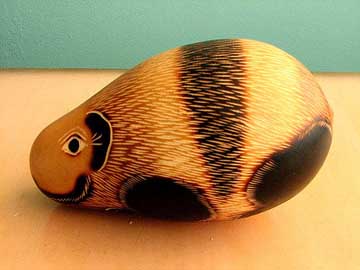 Photo of cuy doll by
 When I married my archaeologist wife, I figured I was signing up for a life of Indiana Jones-type adventures. Those pictures of her hunched in tombs, the stories about unearthing 1,000-year-old skeletons—all of the relics of her time in the field were evidence that her professional life, and our personal life together, would be anything but ordinary.
Nothing, however, prepared me for eating a cute and fluffy household pet in the name of science.
The gastronomic escapade occurred in Lima, Peru, where the two of us lived while Dr. Nikki researched her Ph.D.
Her project was heady stuff. During the course of three months, she identified and sampled bones excavated from a sleepy fishing town named Ancon. Later, with pricey chemical analyses back in the U.S., she would determine whether the people composed of those bones hailed from the coast or migrated there later in life.
These chemical analyses were critical. Critters (including humans) that eat lots of seafood have different chemical ratios in their bones than those who eat lots of meat. But because mammal bone tissue changes with diet, in order to figure out who came from where, Nikki needed to establish controls for chemical signatures native to the coast.
This is where the guinea pigs came in.
The fluffy little rodents have been seen as a special meal in the Andes for about 1,000 years. In Inca times, they were consumed only by nobility. Today, onomatopoetically known as cuy (coo-ee) for the sounds they make, the creatures are still considered a delicacy, the Peruvian equivalent of Beluga caviar. As such, farmers raise them all over the place.
Cuy don’t travel much, so Nikki knew that guinea pigs raised at Ancon would provide the perfect chemical controls for her research.
All she needed were their bones.
In any other society, it might have been easy to buy a few cuy, kill them and pocket the requisite bones. In Peru, however, where the little buggers are seen as furry four-legged deities, nobody—and I mean nobody—was willing to part with cuy without preparing a feast.
And so we scheduled a meal to remember. Nikki found a farmer in Ancon who raised cuy, and she ordered three. The farmer, delighted at her windfall (cuy cost roughly $8 piece), eagerly agreed to skin the animals and fry them with a sauce of pepper and achiote, a South American spice.
I wasn’t keen on eating these little fluffy critters. As a sixth-grader at Pulaski Road Elementary School, we kept them as pets in my gifted and talented class. The guinea pigs were so tiny, so innocent, so harmless. They made that adorable little squeaky noise.
Once, I took a furball named Cinnamon home with me for a weekend. I fed him diligently. I cleaned his cage. I even let him run around a maze I built with Legos.
Now I was about to eat his distant cousins. The thought was enough to make me nauseated.
Speaking of nausea, on the morning of what I had labeled “Cuy Day,” Nikki woke up vomiting from bad sushi the night before. She took medicine, and vomited some more. After her fourth trip to the bathroom, it was clear that she wasn’t leaving the apartment.
In the name of science, I’d have to go to Ancon, eat the critters and fetch the cuy bones alone.
I grabbed some Ziploc bags for bone transport and hailed a cab. The cabby spent the entire ride marveling about my impending meal.
“You eat cuy?” he asked in broken English? “Maravilloso!” he exclaimed, answering his own question.
About 30 minutes later, he dropped me off outside the Museo del Centro de Investigación Arqueológica de Ancón, the local museum where Nikki had done her research.
Inside, the museum’s director, Justo, was skipping with excitement.
“Estas listo para comer cuy?” he asked, asking if I was ready to eat the guinea pigs.
“I think so,” I replied in Spanish.
Justo led me into the anthropology lab. Normally, this was where Nikki articulated skeletons. Today, however, the room was set up like a banquet hall, with tablecloths on the research tables, candles and bottles of cold Cusquena.
I took a seat across from Benny, the woman who served as the museum secretary, and Azaleah, another researcher familiar with the collection. The two of them were grinning like schoolchildren on Halloween.
The farmer entered carrying a Pyrex dish covered in tin foil. A woman spooned boiled potatoes onto our plates. Then she peeled back the foil and unveiled the main attraction: three fried cuy. The guinea pigs were nestled side-by-side-by-side in the dish, each splayed like an upside-down snow angel. Azaleah gasped. Benny sighed. Justo pursed his lips as if to kiss the air.
“Que ricos!” he said. Then he stabbed one with his fork, and cut it into pieces for everyone to share.
During the next 15 minutes, parts of different guinea pigs found their way to my plate. A leg. An arm. A back. I must have made a face of disgust before diving in, because Justo seemed alarmed.
“Trust me,” he said. “These are really good.”
So I trusted him. And timidly, I took a bite. Then another. And another. The leg and back tasted like rabbit, gamey but moist. The arm was a bit like the leg of a Dungeness crab—tons of work for little reward.
Of course nobody keeps Dungies as pets. As I picked and gnawed at the tiny cuy, I thought back to Cinnamon and all of our other guinea pigs from sixth grade. Again, I felt my stomach in my throat. But I persevered. And ate. Slowly.
With every bite, I tossed bones from each guinea pig into separate Ziploc bags. All for Nikki, I thought.
Conversation was sparse during most of the meal, but when the gang did talk, subject matter was peculiar at best.
“Do you eat guinea pigs in your country?” Benny asked at one point.
No, I explained, in our country they were pets.
“Mascotas?” she asked, quizzically repeating the Spanish word for pets over and over.
Yes, I said timidly, pets.
“Do you eat cats?” she asked.
No, I said, those are pets, too. I told her most people from our country thought cats were too cute to eat, and that many people treated cats like humans. Then I told her about our cat back home, a domestic short hair named Coomer, whom we named after a former baseball player who hit on Nikki one night at a bar.
Benny could not believe her ears. As she gnawed at a cuy foot, she explained that if she had a cat for a pet, she probably would eat it at some point, and that if she didn’t eat it, someone else likely would.
I shook my head in disbelief. Justo and Azaleah laughed, then proceeded to slice up the last cuy and call dibs on each leg.
My appetite had pretty much disappeared after the cat conversation, but apparently, one more ritual remained: the head. Justo explained to me that while the body of the cuy tasted good, the head was by far the best part, and that no guinea pig feast was complete until everyone had tasted a head.
In this case, however, numbers were working against us.
Including the farmer and her assistant, there were six people, and only three heads to go around. Because fried guinea pig heads are roughly the size of garlic cloves, they are challenging, if not impossible, to split. Obviously, Justo and Azaleah each wanted heads. That left one head for the rest of us.
Benny, for all her taunting about eating cats, was not a head gal. The farmer’s assistant also bowed out. That meant the fight for the final fried guinea pig head was between the farmer and me.
A détente of etiquette set in quickly. Mine was a dilemma of chivalry; there was no way I was going to deprive an elderly woman of anything, especially fried guinea pig head. The farmer, on the other hand, was trapped by Peruvian hospitality; since I was a guest, there was no way she could take the head out of my mouth.
Back and forth we went—you eat it; no you; I insist you eat the cuy; seriously, it’s yours. Finally, Justo ended the discussion by popping the entire head into his mouth like a bon-bon. His defense: Cuy head was “too special” to go uneaten for so long.
Thank goodness, I thought. I love my wife, but I wasn’t keen on eating guinea pig brains for anyone, even if a Ph.D. hung in the balance.
We cleaned up quickly, and made sure every bit of bone found its way into the appropriate Ziploc. Later, on the ride home, when I told the taxi driver the bags were full of cuy bones, he got so excited he nearly rammed the cab into a parked bus.
“Three cuy! Three!” he exclaimed. “For me, it would have been a fantasy!”
That’s when the significance of my day at Ancon finally dawned on me.
Sure, I had told myself I was eating fried guinea pigs in the name of science. And yes, the bones eventually would help my wife complete her Ph.D.
But whatever reason had led me to Ancon that afternoon, I had partaken in one of the most long-lasting culinary traditions in Peruvian history. As a traveler, few cultural experiences are more sacred than that, and in my world, the memory of the experience will last nearly as long as any chemical signature. 
 Email to friend
 Twitter
 del.icio.us
 Digg
Digg Facebook
 Furl
Furl Ma.gnolia
 Mixx
Mixx Reddit
 StumbleUpon
 Yahoo! Buzz
Christine Swint 07.23.07 | 5:50 PM ET
Great story! You were truly gallant to all. At least the little critters didn’t die in vain.
Your story reminds me of when a Costa Rican woman prepared mondongo especially for me. Tripe has never been on my list of must-eats, so it was with hesitation that I had my first bite. I finally had to tell her that I couldn’t finish the meal.
Mike 07.24.07 | 4:19 AM ET
Loved reading the story. It reminded me of when I was in Ecuador and had the opportunity to eat guinea pigs. They were selling them in a sort of open garage and it seemed quite common rather than a delicacy. At the end I chickened out, and that’s probably one of the biggest regrets of that holiday.
Refrigerator 07.24.07 | 6:24 PM ET
Big Thanks!
Brandon Watts 07.25.07 | 8:14 PM ET
It’s not always easy to immerse yourself in other people’s cultures when it comes to certain foods, but I admire you for leaving your worries at the door and diving in with everyone else.
Brandon Watts
Criteo Evangelist
Charlie 07.26.07 | 4:44 PM ET
Well done! When I was in Peru many years ago, I had cuy served outside in a family’s courtyard with beans and vegetables. It’s delicious and you get four drumsticks! I don’t remember the heads being attached so it was far easier, perhaps, for my teenage self to ignore the once-cute and furry exterior.
Santa Ana 07.30.07 | 12:10 PM ET
how they can eat that dead body on dish
Harian Metro 02.10.08 | 6:20 AM ET
lol….i can’t bare to see it…how can people bare to eat them just like that ??
Gitar 03.13.08 | 11:28 AM ET
poor little guy…so cute but people still eat this….isn’t there any food left there to eat ??
Auto Auctions Josh 04.10.08 | 12:09 PM ET
Wow, great story! I felt a bit queasy the whole read. :-) You’re very brave. I suppose it tasted like chicken?
Knitting blogs 04.30.08 | 9:12 PM ET
this is very cruel to animals bro
Harian Metro 04.30.08 | 9:14 PM ET
lol..isn’t any food there ??
build a bear 05.12.08 | 11:32 AM ET
so cruel this people lol…i can’r believe it too
abcteach.com 05.14.08 | 12:00 PM ET
lol…i hate when this thing happens in this world lol