RECENT DISPATCHES
11.18.08
Six Degrees of Vietnam
Julia Ross went to Vietnam seeking relaxation and a place to recover from a breakup. She found a whole lot more. 10.16.08Another Tet Offensive
At a cafe in Nha Trang, Vietnam, in the midst of Chinese New Year celebrations, Joel Carillet worked up the courage to ask out his waitress TRAVEL BLOGThe Perils of Traveling by Private JetSmoke-Free Hotels On the RiseLos Angeles Native Jonny Olsen: Huge in LaosSaving Chekhov’s Yalta ‘White Dacha’ Home
ASK ROLFHow Can I Save on Transportation During a Round-the-World Trip?Vagabonding traveler Rolf Potts answers your questions about travel THE LIST
13 Great Travel Horror MoviesThe Hollywood horror archives are filled with tales of bad trips. To celebrate Halloween, Eva Holland and Eli Ellison sift through the carnage to pick their favorites—and lose a little sleep doing so. Q&AMatt Weiland: Through 50 States With 50 WritersThe coeditor of “State by State: A Panoramic Portrait of America” talks to Frank Bures about the book, the WPA and how the United States hasn’t been “bulldozed for speed” HOW TOLove Herring in SwedenFrom artery-clogging casseroles to a fermented concoction that smells alarmingly like vinegary flatulence, Lola Akinmade digs in to a smörgåsbord of herring and explains how to best appreciate Scandinavia’s favorite fish. BOOKS
The Water Is WideBronwen Dickey considers Tim Butcher’s “Blood River: A Journey to Africa’s Broken Heart,” which takes readers deep into the Congo SPEAKER'S CORNER
Vagrant Ruminations of a Compulsive TravelerWhere does the urge to hunt for that “fleeting fix of elsewhere” come from? Peter Wortsman recalls a life of travel inspiration. AUDIO SLIDESHOWNotes From an Unofficial Tourist GreeterSummer is over, and so is Julia Ross‘ season as an ambassador to travelers in Washington, D.C.’s Woodley Park neighborhood. She’s happy to be off duty. |
DISPATCH9.9.08
Visit Myanmar—That’s an OrderTravel to Myanmar has slowed to a trickle. But a decade ago, with great fanfare, the government launched a new tourism campaign. Stephen Brookes, then Rangoon bureau chief for Asia Times, remembers its bizarre launch ceremony.
You could hardly blame them—the enormous heads were hot and airless, and the guys inside had to peer out from two little eyeholes cut into the mouth. Besides, the dancing girls were cute and had jasmine flowers in their hair, and they weren’t due in the stadium for another 15 minutes, to do their part—along with more than 5,000 other costumed performers—for a massive ceremony to usher in “Visit Myanmar Year.” It was November 18, 1996, and at 5:30 that morning, Myanmar’s military junta had rounded up the few foreign journalists in town and bussed us to a stadium just outside Rangoon, for what they promised would be the media event of the year. Now, two hours later, most of us had managed to sneak out of our assigned seats and were wandering around on the field, trying to figure out what was going on. I stumbled into a makeshift staging area, where I found the gigantic papier-mâché dolls. One of them offered me a Marlboro. “What are you, exactly?” I asked him. His head looked ridiculously tiny, poking out of the huge wire-and-cardboard body that hung on his shoulders with a pair of straps. His little white-gloved hands dangled comically at the end of enormous arms, and his costume was a lurid cascade of gold ruffles. On the ground beside him sat his huge head. It was difficult to look at him for very long.
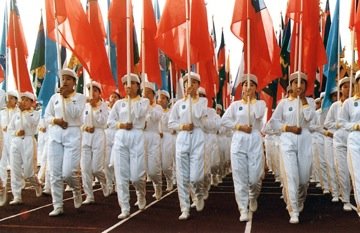
The dancing girls had danced away to a safe distance, but a crowd of small boys—also dressed up as pageboys but normal-sized—had moved in to see what was going on. There were hundreds of them, all dressed in identical crimson-and-gold costumes, all wearing black polyester wigs tied in two pigtails, all made up disturbingly in bright red lipstick, pink eye shadow and yellow face powder. They were difficult to look at, too. A nervous-looking woman noticed me, then barked something at the boys and began clapping. The boys began to leap rhythmically up and down, pointing with their index fingers in various directions and grinning like miniature maniacs. “That’s the pageboy dance,” explained the big doll. “The pageboys would walk ahead of the king and tell people where to go. ‘Go this way! Go that way!’” He stuck his fingers in the air and wagged them like the boys were doing, to show me what he meant. The woman barked again, and the pageboys stopped jumping. “Impressive,” I said. “How many of them are there?” He looked around at the sea of faces that surrounded us and took a drag on his cigarette. “About five hundred,” he said, exhaling a long stream of smoke. Out in the stadium, meanwhile, the ceremony was getting ready to start. From a huge gate at one corner, a marching band burst onto the field playing the national anthem, and from another gate, a battalion of uniformed flag-bearers entered. As they marched around the field in perfect precision, an announcement burst out of the loudspeakers and everyone looked up into the sky. Far above us, a team of parachutists was descending, unfurling a gigantic “Visit Myanmar” banner as they fell. At the moment they hit the ground, the entire audience on the far side of the stadium stood up holding colored cards that spelled out in huge letters, “Enjoy Your Stay in Myanmar.” Next to me, a Japanese journalist was staring wide-eyed at the spectacle, shaking his head as he searched for the right word. “It’s so ... so ... North Korean,” he said, finally. The rest of the event came off with, as you’d expect, tight military precision. As a helicopter circled lazily above the stadium and the TV Myanmar film crews beamed footage back for the live broadcast, the Minister for Tourism extolled the joys and natural beauty of the country, adding that the tourism campaign should convince any doubters about “our commitment to open our doors to the world.” Then there were floats made up as white, winged elephants; flying wedges of pom-pom girls; and troupes of dancing girls who swayed vaguely back and forth to Burmese pop tunes. And, of course, the 10 giant pageboy dolls I’d seen earlier that morning came out and lumbered their way around the stadium, waving blindly at the audience and trying not to knock each other down. But as the ceremony wore on, one of the photographers noticed something odd. Almost the entire audience seemed to be divided into groups of women dressed in the same bright distinctive colors. Not only that: Each section would periodically empty out and suddenly reappear on the stadium field—as dancers. “Too much!” the photographer said, when it dawned on us what was happening. “They’re performing for themselves!” It was true—and it explained the listless, vacant quality of the applause; they’d all seen everything before, in rehearsal. And as we scanned the viewing stands, with their bored enclaves of military officials, diplomats, travel agents and hotel managers, we realized that, for the Grand Opening of Visit Myanmar Year, there were only about 30 actual tourists—bussed in unknowingly, we found out later, as part of a group that happened to be in Rangoon that day. After the closing song ("We sing of our modern developed country, and we welcome all visitors to this wondrous golden land"), I joined the mass exodus, got a useless quote from the Minister for Tourism ("We had a very good opening to Visit Myanmar Year!") and bumped into Sue Reitz, the smart, sardonic manager of the Strand Hotel. “Enjoy your stay in Myanmar, Sue,” I urged her, as we walked out into the parking lot. “Thank you, Stephen, I will,” she replied, with a thin smile. “But then—we don’t really have much choice in the matter, do we?”
Stephen Brookes is a journalist based in Washington, D.C., and a classical music critic for The Washington Post. His writing has appeared in Newsweek, Asia Times, Insight, The Far Eastern Economic Review and Architectural Digest. Photos by Stephen Brookes.
COMMENTSBrilliant! I got a chance to visit Myanmar as a student a few years… Powerful essay capture the contrived nature of Junta trying to make whatever it can a spectacle as a facade from the grim reality of day-to-day life there. I can’t wait to go back. By on 9.9.08 at 05:22 PM
Thanks for sharing this article of Stephen who has been here more than a decade ago. 12 years ago, it might have been true. And it might have been a game plan between the political party and the Junta itself to show how gigantic they are. Meanwhile, Daw Suu Kyi told “don’t visit!”. To put exact way, “Tourism to Burma is helping to prolong the life of one of the most brutal and destructive regimes in the world,” she told reporters once. “Visiting now is tantamount to condoning the regime.” (Ref: BBC News | Asia-Pacific 1996) But we have to rethink that since then she has been under house arrest along without press release. So that must also be outdated, happened in 12 years ago. It was a kind of show between them, the Writer could express it pretty well. But I think it is a bleeding humble request now by the people, for the people. So it’s not an order, it’s a request. By Nyi Nyi on 9.15.08 at 03:25 AM
I would love to visit Burma but the bad news coming out from the country is creating a concern for me. I hope all of you are well and bringing the peace back so we can travel to Burma. By Debra on 9.19.08 at 01:12 PM
I heard that Burma (or Myanmar) is an extremely beautiful place. If I had the time and the money to go there, I for sure would. That, and Italy, is on my “to go” list. By Torah on 10.4.08 at 12:09 PM
ADD YOUR COMMENT
We reserve the right to remove comments with profanity, personal attacks, spam, overt advertisements or other inappropriate material.
|
Latest from the Travel Channel‘The Amazing Race’ on Travel Channel
Anthony Bourdain: ‘No Reservations’
Subscribe to World Hum's RSS feed.
Got a suggestion? Follow World Hum on Twitter Check out our take on the BLOG CATEGORIES
Adventure Travel |
||||||||||||||||||