
Happy Birthday, Stewardesses
Travel Blog • Jim Benning • 05.15.07 | 2:29 PM ET
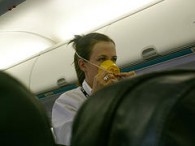 Yes, you in the fabulous oxygen mask. And your colleagues. On this day back in 1930, long before they became flight attendants, stewardesses had their big debut. The Today in History column notes that registered nurse Ellen Church started work as a stewardess for Boeing Air Transport on a flight from Oakland to Chicago. Slate, which suggests it was actualy a flight from San Francisco to Cheyenne, has a slide show to mark the occasion.
Related on World Hum:
* The New Hot Job in India: Flight Attendant
* ‘Has the Romance Gone Out of Travel?’
* Who Wears the Pants on Alitalia Flights?
* Singapore Girl: Icon, Anachronism, Winged Geisha and Pretty Young Thing
* Flight Attendants After 9/11
Photo by Mandroid via Flickr (Creative Commons).
 Email to friend
 Twitter
 del.icio.us
 Digg
Digg Facebook
 Furl
Furl Ma.gnolia
 Mixx
Mixx Reddit
 StumbleUpon
 Yahoo! Buzz
Jim Benning is the editor and co-founder of World Hum.

Tim Kirkwood 05.17.07 | 9:18 AM ET
Actually, Ellen Church was the first FEMALE flight attendant:
The first flight attendants were called “couriers,” and their ranks included the young sons of steamship, railroad, and industrial magnates who financed the airlines. Stout Airways was the first to employ stewards in 1926, working on Ford Tri-Motor planes between Detroit and Grand Rapids, Michigan. Western (1928) and Pan Am (1929) were the first US carriers to employ stewards to serve food. Ten-passenger Fokkers used in the Caribbean had stewards in the era of gambling trips to Havana, Cuba from Key West, Florida.
During the early days of commercial aviation, a pilot or first officer on flights would often serve as cabin attendant, as well as assisting in flying the plane. But this splitting of duties proved inefficient, and airlines began to consider other options.
Boeing Air Transport, a forerunner of United Air Lines, was the first airline to hire women, beginning with Ellen Church on May 15, 1930. Airline exec-utives believed that the presence of a female attendant on board would reassure passengers of the increasing safety of air travel. It would be difficult for potential travelers to admit fear of flying when young women routinely took to the air as part of an in-flight crew. Further, it was believed that women would cater to their predominantly male passengers. (Not everyone was enthusiastic about the idea, though. Pilots claimed they were too busy flying to look after “helpless” female crew members.)
Flying on Boeing 80s and 80-As, stewardesses would serve their ten passengers a cold meal, usually consisting of fried chicken, apples and sandwiches, which they would pick up at the hanger prior to passenger boarding. On flights out of Chicago, the famous Palmer House catered the food. In 1931, Eastern Air Transport hostesses served passengers in a hanger at Richmond, VA. On Curtiss-Wright Condor aircraft (which had no galleys) hostesses served their eighteen passengers coffee, tea, Coca-Cola, biscuits and coffeecake from a picnic hamper. United used fine bone china until turbulence made that economically unsound. Coffee was served from thermos bottles.
In addition to meal service, stewardesses were also responsible for winding clocks and altimeters in the cabin, and ensuring that wicker passenger seats were securely bolted to the aircraft floor. They were also required to advise passengers not to throw lighted cigars and cigarettes out aircraft windows while over populated areas and to ensure that passengers didn’t use the exit door instead of the lavatory door! All this for an exciting salary of $110 (Eastern) to $125 (UA/Boeing) per month. As this was during the depression, no one received raises. At the start of the New Year in 1933, there were only thirty-eight stewardess in the United States. Twenty-six worked for United, on Boeing aircraft, another twelve for Eastern, flying on Curtiss-Wright Condors. On May 3, 1933, American Air Ways, predecessor of American Airlines, hired their first four hostesses and a week later, hired two more registered nurses. By the time Trans-Canada Air Lines (later renamed Air Canada) was created in April, 1937, the stewardess concept was firmly established.
In the beginning, airlines preferred to hire only registered nurses, not just for their medical experience, but also because it was believed that nurses led a disciplined life which would transfer well to the rigors of airline travel. During World War II, the airlines hired only men to work on the Civil Reserve Air Fleet (CRAF) flights, thereby opening the market for women on non-military commercial flights.
-excerpt from The Flight Attendant Job Finder & Career Guide by Tim Kirkwood
http://www.FlightAttendantCareerGuide.com
FAJim 10.30.07 | 12:55 PM ET
Thanks, Tim, for pointing out the historical facts. The “journalists” never do..on any subject..they’re often ignorant of the subjects they writeabout, lazy, sloppy and under deadline pressure to boot. Good thing they don’t have airline jobs ..