
Illuminating ‘Dark Travel’
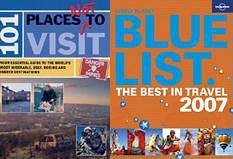
Travel Books: The "Lonely Planet 2007 Blue List" and Adam Russ's "101 Places Not to Visit" spur Frank Bures to contemplate why travelers don't always want to be delivered from inconvenience.
06.18.07 | 1:45 PM ET
 Not long ago, I went to Dubai, where mega project after mega project competes for the world’s headlines. There I stood in the shadow of the Dubai Sunny Mountain Ski Dome—just a metal tube from the outside—and looked around.
On the horizon I could see the desert, where they were building Dubailand, a 2 billion-square-foot theme park designed to encompass “the entire human experience.” It would contain “Snow World” and “Water World” and “Extreme Sports World” and “Bio World.” In an interview with Newsweek, Franz Fischnaller, the head designer of Dubai’s Space City, summed it up. “Today,” he said, “travel is part of the entertainment industry.”
Dubai may be the poster child for this side of travel, which we’ve documented on World Hum. In Planet Theme Park, we arrive at a destination like a movie set, buy a ticket and walk through the experience according to plan. That’s what many people love about Dubai: You get just what you expect.
But what many people love about Dubai is exactly the opposite of what others of us love about travel. We don’t want be delivered from inconvenience. We don’t want to escape from reality. We want to see how things really are. After all, these are dark times. Sometimes we want to see how dark.
Now a couple of new books offer some help. First, the Lonely Planet 2007 Blue List has a section on what it calls “Dark Tourism,” meaning everything from Ground Zero tourism in New York City to Killing Fields tourism in Cambodia to Favela Tourism in Brazil to Apartheid Tourism in South Africa. Dark Tourism means travel to sites associated with death, disaster and depravity.
The “Blue List” has great pointers on sites, like Kutna Hora in the Czech Republic and Actun Tunichil Muknal in Belize and Toul Sleng in Cambodia. It even asks whether volunteering overseas for disaster relief isn’t a new form of this. And finally, it gives another, more hopeful side, somewhat awkwardly labeled “Phoenix Tourism,” meaning travel to the beaches in Sierra Leone, the national parks in Rwanda and the Roman Ruins of Libya. Post-traumatic tourism.
Some scholars note that Dark Tourism (also known as thanatourism, or grief tourism) “raises questions about appropriate political and managerial responses to the range of experiences perceived by visitors, local residents, victims and their relatives,” according to the Web site for the first Dark Tourism conference, which took place earlier this year.
But Dark Tourism also raises questions about Planet Theme Park and packaged, bundled, marketed and scripted entertainment experiences. I can’t help but think that the allure of the dark side is in part a backlash to the aggressive theming and constructing of the travel experience, which unfolds as others have determined it to unfold, where we feel things we’ve been told we’ll feel, and where our travels are not, on some fundamental level, our own. Because sometimes we want more than that. We travel exactly because we want to see and feel things for ourselves. We want to write the script to our own story, not just read someone else’s.
Which is why I was happy to see another book cross my desk recently, which could also be a good antidote to Planet Theme Park, if an unwitting one.
Adam Russ’s 101 Places Not to Visit: Your Essential Guide to the World’s Most Miserable, Ugly, Boring and Inbred Destinations is written in a kind of cheeky British way, and is kind of a faux guide, though not quite in the extreme ironic vein that Phaic Tan and San Sombrero are, nor in the political vein of No Holiday: 80 Places You Don’t Want to Visit. And it’s not nearly as testosterone fueled as Robert Young Pelton’s The World’s Most Dangerous Places.
Rather, it is a halfway serious list of “the world’s most miserable, ugly, boring and inbred destinations.” Places like Murmansk, Russia; Astana, Kazakhstan; Deshnok, India; Rabbit Flat, Australia or Yomoussoukro, Ivory Coast. Places, in other words, you’d never think to go.
Each entry has a clever description of the place, along with a starred “Boredom Rating” and “Likelihood of Fatal Visit” and a (mostly ironic) “likely cause of death.” (Runaway Camel Train in Ulaanbaatar, Attempting to Cross the Road in Madrid, The Mine with Your Name on it in Mogadishu.)
Despite the tone and humor, this book’s value lies elsewhere. Where else (besides the atlas) can you find a list of obscure, largely undesirable places in the world, places where there is nothing pulling people, places where very little is scripted or staged, and where you can just see life going on, and maybe even be a part of it.
In my understanding, that’s the way travel used to be. You heard about a place, developed an inexplicable curiosity and went there to see it. It wasn’t easy. It may not have even been fun, and definitely not like a gentle trip to Disneyland. But it was real.
This urge to have some actual personal experience, some meaty interaction with the world, still exists, driving a small but growing number of people off the path, into the dark and hard corners of the world. The way is harder, but as one traveler who visited Dubai long before the first mall was a glint in the sheik’s eye noted, that just makes the journey all the more worthwhile.
 Email to friend
 Twitter
 del.icio.us
 Digg
Digg Facebook
 Furl
Furl Ma.gnolia
 Mixx
Mixx Reddit
 StumbleUpon
 Yahoo! Buzz