
‘The Condé Nast Traveler Book of Unforgettable Journeys’
Travel Books: A new anthology gathers some of the most memorable stories from the magazine's 20-year history. Tyler D. Johnson says it contains the humor and wisdom only travel can deliver.
10.05.07 | 10:23 AM ET
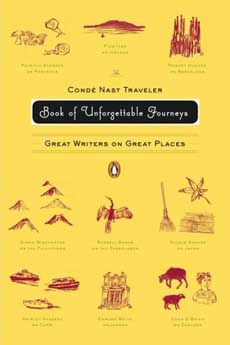 Sometimes the pleasures and pains of travel are indistinguishable. On one hand, you meet gracious strangers; on the other, you discover that none is immune to the universal plague of road rage. In The Condé Nast Traveler Book of Unforgettable Journeys: Great Writers on Great Places, writers report from several countries where normally lovely people who will invite you into their homes become raving, snaggletoothed werewolves as soon as they grip a steering wheel. James Truman writes that a formal greeting in Iran is masochistically generous—“May you step on my eyes”—yet drivers in Tehran emulate the “Ben Hur” chariot races and gleefully run each other off the road. When Truman tumbles out of a cab and pronounces the ride the worst of his life, the cabbie offers this response: “I hear the Turks in Istanbul are much worse.”
Moments like these are worth the trouble. In this collection of remarkably well-crafted stories culled from 20 years of Condé Nast Traveler magazine, the focus is the humor and wisdom that only travel delivers.
Travel compilations often disappoint because the selected stories are so inconsistent in quality, therefore the book as a whole lacks the appealing zest of travel. It’s like anticipating photographs from a friend’s trip to India and getting a handful of overexposed snapshots from a train window. The difference here is the caliber of writing and the quality of observation. These 21 stories contain the best kind of travel writing, where the authors bring a depth and perspective to a place while maintaining the keenest eye for detail.
William Dalrymple walks the pilgrimage route to Santiago de Compostela, Spain and finds the medieval rhythm of walking and the personal nature of prayer are connective links throughout human history. Russell Banks goes further in the Everglades and describes Florida before they paved it and painted it tacky—a primal Florida: “We want to travel even farther in time, to view and imagine anew the planet earth without billions of human beings on it.” Edna O’Brien details Bath, England; Nik Cohn savors Savannah, Georgia; Simon Winchester climbs a Philippine volcano. The moments to relish and consider are many:
* In Ethiopia, Pico Iyer describes the physical sensation of silence as it characterizes a church. He also records the haunting image of “women with blue crosses painted on their chins.” In Iceland, he reports that every member of parliament must speak in rhyme one night every year.
* Walking in Athens, Patricia Storace has this wonderful thought when a Greek soldier tells her through a fence that he likes her earrings: “The literal-minded might hear that whisper as a breach of discipline, but who could criticize the guard’s power of observation, or feel less safe under the protection of a soldier with an appetite for life?” In France, she divines that Provence is “a place where food represents culture, not gluttony, where the exercise of critical intelligence is itself a voluptuous pursuit, and no genuine delight is divorced from knowledge.”
* In the Himalayas, Suketu Mehta travels with a national park guard who protects the endangered rhinos of Kaziranga Park and asks the man if he has any guilt about shooting poachers. Not a whit: “It’s because of them that we don’t know day from night, working out here in the jungle twenty-four hours. They are our enemies.”
One powerful thread throughout is the passage of time as authors revisit places they knew in their youth. They report the predictable influx of modern afflictions—more cars, drugs, AIDS, too many people, pointless bustle—but they are able to revisit their old selves with the clarity and sometimes burden of age. The art critic Robert Hughes apparently had one helluva good time as a younger man in Barcelona, especially when he ran with the Catalan sculptor Xavier Corberó, who kept hundreds of bottles of good wine piled in the caves adjoining his farmhouse. Hughes uses his past as an entrance to the history of Barcelona’s architectural culture and then traces how the city evolved into an international epicenter for creative building. In another essay, he is such an intellectually ferocious tour guide to Italy’s largely lost Etruscan culture that visiting the painted tombs along the Tyrrhenian coast seems absolutely essential. How can you live your entire life and never see the catacombs of Tarquinia?
There are a few duds in this collection—John Norwich’s tour of the Vatican’s riches is (perhaps unavoidably) cluttered; Nicole Krauss’s consideration of Japanese gardens seems hesitant—but the book is overwhelmingly inspiring by showing that the upshot of meaningful travel is the enrichment you bring home. Hughes notes that D.H. Lawrence visited the necropolis of the Etruscans in 1927. He wrote: “It is as if the current of some strong, different life swept through them, different from our shallow current of today; as if they drew their vitality from different depths that we are denied…Behind all the dancing was a vision, even a science of life, a conception of the universe and man’s place in the universe which made men live to the depth of their capacity.”
 Email to friend
 Twitter
 del.icio.us
 Digg
Digg Facebook
 Furl
Furl Ma.gnolia
 Mixx
Mixx Reddit
 StumbleUpon
 Yahoo! Buzz
Stuart Simpson 07.02.08 | 4:09 AM ET
I was disappointed in this book because the stories are so lifeless. There are a lot of facts about each destination but it falls extremely short of inspiring travel. I think the people who wrote the chapters need a little excitement in their lives…