
‘Travels with Herodotus’: Kapuscinski and the Weight of History
Travel Books: Frank Bures considers Ryszard Kapuscinski's newly translated book -- and the Polish writer's controversial legacy
07.03.07 | 3:11 PM ET
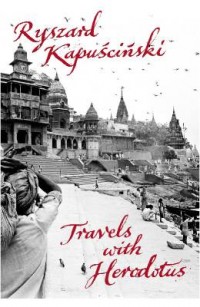 In the middle of the 1950s, a young, naïve Polish reporter named Ryszard Kapuscinski made an offhanded remark to his boss. He said he wanted to go abroad. A year later, she sat him down and told him he was going to India. Then she handed him a stiff-covered book with gold letters on the front that said, “Herodotus, The Histories.” Kapuscinski went off to India and, as he tells it in Travels with Herodotus, his final book before he died, he had no idea what he was doing. He didn’t know any English (let alone Hindi or Bengali) and was, journalistically, at least, a failure. But he’d gotten a taste for travel, for crossing the border, for experiencing the world firsthand, and was completely hooked. The love of travel and foreignness and adventure would guide the rest of his life.
Kapuscinski also fell in love with that ancient book, written by another traveler whose impulses would come to seem so much like his own. Herodotus was a Greek (or half-Greek) born in the 5th century B.C.E. who wrote just one volume. He was an amazing traveler who seems to have gone everywhere in the known world, trying to track down stories, trying to piece together history in a way no one had, and ultimately trying to write things down so they didn’t disappear. “The Histories” (or “Enquiries”) is made up of nine books that explore the background and events of the Greco-Persian wars. In his travels around the known world to piece this information together, Herodotus was tireless, fearless, skeptical and scrupulous. In fact, he was the first real historian.
Kapuscinski shared much with Herodotus, in terms of outlook and aspirations and the basic drive forward. In “Travels,” Kapuscinski imagines the Greek as a “vivacious, fascinated, unflagging nomad, full of plans, ideas, theories.” Kapuscinski continues: “Always traveling. Even at home…he has either just returned from an expedition, or is preparing for the next one. Travel is his vital exertion, his self-justification in the delving into, the struggle to learn—about life, the world, perhaps ultimately oneself.” As Kapuscinski moved on in his own travels to China, Africa, South America and other places, he often brought his copy of “The Histories” with him, and would dip into it, losing himself in the machinations of the Greek and Persian armies, in the strange customs Herodotus records, and in the interesting questions Herodotus poses, questions not unlike the ones Kapuscinski had. Throughout Kapuscinski’s book, he recounts his own travels and mixes them with interludes in which he goes back to his room and reads Herodotus.
These sections include some very long descriptions of what Herodotus writes about. When he explores Herodotus’s interest in culture, or Darius’s siege of Babylon, this can be fascinating. But other times these passages make the book drag with summaries of elaborate Persian military maneuvers Kapuscinski was reading about while in Sudan or Tanzania or China. In these sections, I wondered why I wasn’t just reading Herodotus. When Kapuscinski tacks back to his own travels and musings, however, the pace picks up again.
“Travels with Herodotus” is a better book than his last one, Shadow of the Sun, but not as good as The Soccer War. It is also quieter and more reflective and it fills in some holes about Kapuscinski’s life left by his other handful of books that have been translated into English. (There are more in Polish waiting in the wings.) But there is also a hole that Kapuscinski seems only partially aware he is filling in this new book. Early on in his career, as he tells it in “Travels,” he was playing the game of foreign correspondent, running around, trying to get to where the action was so he could report on the latest explosions, the latest demonstrations, the latest executions. Whenever that wasn’t possible, he and the other reporters would sit on the veranda or in the hotel bar and talk.
“Someone had heard that there had been a coup against Mobutu,” he writes, “others dismissed it as gossip—and how could one verify it, anyway? From such rumors, whispers and conjectures—and facts, too—we cobbled together our reports and sent them back home.” Then one day, Kapuscinski got a strange tip from the Algerian ambassador in Tanzania, and flew off to Algiers for some purportedly big story about to break. Once he got there, though, he found that a coup had already happened. And it was a boring coup. No flags burning. No running battles with police. No riots. Not a peep. He had no idea what to write about, but he had to write about something to justify the cost of the trip. So Kapuscinski decided—here’s an idea—to try to understand the forces behind the coup. He ended up writing about the legacy of the Algerian war, the split between moderate “sea Arabs” and severe “desert Arabs,” and about the how the coup revealed a larger disintegration of Algerian society. The result was a piece called “Algeria Hides its Face,” a moving, fascinating story collected in “The Soccer War” that should make key reading for anyone interested in, or traveling to, Algeria today.
This entire incident seems to have taken Kapuscinski by surprise. “Until that awakening,” he writes, “I had been searching for spectacular imagery, laboring under the illusion that it was compelling, observable tableaux that somehow justified my presence, absolving me of responsibility to understand the events at hand.” What he means, I think, is that this is was the point when he went from being a reporter of events to a writer of literature; from a magpie collecting bits off history’s trash heap, to an artist making something beautiful and resonant out of them; from someone who saw only the small picture in front of him, to one constantly aware of the larger frame in which that picture was set. As every travel writer (and writer) knows, one of the hardest things when you’re on the road is maintaining your perspective, keeping your grip on that bigger picture and remembering the larger story that your small story is part of. Having Herodotus as a companion must have informed that point of view, though Kapuscinski doesn’t say so outright. Interestingly, though, this trip to Algiers may also have been another kind of turning point.
Was this also the point where he started caring about that larger picture at the expense of the smaller one? In searching for the resonance and meaning and narrative that gives his work its power, perhaps this was where he started down a road that would lead to some of the charges now leveled against him: in some cases just sloppy reporting that only Africans and African scholars can spot; in the other cases generalizations (sometimes racial) bordering on ludicrous; and in a few cases, seemingly willful fabrications in his attempts to create something allegorical and lasting.
Before he died, Kapuscinski alternately vaguely acknowledged these accusations and curtly dismissed them. But in spite of them, he was still highly celebrated and routinely mentioned as a Nobel candidate. There is little doubt that his books are beautiful and interpretive and in some sense timeless.
The question is: In what sense? Herodotus, too, was wildly inaccurate in his knowledge and understanding of events. But we still read him 2,500 years later because he takes us back there, he puts us in the strange and wonderful ancient world in which he lived. Yet to take him, or any writer, at face value would be a mistake. That’s why I don’t think the hoopla means we shouldn’t read Kapuscinski at all, just that we should read him not as gospel, or as our sole source of information, but as approximation, as if he were sitting next to us in a bar, telling some great stories about some of the things he saw on his way through the world.
Because while a part of me feels let down by these accusations, and recoils at the “theories” in Kapuscinski’s later work on Africa, and has lost some trust in him, another part of me still wants to fall on the side of Kapuscinski’s defenders and fans. I still feel that what he did was amazing and suspect that in a hundred years he will still be read while his scrupulous contemporaries will have been forgotten. Because sometimes, I don’t always need the exact details of what happened—especially in the 24-hour news-cycle. Sometimes I just want to know what it felt like to be there.
And no writer transports me there like Kapuscinski, who said, “It is not the story that is not getting expressed: it’s what surrounds the story. The climate, the atmosphere of the street, the feeling of the people, the gossip of the town, the smell; the thousand, thousand elements of reality that are part of the event you read about in 600 words in your morning paper.”
Which is why I still love Kapuscinski in spite of his flaws, and feel his work should be read and understood for what it is: not a compendium of facts, but the story of the world as he saw it. I agree with Salman Rushdie, who said, “If you want just the facts, you go elsewhere. There are a lot of writers who can give you that. One goes to Ryszard Kapuscinski to penetrate to something deeper and stronger.”
And that is why “Travels with Herodotus,” and perhaps all Kapuscinski’s work, should be read as art, not science—but without a doubt, it should be read.
 Email to friend
 Twitter
 del.icio.us
 Digg
Digg Facebook
 Furl
Furl Ma.gnolia
 Mixx
Mixx Reddit
 StumbleUpon
 Yahoo! Buzz
jesica 07.20.07 | 6:51 AM ET
Very interesting website the information which is in your site it’s great and i got information about some book and book summaries.I got the information about many topics. And i have gone through your website it’s good site it is very use full to all the book lovers.Very recently i have visited one book summaries website may be it will use full to you and your visitors.