
Destination: Asia
Japan’s “Freeters” Take Manhattan
by Michael Yessis | 10.16.06 | 6:40 AM ET
Freeters are “a Japanese version of slackers,” and according to a great story in Sunday’s New York Times, they’re escaping their home country’s societal pressures by running off to New York City to explore the arts. “In Tokyo bookstores, guides like ‘Finding Yourself in New York,’ and ‘The ‘I Love New York’ Book of Dreams’ fuel the fantasies of those [who] follow in [D.J.] Kaori’s footsteps,” writes Sheridan Prasso. “In an indication that a phenomenon has truly taken off, there’s a contrarian title, ‘Even If You Live in New York, You Won’t Be Happy.’” According to the story, more Japanese live in New York than any city outside Japan.
 Email to friend
 del.icio.us
 Digg
Digg Facebook
 Furl
Furl Ma.gnolia
 Mixx
Mixx Reddit
 StumbleUpon
 Yahoo! Buzz
Travel Book Among National Book Awards Finalists
by Ben Keene | 10.11.06 | 1:45 PM ET
It’s true. The National Book Foundation announced its finalists for the 2006 National Book Awards this afternoon, listing as usual, five nominees for each of its four main categories: fiction, nonfiction, poetry, and young people’s literature. Rarely are travel-related titles recognized by the foundation. Yet there it is, among the finalists for the nonfiction award: Peter Hessler’s Oracle Bones: A Journey Between China’s Past and Present, published this spring by HarperCollins. Whether or not the book wins the big prize Nov. 15, we’re delighted. Hessler is one of the writers we celebrated back in May—his first China book, River Town, made our list of the top 30 travel books of all time. Earlier this year, Hessler shared his thoughts with us on our list, including his take on travel writing as a genre.
R.I.P. R.W. Apple
by Michael Yessis | 10.05.06 | 3:30 AM ET
Legendary New York Times journalist R.W. “Johnny” Apple passed away yesterday from complications of thoracic cancer. Apple, who made his name as a hard-hitting newsman, wrote mostly food and travel stories in recent years. Times editor Bill Keller wrote in a note to his staff that Apple wrote his last story for the Times—this story about 10 restaurants abroad worth boarding a plane to visit—from his sickbed.
Dancing for Tourism on Bali
by Jim Benning | 10.02.06 | 2:51 PM ET
Reports Reuters via CNN.com: “About 5,000 people danced in a trance outside a Balinese temple on Friday in a colossal show aimed at reviving the Indonesian island’s tourism industry, still feeling the pinch of last year’s deadly bombings.”
Seven Travel Stories to Tell Before You Die
by Jim Benning | 10.02.06 | 6:43 AM ET
I’ve never been too enamored of the 1,000 Places to See Before You Die approach to travel—or at least the approach that the title of the book suggests. Among other things, it emphasizes quantity over quality. But the San Francisco Chronicle’s John Flinn has offered a modest alternative checklist that I can get behind: seven travel stories you should be able to tell before you die. It puts the emphasis where it belongs, I think: on experiences and stories. Flinn just concluded a series of columns exploring the seven stories he believes are essential for every traveler, and he recounted his own version of each. “Go ahead and visit every one of those ‘1000 Places to See Before You Die,’ as catalogued in the best-selling book,” he wrote. “But spare your friends the description of the Taj Mahal. Yes, it’s beautiful. And, yes, of course, the Great Barrier Reef is awesome. Everybody knows this. And we don’t need to hear about the seventh hole at Pebble Beach. What we want to hear are stories.”
Bangkok’s “Golden Land” Airport Opens
by Jim Benning | 09.28.06 | 2:26 PM ET
Despite the recent coup, Southeast Asia’s largest airport opened today, the highly anticipated $4 billion “mega airport” 20 miles from central Bangkok called Suvarnabhumi, or “Golden Land.” “First conceived in 1960,” the AP reports, “the high-profile project transformed a swamp where villagers once caught cobras for a living into a fertile ground for politicians and their cronies to profit from shady deals, allegedly ranging from land speculation to bribery and kickbacks from the $3.8 billion project.” Okay, so it got off to a shaky start. But since then, 99 monks and Brahmin priests have apologized to the spirits for any harm done. And now, travelers are raving about the place. According to the International Herald Tribune, officials hope the new airport, designed to move 45 million passengers a year, will “surpass Hong Kong as a regional air hub.” An express train to downtown Bangkok is scheduled to open next year.
Travel Writers Pick Their Favorite Airports
by Michael Yessis | 09.27.06 | 2:09 PM ET
USA Today’s Jayne Clark asks a handful of travel writers about their favorite airports in today’s edition. Among them: The Naked Tourist author Lawrence Osborne, who notes about his favorite, Wamena, Irian Jaya, on the island of New Guinea, “It’s the anti-airport. It has almost no staff. There is no glass in the windows, just naked men in pig fat jumping up and down.” Hmmm. Could be worth a trip just to see that.
Cohan, Bourdain in T Style Magazine: Travel
by Michael Yessis | 09.25.06 | 7:05 AM ET
The latest issue of T Style Magazine: Travel in the New York Times features a couple of noteworthy stories. “On Mexican Time” author Tony Cohan immerses himself in the rejuvenated city of Guanajuato, Mexico, and globetrotting chef and television host Anthony Bourdain eats his way through Singapore. “There’s a fever-dream quality to Singapore, particularly if you’re a foodie,” Bourdain writes. “Outdoors, the heat is smothering. In the ubiquitous megamalls, the air-conditioning could frost a bottle of beer. Everyone, it seems, when not shopping for Prada or Armani, is feeding their faces.”
Backpacker on the Thailand Coup: “Nobody’s Up in Arms About It”
by Jim Benning | 09.20.06 | 1:53 PM ET
Apparently the banana pancakes-eating, hair-braiding backpacker set hanging out on Bangkok’s Kao San Road continues to, uh, chill, despite the tumultuous events of the last 24 hours in Thailand. It was 21-year-old Scottish traveler Amy Farquhar who remarked to USA Today about the bloodless coup to remove Prime Minister Thaksin Shinawatra, “Nobody’s up in arms about it.” Farquhar was referring to her fellow Kao San travelers, we imagine, and not the tank-driving, arms-wielding military who staged the coup. Some travelers are a bit more engaged. Self-proclaimed vagabond Paul Karl Lukacs has been filing reports about events at the blog Knife Tricks. Among other posts, he writes: “This evening, I saw ten soldiers stationed at Tha Phae Gate, the central crossroads in the tourist section of Chiang Mai, Thailand. I rarely see soldiers in the city, so this was clearly a show of force.” According to USA Today’s story, the U.S. Embassy is urging its citizens in Thailand to “monitor the situation closely.” For the time being, Americans are not being advised to leave the country.
Photo by Jim Benning.
Payphones Around the World
by Jim Benning | 09.19.06 | 7:06 AM ET
For many years now, I have had a habit during my travels that has puzzled people close to me. It’s not something I have talked about, and for a long time now, I have felt alone in my predilection for this activity. But today, I am coming clean: I like to photograph payphones. Specifically, foreign payphones. During my travels, I have snapped mediocre photos of payphones in the French Alps, on the Caribbean island of Aruba, in Mexico. I have photographed purple payphones backed by graceful pagodas in China, and blue payphones backed by vast jungle in Malaysia. I have taken photos of sandal-shod, saffron-robed Buddhist monks chatting on Thai payphones that looked like mini-temples—ideal places, I always thought, for reflective conversations. Of course, one might reasonably ask: Why do this?
Confucius in Modern China
by Michael Yessis | 09.18.06 | 6:11 AM ET
Part two of Tom Haines and photographer Essdras M Suarez’s two-part series Into a Changing China is now up at the Boston Globe. The final installment, Haines says, looks at modern China through its relationship with Confucius. And like part one, which we highlighted last week, it features a terrific audio slide show.
Shanghai: Beyond the Skyline
by Michael Yessis | 09.13.06 | 6:38 AM ET
On a recent trip to China, Boston Globe travel writer Tom Haines took the amazing architecture of Shanghai as a given, old news. He and photographer Essdras M Suarez instead took a look a how the rising buildings and economy have affected life in Shanghai, and their story—the first of a two-part series “Into a Changing China”—and a terrific audio slide show highlighting the collision of old and new, are now online. “Across the river, guests at the Hyatt rest their heads on pillows 80 stories above the city. Foreign bankers emerge from apartments in the French Concession and swing into Starbucks for blueberry muffins and venti lattes. Tom Cruise leaps from Shanghai’s real towers in the imagined world of M:i:III,” Haines writes. “It can be easy to forget that beneath it all a local culture evolves.”
Lost City of the Silk Road
by John W. Kropf | 09.12.06 | 10:21 PM ET
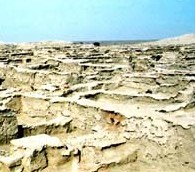 Photo by John W. Kropf.
 To know the heart of Turkmenistan John W. Kropf thought he had to know the ancient city of Merv. That was just the beginning of his search.
Colin Thubron and the “Shadow of the Silk Road”
by Michael Yessis | 09.12.06 | 8:02 AM ET
He’s among the best travel writers working today, and this Sunday The Times of London began a series of three excerpts from Colin Thubron’s new book, Shadow of the Silk Road. Thubron, whose Behind the Wall landed at No. 23 in World Hum’s countdown of the Top 30 travel books, travels through China, Uzbekistan, Kyrgyzstan, Afghanistan, Iran and Turkey, and the first excerpt finds him en route to Tibet.
The 9/11 Anniversary: World Hum Looks Back
by Michael Yessis | 09.11.06 | 7:00 AM ET
Five years ago, on the morning of the terrorist attacks in New York City, Washington D.C. and the air near Shanksville, Pennsylvania, World Hum was barely four months old. I was living in San Francisco, and Jim was making his way through Southeast Asia. “This isn’t the way you’re supposed to feel when you travel abroad,” Jim wrote in Terror in America: A Letter From Thailand, which we posted the following day. “You’re supposed to be immersed in the exotic, pleasantly buzzed, delightfully lost, happily, if temporarily, in exile. You’re supposed to shuck off your old self, lose track of the news back home and try on an utterly foreign way of life.”