
Destination: Burma (Myanmar)
Welcome to Naypyidaw: Burma Unveils New Capital City
by Michael Yessis | 03.28.07 | 7:49 AM ET
International media have been invited by Burma’s military rulers to visit Naypyidaw, the country’s new capital city. Like North Korea’s recent decision to allow U.S. citizens to visit, Burma’s move revolves around a huge, state-sanctioned event. In Burma’s case, it’s the country’s Armed Forces Day parade. According to the BBC’s Jonathan Head, it’s the first time outsiders have been allowed to see Naypyidaw since Burma made the confounding decision in 2005 to move the capital from Rangoon.
 Email to friend
 del.icio.us
 Digg
Digg Facebook
 Furl
Furl Ma.gnolia
 Mixx
Mixx Reddit
 StumbleUpon
 Yahoo! Buzz
Are Burma’s Ruins the Next Disney World?
by Terry Ward | 09.07.06 | 8:58 PM ET
Burma (or Myanmar) has long been on my list of dream destinations. And urgings from fellow travelers to get there sooner rather than later are resonating all the louder after reading a frightening yet fascinating piece in today’s Los Angeles Times. In a country notoriously corrupt and cut off from the rest of the world, some of the greatest ruins on the planet—the temple complex at the ancient city of Bagan—are at serious risk of turning into a “temple theme park,” writes Richard C. Paddock. And this is no mousy attempt at attracting tourists.
Iron Cross and Scott Carrier “Rock the Junta” in Burma
by Frank Bures | 07.07.06 | 12:30 AM ET
Scott Carrier has a fantastic piece on Burma in the July/August issue of Mother Jones. Carrier, who is known for his stories on This American Life and his book, Running After Antelope, traveled to Burma to look for Buddhist temples, but found himself hanging out with Iron Cross, the band whose spirit, if not its censored lyrics, have resonated with the oppressed population of Rangoon. “Everywhere we went, we were watched,” writes Carrier in Rock the Junta. “Long, intense stares coming from every direction, as if we were out of place and out of time, and it was hard to tell whether the Burmese were wondering if we were ‘external destructive elements’ or some second-rate soap opera stars they’d seen on TV. They did not, however, appear to be very friendly, and some of them laughed at us. Yes, a mockery, seconded by legions of squawking crows in every tree.” It is a fine portrait of modern Burma, and an even finer meditation on freedom and oppression.
No. 7: “Golden Earth” by Norman Lewis
by Frank Bures | 05.25.06 | 7:53 PM ET
To mark our five-year anniversary, we’re counting down the top 30 travel books of all time, adding a new title each day this month.
Published: 1952
Territory covered: Burma/Myanmar
In 1951, not long after Southeast Asia had been a bloody battleground in World War II, a quiet, unobtrusive man set off from Wales for Burma, where he would spend three months traveling for one of the classics of travel writing, Golden Earth. It was not the only classic he would write: For more than 60 years, Lewis traveled the world and wrote some 30 travelogues and novels. During his travels Lewis had his skull fractured, watched men brain each other with femurs and, at 80, tried to get into Irian Jaya to interview some tribe members who had apparently barbecued and eaten 13 missionaries. According to another (possibly apocryphal) story, Lewis was sent by Ian Fleming to check in on Ed Scott, the model for James Bond. While the two were talking, unbeknown to them Graham Greene was watching, and used the scene for “Our Man in Havana.” But Lewis was our man in many, many places: India, Guatemala, Vietnam, Sicily, Spain, the Middle East and, of course, Burma, which he wrote, “spread as a dark stain into the midnight sea.” Lewis spent three months there and the going was rough: His train from Rangoon to Mandalay was delayed when explosions damaged the rail in front and behind him. But compared to the road he traveled, Lewis’s prose is smooth. It is also full of the humor and the humanity of the people he met along the way. As Pico Iyer says, “Out of marvels he makes melodies.” “Golden Earth” shows both Burma and Lewis at their most marvelous.
Goodbye ‘Calcutta,’ Hello ‘Kolkata.’ What’s in a Name?
by Jim Benning | 03.07.06 | 3:35 PM ET
To reflect pre-colonial times in India, Calcutta has become Kolkata, Madras is now Chennai and Bombay has become Mumbai. More and more Western newspapers are using the new official names in datelines—the Los Angeles Times made the change Monday. In an eloquent piece in today’s Times, David Lamb wonders what’s lost when such iconic names are tossed into the “historical scrap pile.”
Final Score: United States 5, Burma 5
by Jim Benning | 12.15.05 | 1:51 PM ET
Five journalists, that is. The Committee to Protect Journalists has issued a report on nations detaining correspondents. The news isn’t pretty: The United States and Burma (perhaps the most Orwellian nation on the planet) tied for sixth place for most held, with each nation detaining five journalists. None of the five journalists being held by the U.S. in Iraq and Guantanamo Bay, Cuba has been charged with a crime. China is holding 32 reporters, more than any other nation. The New York Times has the gory details.
Sleepless in Rangoon
by Tom Downey | 11.21.05 | 11:41 PM ET
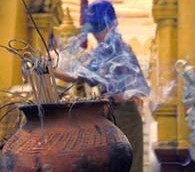 Photo by Tom Downey.
 On his second visit in four years to the same Burmese pagoda, Tom Downey embraces his jet lag and revels in travel's power to reveal change
Ben’s Place of the Week: Pyinmana, Burma
by Ben Keene | 11.11.05 | 4:18 AM ET
Population: 97,400 (2005 est.)
Coordinates: 19 45 N 96 12 E
A resource-rich former province of India, the Union of Burma, or Myanmar as the country is also known, struggles economically in spite of its natural wealth due to poor infrastructure and political instability. No elections have been held since 1990 and the autocratic head of state has demonstrated little interest in democracy, preferring, it would seem, to keep the population ill-informed and dependent on black-market sources of income.
Tracking Travel Inspired by Literature
by Michael Yessis | 10.12.05 | 12:58 PM ET
The Op-Ed Page is the New Travel Section
by Michael Yessis | 07.25.05 | 10:00 PM ET
We’ve said it before and we’ll say it again: Sometimes the best newspaper travel stories don’t appear in the travel section. For the third day in a row, a great travel story has appeared in the op-ed pages of either the New York Times or the Los Angeles Times. On the heels of Bob Greene’s excellent Saturday piece in the New York Times, columnist David Brooks took a break from political mudslinging Sunday with a column about flying with children. It’s not a subject that immediately brings to mind Picasso, but Brooks makes the comparison with his trademark wit.
Interview with Emma Larkin
by Michael Yessis | 07.19.05 | 9:51 AM ET
Emma Larkin, author of “Finding George Orwell in Burma,” will appear on National Public Radio’s All Things Considered this afternoon. Audio for the radio program is scheduled to go online at 7:30 p.m. ET.
Big Brother in Burma
by Frank Bures | 06.29.05 | 8:14 PM ET
Journalist Emma Larkin traveled around Burma to see where author George Orwell spent five years of his life. She discovered what just might be the most Orwellian country in the world. Frank Bures reviews Larkin's new book on the topic, "Finding George Orwell in Burma."
Burma’s Ongoing Cycle of Despair
by Jeff Greenwald | 06.29.05 | 6:50 PM ET
 Photo by Rolf Potts
 Burma was once known as the "Golden Land" by Western adventurers. Not any longer. Under a tyrannical regime, the country's spiritual and de facto political leader, Aung San Suu Kyi, languishes in prison. For her 60th birthday, Jeff Greenwald has a gift idea.
Hell No! They Won’t Buy Lonely Planet Guidebooks!
by Michael Yessis | 07.23.04 | 11:00 PM ET
An organization called Burma Campaign UK has called for a boycott of Lonely Planet because it believes that by promoting travel to Burma through its guidebook, the publisher indirectly supports the nation’s dictatorship. Lonely Planet answered the charges in a recent issue of the Guardian. “Lonely Planet supports the aims of Burma Campaign UK,” says Andy Riddle, sales and marketing director for Lonely Planet Publications Europe. “This is a disagreement about tactics, not objectives. We provide objective information to travellers so they can make informed decisions about the complex issue of whether to travel to Burma, including explicit condemnation of the abominable regime. We show people who decide to visit the country how they can travel responsibly.”
Do You Like the Way My Fanny Pack Goes With My Traditional Burmese Lungi?
by Jim Benning | 03.19.04 | 7:44 PM ET
While traveling through Burma a couple of years ago, Rolf Potts found himself purchasing and donning a lungi—a skirt-like garment worn by Burmese men. By the time he got to Thailand, an Australian observed of Potts’ outfit: “Look at ya, mate. You’ve got it all mixed up.” In a thoughtful story in Sunday’s San Francisco Chronicle, Potts writes: “I looked down at my outfit. In addition to my lungi, I sported a nylon fanny pack (which made up for my lack of pockets) and a North Face dry-wick shirt (which had kept the sun off while biking). This ensemble didn’t strike me as particularly strange, but—according to the Aussie—wearing a fanny pack (stereotypically favored by middle-aged tourists) and a boutique safari shirt (which, while functional, is the modern fashion equivalent of a pith helmet) effectively canceled the lungi out.”
- « Prev Page
- Next Page »