
Destination: North America
Marilyn Monroe’s Forgotten Banff Vacation
by Eva Holland | 10.07.10 | 1:51 PM ET
Move over, Crasher Squirrel: Banff just got a new tourism mascot. In 1953, Marilyn Monroe injured her ankle on a movie set in the Canadian Rockies and wound up at the Banff Springs Hotel to recuperate. A photographer from Look magazine documented her visit, but only two of his photos ever appeared in print—until last week, when they were released in a new book, Marilyn, August 1953. The Globe and Mail has a selection of photos from the book, all of Monroe in full tourist mode—posing with a taxidermied grizzly or riding a chairlift. They’re very cool, take a look.
 Email to friend
 del.icio.us
 Digg
Digg Facebook
 Furl
Furl Ma.gnolia
 Mixx
Mixx Reddit
 StumbleUpon
 Yahoo! Buzz
76-Second Travel Show: The Monopoly Travel Guide to Atlantic City
by Robert Reid | 10.06.10 | 4:01 PM ET

With help from the world-famous game, Robert Reid gets beyond the boardwalk
‘Is Civil War Tourism Fun?’
by Eva Holland | 10.05.10 | 1:41 PM ET
This coming spring marks the 150th anniversary of the onset of the Civil War. John Swansburg, anticipating an upsurge in Civil War tourism as a result, is getting out ahead of the pack—and he’s documenting his jam-packed ten-day Civil War road trip in a series of dispatches for Slate. He begins the trip with a series of questions:
Over the next four years, scores of fathers will use the sesquicentennial celebration as an excuse to don their safari shirts and trundle forbearing wives and irritable children off to Gettysburg or Spotsylvania or Chickamauga. What will they see? Will they learn something they couldn’t have picked up from watching Ken Burns or reading Battle Cry of Freedom? Can visiting these places turn a layman into a buff? Is Civil War tourism fun?
David Byrne: ‘Don’t Forget the Motor City’
by Eva Holland | 10.05.10 | 10:13 AM ET
The musician and World Hum contributor recently spent a week in Detroit, and he’s posted a lengthy, thoughtful item about the visit on his blog. Much of it focuses on the origins of Detroit’s infamous urban decay:
This is a city that still has an infrastructure, or some of it, for 2 million people, and now only 800,000 remain. One rides down majestic boulevards with only a few cars on them, past towering (often empty) skyscrapers. A few weeks ago I watched a documentary called Requiem For Detroit by British director Julian Temple, who used to be associated with the Sex Pistols. It’s a great film, available to watch on YouTube, that gives a context and history for the devastation one sees all around here. This process didn’t happen overnight, as with Katrina, but over many many decades. However the devastation is just as profound, and just as much concentrated on the lower echelons of society. Both disasters were man-made.
(Via The Daily Dish)
Las Vegas Cowers at ‘Death Ray’
by Michael Yessis | 09.30.10 | 11:13 AM ET
It singes hair! It melts plastic cups! It inspires funny leads on blogs!
The “Vdara Death Ray,” as it’s known to some pool employees at the Vdara Hotel & Spa at the Las Vegas CityCenter, is apparently a result of the design of the building. The sun reflects off one of the hotel’s towers in a way that targets a section of the hotel’s pool area with extreme temperatures for short periods of time. From the Las Vegas Review-Journal:
Viewed from above, the Vdara tower resembles a crescent. The crescent’s southern-facing side is concave. There is no tall building farther south to block the sun’s hot afternoon rays, so Vdara receives the full brunt. Its pool lies at the center of this southern-facing wall, on top of a low-rise building that is three stories tall.
How hot is the “Death Ray”? If it can melt plastic cups, as reported, it’s pretty hot. According to the Review-Journal, plastic cups melt at around 160 degrees.
After the Nashville Flood: Grand Ole Opry House Reopens
by Eva Holland | 09.28.10 | 2:15 PM ET
USA Today has video from the restored venue, which opens its doors again tonight for the first time since Nashville’s disastrous spring flooding. The Grand Ole Opry itself stayed on the airwaves—as it has since 1925—broadcasting from other, undamaged locations around the city while its home received a $20 million renovation. Says longtime Opry member Marty Stuart: “It was time for a freshening up, so on the silver side of the flood, it’s like, ‘Thanks, God, for the flood and the insurance check.’”
World Hum columnist Tom Swick made it to one of those relocated Opry broadcasts, at the Ryman Auditorium, this summer. He wrote:
There was still the homey banter and the chummy words from sponsors, the easy mixing of newcomers and old-timers. A student at the New England Conservatory (playing fiddle and singing) followed Jack Greene (singing “Statue of a Fool”). As natural as this assemblage of young and old seemed—conscious preservation of the unbroken circle—it constituted something rarely seen in popular music today.
A Tourist Goes to Church in Harlem
by Eva Holland | 09.27.10 | 2:50 PM ET
Slate writer Jeremy Stahl set aside his discomfort “at the prospect of joining other underdressed white gawkers observing how ‘locals’ pray” and headed north of 96th St. in Manhattan on a Sunday morning. The resulting dispatch is a thought-provoking read. Here’s Stahl setting the scene at Greater Highway Deliverance Temple:
When the music started, the usher who had greeted us began dancing up and down the aisle. The congregation stood up and started to clap and sway. One tourist pantomimed the drumming and imitated the dancing in what looked like an attempt to impress two female friends. The choir performed “I Came To Praise the Lord,” and the lyrics—“I don’t know what you came to do, I came to kneel and pray”—stung almost like a collective rebuke. At one point, a church leader declared the “visitor” count for the day’s service at 147, listed the represented countries, and told us “thank God for each and every one of you”—even, I suppose, the dozing Japanese woman to my left.
When we were back on the bus, our tour guide, Sheila, asked if anyone had any questions. There was just one: “They weren’t offended?”
Las Vegas Bets on ‘Real’ Architecture
by Michael Yessis | 09.27.10 | 11:34 AM ET
Las Vegas, Paul Goldberger notes in the New Yorker, “has started to feel a little uncomfortable about its reputation as a place where developers spend billions of dollars on funny buildings.” That feeling helped inspire the latest over-the-top Vegas production. Goldberger writes:
The complex is called CityCenter, and it is the biggest construction project in the history of Las Vegas. It has three hotels, two condominium towers, a shopping mall, a convention center, a couple of dozen restaurants, a private monorail, and a casino. There was to have been a fourth hotel, whose opening has been delayed indefinitely. But even without it the project contains nearly eighteen million square feet of space, the equivalent of roughly six Empire State Buildings. “We wanted to create an urban space that would expand our center of gravity,” Jim Murren, the chairman of the company, told me. Murren, an art and architecture buff who studied urban planning in college and wrote his undergraduate thesis on the design of small urban parks, oversaw the selection of architects, and the result is a kind of gated community of glittering starchitect ambition. There are major buildings by Daniel Libeskind, Rafael Viñoly, Helmut Jahn, Pelli Clarke Pelli, Kohn Pedersen Fox, and Norman Foster; and interiors by Peter Marino, Lewis Tsurumaki Lewis, Bentel and Bentel, and AvroKO. There are also prominent sculptures by Maya Lin, Nancy Rubins, and Claes Oldenburg and Coosje van Bruggen. “The idea I wanted to convey was to bring smarter planning to the development process in Las Vegas, to expand our boundaries of knowledge,” Murren told me. “Las Vegas is always looked down upon. CityCenter is a counterpoint to the kitschiness.”
Goldberger doesn’t believe the project succeeds.
Paparazzi Fishing at the Baggage Claim
by Jim Benning | 09.27.10 | 10:47 AM ET
The Los Angeles Times covers the work habits of celebrity photographers who camp out at LAX:
If tips are scarce, photographers make their own luck by “fishing”—strolling the terminal baggage claims and entrances for shots. Airport paparazzi scour crowds less for actual famous people than for signs that actual famous people are about to appear. A shiny black Escalade with tinted windows. A muscle-bound man with an earpiece. And, above all, the “star greeter,” hired by movie studios and other companies to whisk VIPs through lines at the airport. Airport photographers tend to memorize the greeters’ faces, walks, wardrobes and client lists.
Six Spots to Relive ‘Travels With Charley’
by Robert Reid | 09.23.10 | 10:43 AM ET
 Robert Reid
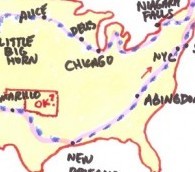
 Fifty years ago John Steinbeck began the road trip that begat a travel classic. Robert Reid unearths the spots where you can still make like the author -- minus the poodle.
A Detour to Seattle
by Eva Holland | 09.21.10 | 3:10 PM ET
Over at Gadling, World Hum contributor Andrew Evans has a sad, thoughtful piece about a last-minute trip to Seattle to attend a funeral. It’s worth reading in full, but here’s a favorite sequence:
The day after the funeral, the friend I was crashing with whipped out a yellow legal pad and began making a list of things to see and do in Seattle. Mostly, he suggested I do a lot [of] eating. We made plans to meet up for lunch at a popular Russian café; my friend slipped me the address as we walked downtown. I had no map and no idea how I would find him.
“Just remember,” he panted, “Jesus Christ Made Seattle Under Protest.” He ran all the words together as one and it didn’t make any sense at all.
“Huh?”
“It’s a way to remember the streets: Jesus is for Jefferson/James. Christ—Cherry and Columbia. Made—Marion/Madison . . . and so on, you’ll see. It’s easy—just follow the streets in that order. Be at Cherry and Third at one o’clock.”
“Jesus! Christ! Made! Seattle! Under! Protest!” he shouted out each word as he spun around the corner and marched uphill. Every street in Seattle goes up or down.
Retracing Steinbeck’s ‘Travels With Charley’
by Jim Benning | 09.20.10 | 3:50 PM ET
Fifty years ago this week—on Sept. 23, 1960—John Steinbeck set out on the 10,000-mile road trip that would inspire the classic American memoir, “Travels With Charley.”
This Thursday, writer Bill Steigerwald will set out to retrace Steinbeck’s journey. He plans to write about it, using the trip as “the frame for a book that compares simple, poor, square 1960 America with 2010 America.”
He admits the two journeys will be very different.
Steinbeck camped out under the stars a bunch of times. I won’t. He drove a clunky uncomfortable truck with a Spartan camper shell on its back. I’ll stay at pre-1960 motels when I can and drive a 2010 Rav4 I can sleep in when I must. When Steinbeck was on the road he had only an AM radio and pay phones to keep him tethered to the world. I’ll have enough communication gear for a trip to the moon.
The book “Travels With Charley” will be my map/guide/timeline to the places Steinbeck went and the things he mused, complained or fretted about. Unfortunately, “Charley” is not a travelogue and wasn’t meant to be. It’s often vague and confusing about where Steinbeck actually was on any given date, and Steinbeck, who died in 1968, left no notes, no journal, no expense records.
There’s more information and an interactive map here.
Four Great Gringo Songs About Mexico
by Jim Benning | 09.17.10 | 2:10 PM ET
We just linked to a list of the 10 “most Mexican” songs of all time, and that got me thinking about my favorite songs about Mexico that aren’t Mexican at all—songs that were, in fact, written and recorded by gringos.
Here are my top four. What are yours?
‘Mexico’ by James Taylor
‘Mexican Radio’ by Wall of Voodoo
The 10 ‘Most Mexican’ Songs of All Time
by Jim Benning | 09.16.10 | 3:05 PM ET
El Universal has offered up a list of the 10 “canciones más mexicanas.” Great stuff from Jose Alfredo Jimenez, Jorge Negrete and others.
Here’s one that made the list, Pedro Infante singing “Cielito Lindo”:
(Via NPR’s Multi-American blog)
Mexico: Celebrating 200 Years of Independence
by World Hum | 09.15.10 | 10:07 AM ET
 REUTERS
 Mexico marks its bicentennial this week -- and the 100th anniversary of the Revolution. (Bonus: This slideshow is 100% free of drug-war references!)
See the full photo slideshow »