Travel dispatches from a shrinking planet

Travel dispatches from a shrinking planet

RECENT DISPATCHES
5.6.08

On the Occasional Importance of a Ceiling Fan

Emily Stone knew well the kind of moment she was experiencing in Puerto Rico: the guy, the Cuba libres, the accelerated intimacy. It was perfectly safe, she told herself, as long as she knew when to get out.

4.23.08

A Writer’s Port of Call

Adam Karlin went to Indonesia to work as a reporter. But after a visit to Jakarta’s old wharf to see the aging Makassar schooners, he left with a calling of a different order.

TRAVEL BLOG
Q&A
image

Tony Horwitz: Rediscovering the New World

Ben Keene talks to the author of the new book “A Voyage Long and Strange” about travel, American myths and the importance of visiting places where “history happened”

SPEAKER'S CORNER
image

In Patagonia, In Patagonia

Tim Patterson packs his fleece and long underwear, and enters the Twilight Zone where corporate branding meets the multilayered reality of place. 

ASK ROLF
image

Should I Quit Law School so I can Travel the World?

Vagabonding traveler Rolf Potts answers your questions about travel

BOOKS
image

‘The Worst Guidebook Writer Ever’?

Lonely Planet author Robert Reid reviews Thomas Kohnstamm’s “Do Travel Writers Go to Hell?” and weighs in on the controversy surrounding it

HOW TO
image

Have a Hockey Night in Canada

From Montreal to Sault Ste. Marie, the sport is the country’s greatest passion. Eva Holland explains where to go to indulge—and who you need to know.

AUDIO SLIDE SHOW
image

Promised Land Closed

And other odd and unlikely signs from around the world. Aficionado Doug Lansky, editor of the book “Signspotting,” recounts his 10 favorites.


THE LIST
image

10 Sizzling Hot Travel Tips From Sir Francis Bacon

Rolf Potts repackages the 17th century philosopher’s ‘Of Travel’ essay in the manner of a 21st century magazine feature

DISPATCH
2.27.06

A Brief and Awkward Tour of the End of the Earth

Jason Anthony was working as a U.S. Antarctic Program fuels operator when he was called to remote Vostok Station. It was a trip he would lie to take.

image

A man who’s warm cannot understand a man who’s freezing.
—Alexander Solzhenitsyn, “A Day In The Life Of Ivan Denisovich”

As I boarded a flight to Vostok Station, Antarctica, to deliver a dozen Russian men, some fuel, and two tons of frozen homefries, I found myself in an ethical crisis: Was it right for me to go? I worked at the time as a fuels operator, part of a crew that managed several million gallons of aviation diesel at McMurdo Station, the hub of the United States Antarctic Program, located 2,400 miles south of New Zealand on Ross Island. We fueled McMurdo’s helicopters and planes, we drove fuel trucks, and sometimes ran temporary fueling systems in remote camps. On this trip, I was to help with the transfer of much-needed fuel from the LC-130 Hercules into Vostok’s near-empty tanks.

On board, but still on the ground in McMurdo, I was told by our Air National Guard loadmaster that the mission was for cargo only, and would offload no fuel. Here I suffered my brief ethical quandary: Should I jump off the plane and go back to work in town, and so miss out on a very rare chance to see Vostok?

The loadmaster solved the crisis for me when, over the growing roar of the turboprop engines, he shouted a request: “We won’t deliver any fuel, but there’s a chance we’ll want you to help us take fuel from the Russians!” I looked at him as if he had told me he hoped to squeeze blood from a snowball. This crew was new to the Antarctic, and they were unclear on the situation at Vostok. Though I explained to him that we had neither the hardware nor the desire to suck up the dregs of Vostok’s dirty tanks, and that the Russians couldn’t afford to give it away, he remained unconvinced. He was the confused messenger for a confused message. Sensing my opportunity, I decided my duty lay in preventing the aircrew from damaging their engines with (unavailable) bad fuel. Nodding to the loadmaster, I quickly sat down, put in my earplugs, and buckled up for my little adventure.

So this trip was a lark right from the start, but a lark to a place that few humans have seen. It’s a trip I would lie to take.

* * * * * *

A small research base huddled against the flat white icescape of the East Antarctic ice cap, Vostok is the farthest terrestrial outpost of an impoverished Russian empire. Occupied since 1957, Vostok is also the most isolated of Antarctic bases. Its few old buildings sit in the middle of the godforsaken polar plateau, near the South Geomagnetic Pole, at an elevation of 11,220 feet. It is as far away from the familiar you can go without leaving the planet.

Vostok (“East”) is also officially the coldest place on Earth, once reaching a ghastly winter temperature of -129°F. Even now, just past midsummer, -20°F would be a heat wave. Two dozen men work in the cold here each summer, while only a dozen stay for the brutal winter. Still bridging the gap between the old wood-and-canvas “heroic age” of Antarctic exploration and the digital age of modern occupation, the Russians at bitter Vostok contend with conditions long forgotten by other Antarctic workers.

No one visits Vostok. It doesn’t exist in the world traveler’s currency of guess-where-I-went. The odds that someone will find their way there to see it on their own are infinitesimal. No one will stumble onto this weathered colony or follow a guidebook to its doorstep.

Even for U.S. Antarctic regulars, awe is always part of a conversation about Vostok. Our rare glimpses of bearded, hard-worn Russian personnel and the rumors of their working conditions remind us of how easy our own jobs are. For USAP workers, most of whom live in comfy McMurdo, Vostok is synonymous with pain and suffering. For us, it’s a mysterious, daunting place that commands our respect.

Buckled into our paratrooper-type webbing benches, we jostled and lurched sideways as the Herc slid down the skiway—a runway for planes on skis—and lifted off. Each bench faced the other, with a line of cargo pallets running down the middle of the fuselage. The mostly silent mix of U.S. and Russian personnel either sloughed off their parkas or sunk into them with their eyes closed.

Every Antarctic flight is like this, each person isolated by the roar of the engines and the earplugs we use to shut it out. Hercs have only a few small portholes on each side of the fuselage, behind the benches. Because the plane is dark and the view is blinding, these are nearly useless. After leveling off, we take turns drifting back to the larger square windows in the rear exit doors.

Most of our guests seemed to be asleep by the time the Herc rose over the Transantarctic Mountains into East Antarctica. Vostok’s winter station manager, however, kept his eyes open, staring at the pale-green insulation across the military fuselage. His responsibility for the next year was to keep all 12 men safe and sane. Soon we were droning across an ice sheet the size of China.

Some of the stark Russian faces reminded me of American Civil War portraits staring out from sepia photos. Carved and rugged, dark and impassive: And these were the men who had not yet spent their year on the ice. Then again, the lines on their faces may have been from jetlag. They flew from St. Petersburg to Amsterdam to Singapore to Sydney to Christchurch to McMurdo on an epic one-way ticket.

Over the white emptiness, we veered across Antarctica’s bent tapestry of tightly packed lines of longitude. For three hours of our months-long summer day, time zones passed beneath us like crevasses. Imagine flying from Boston to Chicago and seeing nothing but whiteness out the window until suddenly, out of the snowy expanse, a small speck appears, like a distant dark raft.

Vostok looks to the approaching eye like a small broken blister on the ice cap’s alabaster skin. Mostly submerged by 40 years of accumulating snow, the station (several old small buildings – McMurdo has 100) is not a showpiece. Scattered broken-down equipment reminded me of junk-filled yards in rural America. Vostok, the earnest product of an intellectual nation, has the hollow look of poverty.

We landed, on the hard snow of the plateau. Our flight had launched in the balmy 30°F of sea-level McMurdo but landed in Vostok’s two mile-high -30°F. We’d climbed up to the jet stream and only come partway down, as if we’d ascended to a strange life in the clouds. Around the skiway was perfect whiteness, under a perfect blue bell jar of sky. Breaking up the emptiness were an immense radio tower and a “BOCTOK” sign at its foot. Each seven-foot-high Cyrillic letter (red, of course) stood alone, like the Hollywood sign.

The wonder I felt on arrival was interrupted, as it always is in the Antarctic hinterlands, by the noisy, stinky, busy work we do behind the Herc’s turboprops. The engines would continue to spin during our entire visit, spewing vaporized aviation diesel and keeping their gaskets warm. We pushed the cargo pallets by hand off the end of the plane’s loading platform, because Vostok’s forklift had broken down. Their 30-year-old snowmobile began to ferry loads to the base.

The snow beneath us was like light cement. In central Antarctica, zero humidity, deep cold, little accumulation, and steady winds create tiny snow grains and ice crystals that sinter into an airy white pavement. You can just as easily land a plane on it as cut it with a saw.

One man, just off the plane, with nothing before him but the fringe of the half-buried outpost, pulled off his hat, pulled out a pocket mirror, and checked his mussed black hair. I was reminded of Sir Ernest Shackleton’s Endurance journey, in which Shackleton, Crean, and Worsely, having arrived at Stromness whaling station after 17 horrendous months, began to fuss with haggard soot-caked hair and ragged clothes. Their concern, however, was that there might be women: Here at Vostok, this was unlikely. Women have on rare occasion done summer science here, but no woman has ever wintered at this small male-only plywood space station.

Wintering in central Antarctica is hardship duty in extremis. There is no way out. People can fall apart, with small irritations sometimes mutating into seething disputes. Some winters at America’s relatively comfortable South Pole station have ended with a once-joyful community split into enraged factions. And within the thinner walls and deeper cold of a Vostok winter, one of Antarctica’s most notorious events took place: a disputed chess game that ended in an ax murder.

* * * * * *

Once I’d been assured that the Herc crew wasn’t going to try to take fuel, I set off over the white rise—years of plowed-out snow—toward the station. The visible exteriors of the station buildings were sun-bleached and rusting. Slumped-over tracked vehicles littered the outskirts.

Wearing the USAP parka is like wearing a sleeping bag, but at -30°F, it’s helpful. I would have left it in the plane, but it made walking the long path between skiway and base more comfy. On that walk, noisy Herc behind and Russian unknown ahead, I was able to briefly tune in to the immense silence of the continent. I can only compare it to walking over a frozen Atlantic Ocean. Until you’ve lived at length in the white abstraction of central Antarctica, it’s hard not to feel the weight of the frigid expanse crowding in on you. I can’t say that Vostok felt more isolated than other camps—one raft in the ocean feels like any other—but the tenuous barrier this facility maintains against the cold unsettles the American mind. 

Pushing through heavy wooden doors into the small dark common room of the main building, I stepped into another world. Vostok’s residents were gathered around an old billiards table, smoking their raw Russian cigarettes and talking quietly. They sat in a dense smoke that had years ago seeped into cracks in the balls and left a stain the color of sunburnt grass.

Murmured Russian syllables followed me into the empty dining room. Spare and plain, the room was clearly Vostok’s heart, a repository of old culture and simple food. Years of smoke and grease had browned the high pale-yellow ceiling. Much of the paint on the yellow walls had long ago flaked off, and beneath it an older icy blue spread like frost, as if the snow outside the windows had seeped through.

A mound of boiled eggs glistened in a large bowl like dabs of white paint. Withered window box plants stood silhouetted against the snow. In the dusty light, half a dozen scuffed dark tables held slabs of black bread, a brick of yellow butter, and a plate of sliced pink salami. On the sideboard, a massive cutting board and heavy cleaver wore the deep scars of years: the labor, hunger, anger, and celebrations of men living difficult, cloistered lives. I’d walked into a Russian still-life that seemed to breathe in its dark frame.

A transient, I was still bundled up in my parka as I shuffled between the modest invitations of the dining tables. Camera in hand, I was on the prowl for images. The strangeness of entering another culture in central Antarctica was almost dreamlike. How could I walk in from the palpable center of nowhere and find a stained wooden kitchen extracted from the pages of Solzhenitsyn?

The cook, with a blue and white broad-striped shirt and a broader smile, walked in from the kitchen to offer me tea. His arms were open, with a cup held in one hand.  To this day, I wish I had accepted.

* * * * * *

“Tea, for you?” he said (I think), in Russian.

“No, no, I’m just – I’m looking around. I – no, thank you,” I said, lost in my thoughts.

A shrug and another smile said: “As you wish.”

He was the only Russian at the camp I spoke with, and it lasted just these few seconds. He gestured to me, and I paused in my bustling exploration—so much to see, a mental map to make—to consider his kindness. Then, to my regret, I declined, so I could spend my last twenty minutes outside where there was enough light to take bleak photos of their industrial graveyard. I wanted to frame Vostok’s strangeness, as if I was the empty Antarctic.

And maybe I was. What was this trip? Not work, certainly, and scarcely travel. It was motion without emotion. As I look back, I remember my big red parka as a bubble of self-absorption. My thoughts and experience of Vostok were all exterior. I had found my way to one of the rarer places in the world, but didn’t have the insight to take off my coat, sit down, and talk? Pathetic.

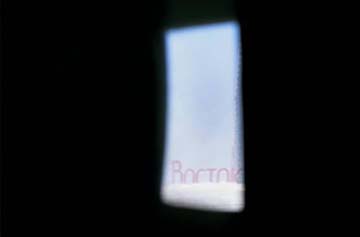
As proof of my disconnect, the photographs I took of Vostok are dismal—blurry, fragmented and boring. One exception is an abstract of the BOCTOK sign seen through a window of the plane, taken on arrival, before I’d replaced awe with an intellectual hobby.

Soon it was time to go. I loaded up silently with the departing Russians as they began their ascent into the warm latitudes. None of them had complaints. Vostok is a place of hardship, but it’s also a landscape of their choosing. Like many of us, many of them return to the ice again and again. We all go to the trouble of returning to the Antarctic out of some strange love for the human experience of this inhuman landscape. These exhausted Russians on board the Herc with me, heading north, formed a community that I had not touched. While flying back to McMurdo, my camera stayed in its case on my insulated lap.

Even as I clicked off my roll of film at Vostok, I realized I should instead have sat with their friendly cook to sip some tea, eat an egg, and slab some butter onto the local dark bread. I tried to see this strange place from the outside rather than taking the time to taste it. That was bad traveling. I bypassed Vostok, Russia, and the warm human thread stretched thin between them. I wish very much that I could go back and do it right. But even this wish is a tourist’s wish.

* * * * * *

Jason Anthony has worked off-and-on in the Antarctic since 1994. Other Antarctic essays, poetry and photographs have been published recently in The Missouri Review, Isotope, and The Seneca Review, and in the forthcoming book, “In Pieces: An Anthology of Fragmentary Writing.” He is working on a book about Antarctica and his experiences there. He currently teaches English at the Deck House School in Edgecomb, Maine.

Photo by Jason Anthony.


WEBLOG CATEGORIES

Adventure Travel
Afghanistan
Air Travel
'Airworld'
Africa
Alaska
Albania
Antarctica
Architecture and Travel
Argentina
Asia
Audio/Video
Australia
Bali
Bookstore Tourism
Belize
Ben's Place of the Week
Bhutan
Bolivia
Botswana
Brazil
Brand That Nation!
Budget Travel
Burma
California
Cambodia
Canada
Caribbean
Celebrity Travel Watch
Chile
China
Colombia
Costa Rica
Cruising
Cuba
Denmark
Czech Republic
Dominican Republic
Dubai
Eco-Travel
Ecuador
England
Egypt
El Salvador
Estonia
Ethiopia
Europe
Family Travel
Fiji
Finland
Florida
Food: The Moveable Feast
France
Geography for Fun and Profit
Germany
Georgia
Global Village
Ghana
Greece
Greenland
Guatemala
Guest Blogger: Thomas Swick
Guest Blogger: Michael Shapiro
Haiti
Hawaii
History Travel
Holland
Honduras
Hong Kong
Hot Americans on Television Botching Geography Questions
Hotels
Iceland
Icons: Ernest Hemingway
Icons: Che Guevara
Icons: Jack Kerouac
Icons: Mark Twain
In the News
India
Indonesia
Iowa
Iraq
Iran
Ireland
Islands
Israel
Italy
Jamaica
Japan
Jordan
Kenya
Kosovo
Las Vegas
Latvia
Life of a Travel Writer
Lebanon
Libya
Literary Travel
Los Angeles
London
Malaysia
Mali
Media Addict
Mexico
Moldova
Mongolia
Morocco
Moscow
Movies and Travel
Music
Nation Branding
Nepal
New Orleans
New Travel Books
New York
New Zealand
9.11.01
Nicaragua
North America
North Korea
Norway
Outdoors
Page Turner
Pakistan
Paris
Peru
Planet Theme Park
Poland
Portugal
Puerto Rico
R.I.P.
Road Trips
Romania
Russia
San Diego
San Francisco
Saudi Arabia
Scotland
Shameless Self-Promotion
Shanghai
Shrinking Planet Statistic of the Week
Singapore
Somalia
South Africa
South America
South Korea
Space Travel
Spain
Suriname
Sweden
Switzerland
Syria
Taiwan
Tanzania
Technology and Travel
Thailand
The Critics
Thomas Swick on Travel Writing
Three Great Books
Three Travel Books
Tibet
Tokyo
Top 30 Travel Books
Train Travel
Travel and Security
Travel Disease du Jour
Travel Fashion
Travel Headline of the Day
Travel Lexicon
Travel Photography
Travel-Terror Fatigue Index
Travel Tips
Travel Writer Book Tours
Tres Loco
Turkey
Ukraine
United States
Venezuela
Vietnam
Voluntourism
War and Travel
Washington D.C.
What we Loved This Week
What Would Edward Abbey Think?
Where in the World Are You?
World Hum Travel Zeitgeist
Zambia