
A Direct Impression
Travel Stories: To guide him through Tunisia, E. Casey Kittrell chose a nearly 100-year-old travelogue and discovered what it's like to travel with an observant, prescient, and, sometimes, bigoted man
01.23.06 | 10:31 AM ET
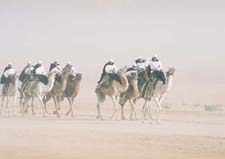 Photo by Michael Keating.
Like many people, I try to read more than guidebooks when traveling. Guidebooks are important, but they are geared to a traveler’s needs, not his wants—that is, his understanding and experience of a new place. Travelogues and works by local authors (including fiction) have opened my eyes to the subtle shades of local life that make a place memorable. Where a guidebook draws a map, literature paints a picture.
Choosing a book for a short trip to Tunisia last year was harder than I imagined. A host of legendary figures had traversed and commented on the country, from Hannibal and Homer to Ibn Battuta to Atlantic correspondent Robert Kaplan. In the end, I chose Fountains in the Sand, a 1912 account of the Tunisian Sahara by the British writer Norman Douglas.
Lawrence Durrell called “Fountains in the Sand” “one of the best portraits of North Africa,” and because Douglas had spent time in many of the same oases I planned to visit, he seemed a promising guide. He would eventually prove to be observant, even prescient, as well as bigoted. What struck me immediately, however, was his description of a fellow traveler, “a well-known French painter…an impenitent romanticist of contagious youthfulness,” who didn’t believe in knowing anything about a place before going there. “[I]t is a mistake,” Douglas quoted the artist as saying, even “to learn their language—it only leads you astray, it spoils the ‘direct impression.’” Hmmm. Traveling light is good advice for packing, but going in ignorant sounded so typically American (especially going into the Islamic world) that ugly experiences would be inevitable. I dismissed the line as an artist’s contrived attempt at inspiration.
Arriving almost a century later than Douglas, I would not see the same Tunisia that he did. I hoped, however, that his book would be a guide to what remains of Old Tunisia. The first place it led me to was Douz, site of the International Sahara Festival. The festival, now in its 39th year, celebrates the nomadic traditions of all Saharan peoples, including Tunisians. Those traditions still flourished in Douglas’ time, but today very few Tunisians live a nomadic life. Where Douglas got to see the real thing, I saw a re-creation.
It was a spectacular re-creation nonetheless. The grandstand faced a flat oval of parched brown earth, while the sky was bleached of all color. The flags of more than two dozen nations snapped in a steady west wind that blew the peaks off nearby sand dunes, bringing the desert—literally—into our laps. We shook the sand off as we stood for the Tunisian national anthem, and within moments of the last note the bleak scene before us was transformed into a circus of color, sound, and motion. Long-haired maidens whipped their raven locks in rhythm with the drums and horns of accompanying musicians. Horsemen atop brightly woven saddle blankets paraded past us, then returned at full gallop, some balanced in headstands atop their saddles. More than 50 camels and riders assembled around the perimeter of the oval. Sloughis, a kind of Arabian greyhound, showed their speed by chasing down hares. All in all, it was a lovely day at the Saharan circus. Actually, it was far better than any circus I’ve ever attended.
Douglas, though he saw them separately, in their natural contexts, records several of the festival’s traditions in “Fountains in the Sand.” He noted, for instance, that sloughis are always muzzled because “unmuzzled, they rend it [the hare] to pieces.” But it was his comments on Arab fashion that were in my mind that day. The crowd was mostly North African, and the late December wind was whipping up so much sand that it obscured the horizon and forced us to squint to keep the grit out of our eyes. It was also cold. What I needed was one of those hooded cloaks everyone seemed to be wearing: a burnoose. Douglas, however, judged them useless: “For what is the burnous save a glorified aboriginal beast-skin? [It] unfits the wearer for every pleasure and every duty of modern life. An article of everyday clothing which prevents a man from using his upper limbs, which swathes them up, like a silkworm in its cocoon—can anything more insane be imagined?” Indeed, wrapped in a burnoose one’s upper body can do little more than hug itself, but that’s exactly what I was doing as I shivered in my wool sweater. And I liked the way they looked. The low-tech design was timeless, and there was something of the desert’s mysteriousness in the way they rendered everyone shapeless, and anonymous. It was clearly the right garment for the occasion and had Douglas been sitting next to me I have no doubt, despite his critique, that he would have agreed. The burnoose, he admitted, “adds charm to the landscape…the smooth-faced youths, peering from under its coquettish folds, remind one of third-rate actresses…it befits equally well the repose of old age, crouching at some street corner in hieratic immobility. Yes, there is no denying it looks artistic…picturesque…I have bought one, and am wearing it at this very moment.”
I, too, bought a burnoose. I also continued reading Douglas. At times his insight extended all the way to the present as well as the past. Tunisians, he wrote, exhibit “considerable tolerance in matters of religion. They are the least bigoted Orientals one could wish to meet.” (Tunisia has an emphatically secular government, despite the fact that 98% of its population is Islamic.) Other times, he seemed blinded by his own bigotry: “I observe a defect in the eyes of all Arabs, namely, that they seem to be unable to utilize them as a means of conveying thoughts; they have no eye language. The best-looking youth or maiden has eyes which, beautiful as they are, might be those of a stuffed cow for all the expression they emit.”
At first it was easy to dismiss comments like the one about Arab eyes. Norman Douglas was a sardonic Old World author far from home—I expected as much. More importantly, he sketched wonderful scenes such as this description of a date grove at high noon:
“Go…to the thickest part of the grove…it must be the prick of noon, for the slanting lights of morning and eve are quite another concern; only at noon can one appreciate the incomparable effects of palm-leaf shadows. The whole garden is permeated with light that streams down from some undiscoverable source, and its rigid trunks, painted in a warm, lustreless grey, are splashed with an infinity of keen lines of darker tint, since the sunshine, percolating through myriads of sharp leaves, etches a filigree pattern upon all that lies below. You look into endless depths of forest, but there is no change in decorative design; the identical sword-pattern is forever repeated on the identical background, fading away, at last, in a silvery haze.”
When I found myself standing among the lovely palms, I was at first distracted by my guide’s astounding array of date trivia (which I meticulously noted): how this was the best year in a quarter century for Tunisian dates; how there are more than a hundred different kinds of dates; how the date palm provides centuries of service to its cultivators (more than 100 years of dates, another century or so as the wooden frame for a house); how Mohammed advised his followers to eat seven dates a day; how the harvest is always done by hand, usually by Sudanese or other black Africans…. I was also hungry. Eventually, I ate a date. And another. I ate seven in all (to satisfy the Prophet) and it was as delicious a food experience as I have had outside a restaurant. After the seventh date, I rested. Finally, I decided to take some pictures of the dates, the palms, and the Sudanese men climbing them. As I tried to adjust for the forest light, I remembered that passage from Fountains. The light, perhaps thinned by a passing cloud, was otherwise exactly as Douglas described it. I checked a watch; it was nearly noon. The slightest breeze came through the palms and the filigree patterns quivered, then stilled.
And yet for every dead-on description of a date grove or burnoose, Douglas undermined his credibility with deeply embedded ethnocentrism. He referred to Tunisians as “children,” “uncivilized,” even “savages.” I began to enjoy experiences for which I knew Douglas would have no comment, good or bad. The former Star Wars set, for instance, was a blast. But when I went to the barber and asked for a shave, my mind unconsciously returned to Douglas. I wondered if he would sit in this chair, the “savage’s” razor hovering above his vulnerable jugular. If so, how would he answer when, after the soccer match on the TV ended and, just to pass the time, the barber asked, “What do you think of Tunisia?” Would he quote the final sentence from Fountains in the Sand, a line that might incur a fatwa were it published today: “...the evils which now afflict Northern Africa, its physical abandonment, its social and economical decay, are the work of that ideal Arab, the man of Mecca. Mahomet is the desert-maker.”
Such politically incorrect language, though not unusual among colonial-era writers, may be why “Fountains in the Sand” is not better known today. Whether Douglas would see a kinder truth in today’s moral climate I don’t know. I do know travel tends to break down bigots, but it didn’t help Douglas and I have encountered plenty of bigotry and neocolonial attitudes among today’s travelers, too. Yet I also know Douglas admired the proper prejudice-free perspective in another traveler, even if he felt unable to internalize it himself. Of an acquaintance, he wrote, “He had travelled far in the Old and New Worlds; in him I recognized, once again, that simple mind of the wanderer or sailor who learns, as he goes along, to talk and think decently; who, instead of gathering fresh encumbrances on life’s journey, wisely discards even those he set out with.”
I wanted to leave my copy of “Fountains in the Sand” in Tunisia, partly because I wanted someone else to enjoy it in the place it was meant to be read. (Unfortunately, it was a library copy and I brought it home.) But mostly I wanted to leave Douglas behind because he was, even at his best, one of those “encumbrances” the wise traveler discards in favor of the French painter’s “direct impression.” Travel literature can be informative, even inspirational, but sometimes its authors are best treated as companions—ones we can eventually part from—in the journey, not as guides.
 Email to friend
 Twitter
 del.icio.us
 Digg
Digg Facebook
 Furl
Furl Ma.gnolia
 Mixx
Mixx Reddit
 StumbleUpon
 Yahoo! Buzz