
Fire in the Night
Travel Stories: In a Florida lagoon, Bill Belleville paddles among the manatees and mangroves on a quest to see the dazzling blue-green light of bioluminescence
06.25.07 | 10:53 AM ET
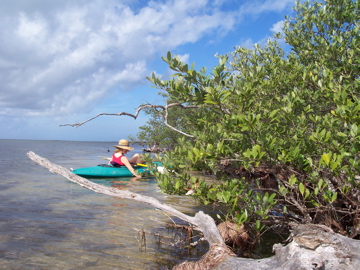 Photo by Bill Belleville.
We launch in a shallow Florida cove just before sunset, excited with the possibility of having fire rise from the water.
Clumps of turtle grass float at the surface, and black mangroves hug the shore, distinct air roots poking up under the bushes like black pencils. Bobby is in a single canoe and the rest of us—Michelle, her daughter Alex, and a few more are in kayaks. We scuttle about until everyone is ready and then we paddle out into the Haulover, an old canal that links the Mosquito Lagoon to the north with the Indian River to the south. Long legged herons and egrets hunt near the mangroves, each a study in precision.
The fire in the water we are hunting is bioluminescence, less of a burn than a dazzle of cold blue-green light. Although this happens in the night seas worldwide, it’s more realized in some places than others. In Puerto Rico, Phosphorescent Bay is named for the phenomenon. I guess it’s been taking place in this lagoon for thousands of years, but we’ve only recently caught on.
Guides will take people to such places, but I usually like to go it alone, or with a few good friends. The risks may be a bit greater, but the surprises always seem somehow more real.
I paddle out into the deeper canal and the surface around me becomes suspiciously flat, as if something immense is moving just below. My little boat wobbles gently. Within seconds, the back of a manatee materializes a few feet away, its gray, barnacled body like a gigantic sausage.
A shaggy snout gently breaks the water, human-like eyes deeply set, each inside a starburst of wrinkles. It glances at me, inhales. From inside its massive body, the air resonates as if in a cave. Then it sinks back down. I look over at Michelle, smiling broadly, without guile.
Despite its size, the coming and going of such an animal was incredibly delicate, almost like a disassembling of molecules. It could have flipped me in a heartbeat if it had wanted. I am exhilarated, and also deeply thankful I am still upright.
We paddle north where the canal meets the Mosquito Lagoon. It is twilight and the primitive landscape is golden. Men are fishing and drinking beer on the shore, many of them fried after hours of it. A really bad country music song celebrating the glories of redneck women blares from a pick-up truck. There is a small mangrove island offshore and we paddle towards it, riding a gentle evening breeze. As we go, the gray dorsels of a pod of bottlenose dolphins slice through the water nearby.
The sun vanishes and a dark cloud bank on the horizon begins to shoot out jagged spires of lightening, soundlessly. I look back to the land, now a half mile away, and see most of the fishermen packing to leave. The music shuts off and what remains is the slosh of our hulls, the cry of wading birds, the muffled sighs of anticipation.
The lagoon is encircled by public land; like the manatee, it’s a relic of what used to be. The landscape here was protected decades ago when the government bought a massive swatch of coastline to buffer its rocket launching at the Kennedy Space Center. In a strange twist, the ambitions of the future have preserved the past. Bobby, a cardiologist by day, sometimes brings his flats boat here to fish for sea trout and reds that school over the sea grasses and sandy shoals.
The cold light remains hidden and I find myself wondering if it will actually turn on tonight at all. We have brought Cyclamen sticks and we snap and hang them around our necks to keep track of each other. This seems a simple task, but I botch it and, for the moment, the lanyard tightens on my forehead. Michelle and Alex laugh good-naturedly at this.
We float in the lagoon, letting the gentle evening breeze push us. It is almost completely dark now. We are all silhouettes with light sticks, finer details lost to the night. Suddenly I hear Alex’s voice from somewhere nearby, as if announcing the arrival of a special guest: “It’s happening.”
I look over to where I know Michelle to be. As she moves her paddle through the water, it glows dim with turquoise and she lets out a long, low wow.
I turn in my seat, watching as my own blade draws up the cold light. I hear murmurs rise around me, voices slightly higher and full of wonder, and I realize everyone is doing a version of the same thing, creating light from water. The alchemy has taken time to cook, but now it has us in its grip.
We paddle back toward the canal, where marine life is more concentrated. The lagoon water under us is so clear we can see through it, can watch as the grasses on the bottom glow with the light. Small fish and then larger ones, down deep, are outlined in blue-green.
In the canal, sunken logs effervesce with color. Suddenly, the form of a massive alligator swims under us, odd, tiny arms from its body swishing the blue. It’s amazingly graceful, and, like the wading birds, its movements are precise.
Crabs drift along, glowing, sometimes bumping into my hull, hard calcium shells clanking oddly against plastic. Alex cups her hand in the water, and the liquid she holds sparkles as if electrified. In the distance, a dolphin arches out of the water, bringing a massive column of light with it.
I know, intellectually, that tiny, single-celled plankton called dinoflagellates do this, absorbing energy from the sun and releasing it to confuse predators at night, twisting and turning in the water. But that doesn’t explain the full magic of it to my senses.
Another cove splays from the canal and we paddle into it. It is shallow and loaded with great schools of mullet. When Bobby and others move far ahead they spook the mullet and the fish leap from the water in great explosions of energy like low-level skyrockets. Sometimes, in their jumps they whack into our boats; sometimes, into us. I look down, see a blue-green stingray move next to my hull, its wings undulating as if it is flying in the water.
Above, stars have filled the void over the cloud banks, and now a meteor traces a line through them. A collective murmur rises at once from us, an exhalation of natural awe. It seems as if the sky has split in two, no clear line left any more between it and the water around us. And now we have stopped being writers and doctors and whatever else we are and have become kids, alive only for this moment, in this place.
I drift some more and it vaguely occurs to me that stardust started it all, showering this earth with its energy so long ago, and now, many molecules later, here we are in a dark Florida lagoon, watching it happen all over again. Like the dinoflagellates, we twist and turn in the night, glowing blue-green ourselves, a theater of creation in the mangroves.
We are all quiet now, and, soaked with the energy of the stars, as fully conversant as we will ever be.
 Email to friend
 Twitter
 del.icio.us
 Digg
Digg Facebook
 Furl
Furl Ma.gnolia
 Mixx
Mixx Reddit
 StumbleUpon
 Yahoo! Buzz