
Letter to a Volcano
Travel Stories: Soufriere Hills Volcano may have thought it delivered a knockout blow to the Caribbean island of Montserrat, but David Wallis has news for the "Lady in the Mountain"
09.10.07 | 12:18 PM ET
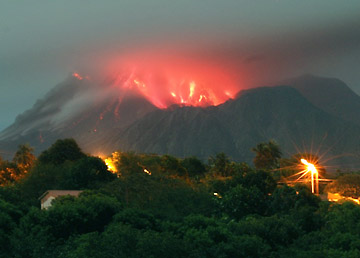 Photo: AP
Dear Soufriere Hills Volcano,
I’ve been meaning to write you since visiting Montserrat and witnessing your power.
In your homeland, some locals call you the “Lady in the Mountain,” but in recent years you’ve been behaving in a very unladylike manner. Since 1995, when you woke up in a fury after a more than 300-year-long slumber, you periodically belch clouds of dirty gray ash that leave streets, cars and houses coated in dust and difficult to clean. And, on occasion, you vomit super-hot avalanches of gas, lava and molten rocks known as pyroclastic flows. These firestorms, and resultant mudslides, scare the bejesus out of your neighbors—and no wonder; your violent outburst on June 25, 1997 killed 19 people. On a 39-square mile island, where drivers routinely beep their horns to greet friends and relatives in passing cars, those 19 deaths amounted to a tragedy of Hurricane Katrina proportions.
Do you have any idea of the damage you’ve done to this pleasant little British colony? Let me fill you in. Montserrat, a lush, hilly island located between Antigua and Guadeloupe, once had a booming economy fueled by tourism. Regular visitors ranged from cruise ship passengers on excursions to rock stars like Paul McCartney, Elton John and Eric Clapton, who recorded at the legendary Air Studios. Since your latest tantrums, far fewer tourists venture to Montserrat. You savaged the island’s main airport, and it took the Montserrat government until 2005 to open a new one. With job prospects dim and housing scarce, more than half of the island’s approximately 12,000 people fled. Air Studios is now abandoned, in part because of its location inside the “exclusionary zone”—the roughly two-thirds of the island that’s now off-limits to residents.
I met Air Studios’ owner, Sir George Martin, at his estate inside the “Safe Zone” on the northern part of the island. Aside from your destruction of his beloved studio (don’t worry about Sir George; he made a fortune producing The Beatles), he mourned the loss of Plymouth, Montserrat’s capital. He remembered the city as a “typical colonial port with a little square, whitewashed, with guns pointing out to sea, and a miniature Big Ben.” I told Sir George that I had arranged a police escort to Plymouth, and he warned me about the city’s sorry state: “It’s just as if God had a trough with cement and plopped it on Montserrat.”
You certainly made a mess of Plymouth. Even getting there proved a struggle. The rutted road and the ash clouds kicked up by the police car leading our convoy limited the speed of my four-wheel-drive taxi to about 10 mph. We had to be on the lookout for wild pigs that now run amok in the deserted area. My driver, Samuel White, had not seen Plymouth in years. For much of the hour-long trip, Samuel, who reminded me of a black Frank Gorshin, the Riddler on the “Batman” TV series, cracked jokes about his ball-busting ex-wife, but his comedy act ended at the first sight of Plymouth.
The closer we came, the more the landscape resembled a “Mad Max” set or a Dali painting drained of color. A church steeple jutting from the ground reached no higher than my head. A huge clock frozen at 12:07 was at my knees; it once told time for all the city from atop the now-buried courthouse. We put on Michael Jackson masks and got out by a ravaged Texaco station. A rotten egg odor hung in the air. Little was visible of the gas station except a red-and-white metal sign that read: “Star of the Caribbean Road.”
“If you were looking for life in Montserrat, this is the area you would have found it,” Samuel told me in hushed tones. According to his reckoning, we stood above the very taxi stand where he once waited for fares. He kept repeating, “Calamity, calamity, calamity.”
But please do not get the idea that you defeated Montserrat’s people. They have dusted themselves off, and their island is, quite literally, rising from the ashes. Businesses have relocated to the Safe Zone, plans for a new capital are progressing, and the government recently produced a revised map of the island. Tourists have started to return, often to admire you from the Montserrat Volcano Observatory . The scientists there referred to you as “the most monitored volcano in the world.”
More importantly, many in Montserrat have regained a sense of swagger. When I asked Florence Griffith Joseph, the chirpy owner of a guest house, whether you had ruined her life, she shot back, “I’m enjoying it. It’s a chance to start new things.”
A brave face? Perhaps. But paradoxical as it may seem, most of the people I met in Montserrat managed to say positive things about you. The British-appointed Governor of Montserrat, Deborah Barnes, paid tribute to the characteristic pluck of the Monserratans: “We’ve got lemons so we make lemonade.”
David Lea, formerly a chaplain at the island’s prison, credited you with increasing rainfall. “The island has never looked as green and lush,” he said. Indeed, I noticed many trees so laden with mangoes that fallen fruit rotted by the roadsides. David’s son, Sunny, charitably described you as a constructive force rather than a destructive one. “Insecurity becomes security,” he mused. “I think people realize how independent they can be, and they don’t have to know what’s going to happen the next day. I think that makes them stronger.”
Without doubt, on an island where the national newspaper runs “Today’s Scripture” on page one, you have strengthened the faith of many people. James Daley, a forest ranger and nature guide who goes by the nickname of Scriber (“at school they said I was very good at describing things”) recounted how he had finished building his house in what’s now the Exclusionary Zone just days before you started spewing. Scriber found work in England for several years, but he could not afford to bring over his wife and children. He estimated that traveling back and forth cost him more than $40,000—not to mention emotional hardship. “But you know,” Scriber said with a shrug and a smile, bushwhacking through an overgrown path of ferns and vines, “Jesus went through greater things.”
So, Madame Volcano, if you thought you had delivered a knock-out blow to this verdant Caribbean isle and its plucky inhabitants, think again. You did your damnedest, and it didn’t work. It’s now past your bedtime. Get some sleep. For at least another 300 years.
 Email to friend
 Twitter
 del.icio.us
 Digg
Digg Facebook
 Furl
Furl Ma.gnolia
 Mixx
Mixx Reddit
 StumbleUpon
 Yahoo! Buzz
William Masek 09.11.07 | 8:23 PM ET
What an amazing photo. It would be incredible to be there in person to witness that.
William Masek
http://www.letsgotraveltheworld.com
Shannon 09.14.07 | 10:50 AM ET
..It is indeed incredible to be there in person.. and after traveling via sailboat for 67 hours from St. Croix and Montserrat being the first thing that you see when you “Land Ho”, that…is quite amazing. :)
mrwiring 04.18.08 | 3:06 AM ET
it’s a good idea to avoid volcano.