RECENT DISPATCHES
8.6.08
Like Writing on Water
In western Uganda, Christopher Vourlias met Colin, a farmer and poet who questioned the purpose of life while happily revealing the meaning of nohandika ha maiise. 7.15.08My Senegalese Cousin, the Rice-Loving Pig
When the woman selling peanuts at a Samba Dia market learned the Senegalese name adopted by Katie Krueger, negotiations took an insulting turn TRAVEL BLOGWorld Hum’s Most Read: Aug. 30-Sept. 5What We Loved This Week: Jose Feliciano, Rub’ al Khali and Raw OystersDon’t Be Cruel: Traveling ‘Elvis’ Draws Attention, GroansIt’s Not Easy Being Green and Crucified
SPEAKER'S CORNER
A Tourist With a Shovel and a HoeWhen she arrived in Kenya to volunteer with the Maasai, Daniela Petrova looked down her nose at tourists there to have a good time. But was her own motivation much different? ASK ROLFHow Should I Spend My Time in Spain?Vagabonding traveler Rolf Potts answers your questions about travel Q&A
Paul Theroux: Invisible Man on a Ghost TrainJim Benning asks the author of “Ghost Train to the Eastern Star” about his new book, aging and the challenge of disappearing in the age of the BlackBerry HOW TO
Eat Ceviche in LimaGrab a Cusqueña and get comfortable. As Nicholas Gill explains, a trip to a Peruvian cevichería can be an all-day immersion in good conversation and raw seafood. BOOKS
Unsentimental Journeys: Wrestling With Paul TherouxBronwen Dickey considers “Ghost Train to the Eastern Star: 28,000 Miles in Search of the Great Railway Bazaar” AUDIO SLIDESHOWMy Travels, My FeetAfter taking one too many headless torso shots of herself, solo traveler Sophia Dembling started snapping photos of her feet around the world, from the Grand Canyon to Red Square THE LIST
Seven Reasons to Have a Foreign FlingSure, having an overseas romance is fun. But Terry Ward points out seven other benefits to cross-border love, mon petit chou. |
DISPATCH8.6.08
Like Writing on WaterIn western Uganda, Christopher Vourlias met Colin, a farmer and poet who questioned the purpose of life while happily revealing the meaning of nohandika ha maiise.
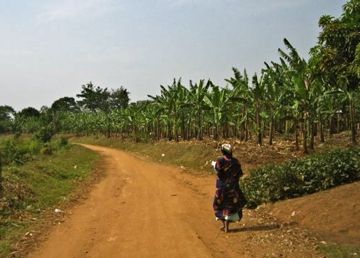
We were on Colin’s farm in western Uganda, 20 miles from Fort Portal, a languid colonial town near the Rwenzori Mountains. I’d met Colin a few days earlier, squished together in the back row of the Horizon bus from Kampala. We’d struck up a conversation on the outskirts of town, as I’d fiddled with my iPod and waited out the bumpy ride. Curious eyes followed my thumb as it whirled in circles, heads poking over seats and craning into the aisle, when the man by the window—lean, bookish, scratching at his wiry moustache—leaned toward me and cleared his throat. He asked about the storage capacity, and we soon got into a heated discussion about file-sharing and intellectual copyright law. This was not, I suspected, your typical conversation on the Horizon bus from Kampala. When we arrived in Fort Portal, he ushered me through the crush of cab drivers and helped me to my hotel. Along the way he professed his admiration for Truman Capote. He’d read “In Cold Blood” and had heard stories of the author’s legendary Black and White Ball. Soon he shyly admitted that he was something of a writer himself. We shook hands and parted warmly and made plans to meet later in the week. Fort Portal slumbers in one of Uganda’s countless backwaters. Once a busy hub for colonial administrators in the West, it now seems content to shuffle along, rubbing its eyes and looking up now and then to wonder what time the British left. It’s a lovely place, with acres of tea plantations sitting in neat parcels on the surrounding hills, and the blue-gray ridges of the Rwenzoris rising on the horizon. I had no plans for my stay—I was only passing through—and was happy to spend a few days strolling down dirt roads and waving to naked kids scooting between the banana plants. Meeting Colin gave me an excuse to stick around, and a few days after our bus ride, he was waiting for me on the steps of the public library. Colin carried copies of the day’s papers folded under his arm and a canvas shopping bag full of muffins and mango juice. We wedged ourselves onto a motorbike and puttered down the street, soon finding ourselves on a dirt road stitched through the hills. Tea plantations and coffee farms sandwiched the road, goats chewed on grass. We passed a dairy farm and Colin gestured to the plump, handsome cows flicking their tails on the hillside. “This is, I think, the best dairy farm in the district,” he said, his voice warming with appreciation. “They have very nice cows—pure Friesian. A very nice breed, from Europe.” A half-hour later we pulled up to his farm. Colin’s cows—lean, scruffy, not-at-all Friesian—buried their faces in a trough. It was a modest bungalow surrounded by bright, flowering plants; by western Ugandan standards, I knew the house suggested some small measure of wealth. Inside we sat across from each other at the kitchen table, picking at the muffins, when Colin offered to read me his poem. “Let me try to pick the least worst,” he said, again adjusting his glasses, which slid back down the bridge of his nose. Finally he leaned forward, cleared his throat and began to read. “Deception,” he said.
Colin continued to the end, sat back, awkward, smiling, lapping up my praise. Gathering confidence, he read another, and then two more. On the table were dozens of poems written in his small, neat hand. He explained he was also working on a handful of stories—even a play—and it dawned on me that Colin Kisembo was, without question, the most prolific writer I knew. But when we talked about publishing his work, he wagged his hands with disapproval. Though a friend in Kampala helped to publish a literary journal, and Colin often thought about submitting his own poems, he still hadn’t worked up the nerve. “I am afraid,” he said. “What if I am rejected?” Rejection, I offered, is part of the writing process. In all my years of writing, rejection had been one of the few constants. And while you never get used to those dismal letters and emails—or the attendant feelings of self-doubt—you learn to negotiate them as part of the landscape. “It will be an act of great courage,” he said, eager to change the subject. He opened the mango juice and passed a muffin to me and asked about my travels. We talked about my long odyssey since leaving home almost two years ago. He smiled and sighed and shook his head as I described Barcelona and Beirut, London and Damascus. Then he told me about his own journey five years ago, when he quit his job as a lawyer in Kampala to travel through Africa. He went south, through Rwanda and Tanzania, making it as far as Malawi. Soon he was low on money. He grew lonely. “It is all the same, wherever you go,” he said. Returning to Uganda, he came west to look after his father’s farm. Life here was hard. Money was scarce; often, he had to ask his sister and an elder brother for help. The neighbors were guarded, suspicious. “They see this house, and they think we must have so much money,” he said. Even years later, he had few people he could trust. He was bothered to see friends and neighbors hobbled by bitterness and petty grudges. “We have a saying: nohandika ha maiise,” he said, tapping each syllable on the tabletop. “It means ‘like writing on water.’” He laughed at this, amused and resigned. “You cannot change how people are.” Outside he showed me around the farm. It was a small plot of land; in just a few minutes we’d crossed through the brown stalks of maize, pausing to stop in the shade of a flowering tree. It was a sunny afternoon, and the heat rose from the dry grass crunching beneath our feet. “I live alone, and it makes me sad and lonely sometimes,” Colin said, shaking his head. There weren’t many guests, and when he alluded to a few fleeting romances through the years, his voice trailed off. We paused beside a small clearing paved over with concrete, where he gestured to three graves lying side by side. The names of his mother and his father and his father’s father were chiseled into gray tombstones. He stopped briefly and then stepped across the lawn, his strides short and brisk, as if the balm for his loss might be waiting somewhere across the yard. We came to his cows, thin and skittish, nuzzling against each other in the shade. He took a few light-hearted stabs at their meagerness. “I’m sure you’re used to udders that sweep the floor when the cows walk,” he suggested, though I had to admit that, as a New Yorker, I was not really used to udders at all. He patted a few of the cows with tenderness. “I watch them feed, I just ...” His voice trailed off, and his eyes grew misty. He frowned. “I feel so ... I don’t know what it is,” he said, resting a hand on his chest. We watched the cows rubbing flanks by the trough, nudging each other out of the way, then scampering off to relieve themselves against a shed. Colin smiled, sighed, shook his head. And then again, turning, leaning forward, he marched back toward the house. Inside, Colin fidgeted with the antenna on his radio. Sitting at the table each night, with the cows huddled together in their pen and the light from the paraffin lamp casting shadows on the walls, he tunes in to the BBC to hear the news from abroad. Sometimes he opens a Bible, scanning well-remembered verses for hope and consolation. Christianity, like writing, had offered a kind of companionship for him, and he was curious about my own beliefs. He asked about my soul, about salvation and the afterlife. In the story he’d begun to read to me earlier, the main character, Lazaro, was inspired by the biblical Lazarus. Did I believe my own soul would play Lazarus and rise from the grave? Scientists, he pointed out, had found that the body loses 21 grams immediately after death. Could those 21 grams be the weight of one soul? Could any of us be saved? He adjusted his glasses and looked across the room, where the half-filled cupboards and dusty bookshelves suggested a life still waiting for fulfillment. It was late in the day, and soon we’d have to head back into town. Colin stared out the window. When the silence became unbearable, he leaned forward and folded his hands on the table. “You have traveled around the world,” he said. “Is there any purpose to this? Or are we just trudging through life, waiting for time to pass?” The wind shook the banana plants outside, rustling the leaves. I wasn’t sure what to say, and soon Colin, slightly embarrassed, wagged his hands and got up from the table. We waited on the porch, insects humming over the grass, sunlight falling through the trees. Then an engine puttered up the walkway. On the back of the motorbike, with the sun dipping toward the horizon, everything was drenched, golden. The wind roared in our ears and we shouted to make ourselves heard over the noise. It was a beautiful ride. I held tightly to Colin’s waist, afraid for every bump and jolt in the road, and thought about our conversation. Nohandika ha maiise. For Colin, it was a simple life lesson on human stubbornness, on the impossibility of changing our ways. But life itself is like writing on water, each of us scribbling our stories across a tide that will bear no trace of our passing. Maybe there’s no purpose to any of this, maybe the collected heartbreaks, rejections and sorrows are all we get. But we’re still here, passing the time as best we can, and taking comfort in the people we find to share the ride.
Christopher Vourlias’s last story for World Hum was The Gift of the Nile. Photo by Christopher Vourlias.
Related on World Hum:
COMMENTSI love this piece, Chris. I felt like I was there with you, hanging with Colin. The writing on water analogy will stay with me for a long time. Love it. By on 8.6.08 at 04:24 PM
What do you maen under @nohandika ha maiise” By on 8.13.08 at 12:17 AM
gorgeous article. This is one of the things I love most about travel - the people we meet along the way and the stories they have to share. By megan on 8.15.08 at 03:02 AM
What a beautiful and poignant story. Thank you. By on 8.16.08 at 07:43 PM
Chris, that was great, moving to say the least By on 8.20.08 at 01:01 PM
Lovely story, skillfully told. Well done, Chris! By Tim Patterson on 8.23.08 at 08:11 PM
This story is not very impressive but the writing style is great. By sugo on 8.26.08 at 10:46 PM
You have a beautiful writing style Chris. I thoroughly enjoyed reading this. I would like to think that you’re wrong though. I would like to think that there is a purpose, and that we do leave an impression that is not simply washed away. By on 8.30.08 at 04:20 PM
Beautifully written piece. Love the analogy. By on 9.5.08 at 03:37 PM
ADD YOUR COMMENT
We reserve the right to remove comments with profanity, personal attacks, spam, overt advertisements or other inappropriate material.
|
Subscribe to World Hum's RSS feed.
Got a suggestion? Follow World Hum on Twitter Check out our take on the WEBLOG CATEGORIES
Adventure Travel |
||||||||||||||||||