
Manuel Noriega Slept Here
Travel Stories: In Panama, Leigh Ann Henion's self-appointed tour guide insisted she visit the home of the country's former strongman -- the same man scheduled to be released from a Florida prison next week
08.27.07 | 11:26 AM ET
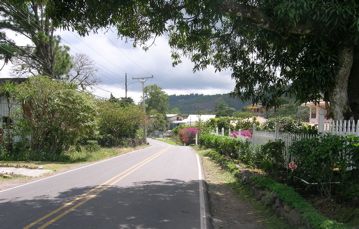 Photo by Leigh Ann Henion.
“Go home gringos!” Honey shouts as we make our way out of Boquete, Panama, headed east against the traffic toward Panama City. I have been promised a trip to one of Panama’s Pacific-side beaches and a tour of the abandoned home of Manuel Noriega, famed former CIA informant and self-appointed Panamanian military leader.
“We used to not have any traffic here; now we have so much because of the gringos,” Honey laments as she puts on oversized sunglasses that appear as round and dark as fly eyes.
“I’m not a gringo,” she adds. “All the Panamanians think I’m a Panamanian from China; they don’t know,” she says, laughing with a high cackle. She is a 50-year-old expatriate of both Korea and America who has lived in Panama, off and on, for nearly eight years.
We have known each other for only a few days, Honey and I, connected by a mutual friend from the United States. The friend described her as “fiery,” and I’m beginning to think he’d meant to say feisty. She is as sweet as her namesake, not flames and fury at all. But she is proving to be a talker who likes an audience.
When we met she declared herself my official guide to Panama. Now, she insists on taking me to see Noriega’s house because she thinks it’s one of Panama’s more intriguing spots, one that is engulfed in drama—something Honey seems to appreciate.
“When we get there you’ll feel the history all around you,” Honey tells me. “Panamanians were scared to walk the streets when Noriega was around. He was a real dictator.”
As we roll down a strip of asphalt leading to the coast, the hills of Boquete rise and fall on both sides of us and Honey points to the large “Se Vende” signs littering the road. Under Spanish lettering they read, “For Sale.” The lush beauty and strange scent of Boquete is soon behind us: the layered greens of the hills, the rank smell of the coffee plantations’ composting hulls.
We move on, completely out of sight of the mountains and past the valley, until all that is left on the horizon is the jutting tip of dormant Volcán Barú. The air streaming through the car thickens with the loss of altitude and Boquete’s pine trees are replaced with the wide, tough-leafed tropical plants of the lowlands. When the sour heat of the day finally gives way to the clean smell of sea salt, we turn right onto a narrow road.
There is no sign to direct us to Noriega’s house, and after a few minutes of driving past what look to be multi-million dollar bungalows with palm frond porch roofs and impeccable landscaping, Honey decides we are lost. We continue on anyway.
Honey starts in on the history of Noreiga’s house, glancing at me every so often to be sure I am an attentive pupil. “You know, a lot of people died the night the Americans came to get Noriega at this house we’re gonna see,” she says. “They came trying kidnap him, but he wasn’t even here.” Honey laughs at the thought of that first, botched kidnapping attempt of Noriega. That night, he had been sleeping somewhere else.
In Panama, Dec. 20, 1989, is referred to as the start of the U.S. invasion. That year, I turned an uninformed 11 years old, an age at which I thought it strange that scoundrels like Noriega made the cover of Newsweek. Back then, I thought being famous had something to do with winning. Infamous was a word that had not yet crept into my vocabulary.
Honey tells me about Panama’s civilian deaths (reports vary from hundreds to thousands) and the American troops that descended on this tiny nation and, ultimately, on the house we are searching for. Mid-story, unable to remember what President George Bush Sr. called the invasion, Honey slaps her thigh with an open palm.
“What was it?” she asks herself aloud.
When she slows to ask two Panamanian policemen directions to “where Noriega lived,” I find myself melting into the upholstery, now ashamed and embarrassed by our quest.
Honey rolls up her tinted window and turns on the air-conditioning as we drive away.
“Just Cause!” she suddenly shouts. “Bush called it Operation Just Cause.”
Moments later, we happen upon an oceanfront compound protected by a dense cement and metal wall.
“This is it,” Honey says excitedly, recognizing the spot from a visit she made years earlier.
As we get out of the car, I consider the house’s curb appeal. It looks like a scarred shell, as if it was tossed violently from the sea. It is an angular mass of cement. From behind the gate, I try to imagine it an accessory to the sordid crimes Noriega has been accused of, but I fail. Running my eyes along its rough whitewashed skin, I find myself feeling strangely sorry for it. It is a casualty of war, a corpse left behind.
I imagine Playa Blanca on the night the U.S. military came to kidnap Panama’s acting leader, a man who had once worked as an informant for them, a man they had trained themselves at the School of the Americas. I imagine shouting and the deep resounding sound of bullets fired. Most of all, I imagine the echoed screams of confused locals.
I peer through the barrier’s metal gate, and I can see that the courtyard is littered with empty plastic bottles and the sort of crumpled trash teenagers leave at night-gathering spots where they go to drink beer, smoke pot and lose their virginity back in the states. There is no indication that this was Noriega’s house, and I never would have found it if it weren’t for a Korean-American-Panamanian woman intent on showing it to me. Other than the blue stenciling on the gate warning of arrest upon entry, and the fact that it has been gutted, the house could easily be mistaken as the casualty of a tropical storm.
With a slight pout, Honey wraps her tiny hand around one of the black metal bars and laments, “Awww, you used to be able to walk around inside the house.”
I hear the clang of a metal gate closing across the road, and I turn to see a well-dressed woman with frosted blond hair walking toward the cabana-mansion beyond. This gesture confirms my belief that the policemen and Honey’s delayed instincts have in fact led us to the right site. The woman wants nothing to do with us.
Noriega has not lived in the house since at least January 1989, the month he surrendered to U.S. forces and was flown to Florida to stand trial. Convicted of drug trafficking and racketeering, his penitence was a reduced sentence of 30 years that he has been serving in an American prison. Like an expatriate experiencing immigration difficulties, Noriega is a man caught between nations. But unlike most expatriates, he is utterly feared by the population of his homeland as well as the government of his host country.
“Look there,” Honey says, pointing through the seahorse-themed wrought iron gate. I strain to examine the distant stucco wall she is circling in the air with her index finger. “Bullet holes,” she says.
Motioning toward the pocked wall of the house, she adds, “Like Noriega’s face. His nickname down here is piña face. He had bad skin, like the skin of a pineapple.”
We stand there staring at this boxy, white house on the ocean as if we are waiting for it to float away. It is hard to believe it was ever a home because of all the debris piled up in a sad moat around it. For the first time since I’ve known her, Honey is silent. It is only when an unseen dog begins to bark that she turns and bounces back toward the car, tour-guide mission accomplished.
As we get ready to leave, Honey leans into me and says, “It’s a shame this place is left empty like this. Wouldn’t this be a great place for a bed and breakfast?”
I furrow my brow and give her a what-in-the-world-are-you-thinking look.
“Why are you looking at me like that?” she demands. “People don’t go to Jerusalem because they think Jesus still lives there. It’s because he used to live there. Gringos would pay $450 a night to sleep in Noriega’s room, even if he only slept here sometimes.” I am mildly concerned that I understand her logic, and that I think the zany bed and breakfast she’s proposing might actually stand a chance.
I do not know then that somewhere in a cell at the southern tip of the United States of America, Manuel Noriega has become a born-again Christian. In my native land, behind the bars that hold him in, he has taken to a religion that dissolves borders of nationality.
When Noriega imagines heaven I wonder if it looks like a cement fortress just a few short steps away from a raging sea.
 Email to friend
 Twitter
 del.icio.us
 Digg
Digg Facebook
 Furl
Furl Ma.gnolia
 Mixx
Mixx Reddit
 StumbleUpon
 Yahoo! Buzz
Steven Lechner 08.28.07 | 12:08 PM ET
Having lived in Panama and Costa Rica for several years in the early 90’s it always amazed me the underlying affection the nationals had and apparently still have for their brutal dictator. The US armed forces who liberated Panama from Noriega are looked at with almost as much disdain. Personally now, so many decades after the fact I think we really need to condsider whether turning Noriega over to any country for further punishment makes sense in light of the fact that he was acting on our behalf as a paid gatekeeper against the drug cartels.
Matt 09.04.07 | 12:46 PM ET
Well, as long as he’s born again; that changes EVERYTHING.
It’ll be interesting to see what all the parties involved have been hiding all these years. Any ideas?
"t" 01.20.08 | 9:20 PM ET
The American government’s mode of operandie is always the same. When they are no longer in need of their “informants” or fear the intelligence of them they (the American government) declare war (disguised as Peace Keeping missions)...Vietnam, Panama ... and now Iraq.
Shame, shame ...