
Power Trip
Travel Stories: Grab your 3-D glasses! Pin that name tag to your jacket! Now get on the bus with American art student Emily Maloney for a class excursion to a Japanese nuclear plant.
09.03.02 | 10:58 PM ET
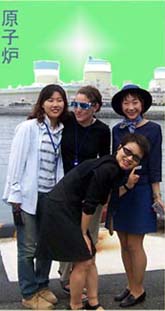 Art by Emily Maloney
I like freakish travel destinations. Also, I’m cheap. So when Naruto University, the rural Japanese school I attend, announced a free bus trip to a neighboring nuclear power plant, I thought, Damn, this could be better than last semester’s trip to the mayonnaise factory. I took out my daily planner. As I suspected it was nearly blank. I penciled in FREE NUCLEAR POWER PLANT TRIP in capitals. Then I circled it and waited.
Don’t get me wrong, I have no lifelong love affair with mayonnaise, or nuclear power, or any combination of the two for that matter. It’s just that I’m an American at a rural Japanese university, and the year is turning out to be pretty rural and, frankly, quite Japanese. I have to take my excitement where I can get it. Whether it’s cutting my hair in my dorm’s communal shower (last Friday night) or touring freakish destinations for free, I’m up for it.
When I finally board the tour bus, I am not disappointed. I receive my name tag, a free canned beverage, a pencil, and nuclear power brochures written in Japanese. I sit by my Korean friends who also enjoy a good free industrial tour. One leans over and asks, “They aren’t giving us highlighter sets?” She is serious. I say, “Wait. The tour is just beginning.” I am also serious. Sometimes you get the sets at the end.
The tour begins like any other Japanese tour around the world: with a tour guide’s description of the weather and other obvious high-pitched pleasantries over a loudspeaker. The Japanese students on the trip, the ones with actual interest in nuclear power, behave like Japanese on a tour. They promptly fall asleep. The tour guide is unscathed. Perky, even. She wonders aloud how the weather will affect our viewing of the nuclear power plant. She is hopeful for minutes about this very topic. She describes the view on the right side of the bus. My Korean friend leans over and asks blankly, “Is that woman going to talk the whole trip?” The tour guide, who has clearly heard, tugs up her white gloves, points to a hill on the left side of the bus and says, “A beautiful mountain can be seen on the left side of the bus.”
There are, however, brief pauses in the tour guide’s chatter for bathroom breaks and three mini-films about nuclear power. From the films I learn about condenser tube leaks and turbine shaft vibration. Pie charts are used. From the bathroom breaks I learn that about every other rest-stop in Japan carries mint chocolate chip ice cream in their vending machines. Old people linger by the toilets and knickknacks at every stop.
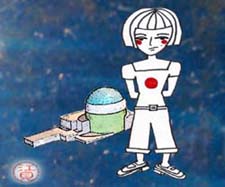 Art by Emily Maloney.
Eventually we break for lunch, which, as promised, is free. All the other foreign students, who horde their university scholarships and resent spending money on the so-called necessity of food, are happy with lunch, or rather its fundamental quality of freeness. I agree with them. I think, I just saved myself 500 yen by coming on this trip. The tour guide, once we re-board the bus, wants to talk about the deliciousness of lunch. “Wasn’t the ramen delicious?” she says over the loudspeaker. The Japanese students are already asleep again. On the last leg of the trip, those of us who are conscious are relieved when the tour guide starts the video of Japan’s Funniest Home Videos.
We arrive first at the nuclear power museum, where we receive a copy of the Yonden company annual report and a pair of 3-D glasses. I’m stoked. I immediately put them on, as do most of the foreign students. We sit through a nuclear power lecture. The tour guide tries to make the lecture fun by using colorful graphs and asking the audience to vote on how large we think the reactor vessel head is. These words are beyond my vocabulary. Sometimes, when I’m tired, I forget the word for Wednesday in Japanese.
Sometimes I forget it in English. My ignorance doesn’t prevent me from voting, though. If I have any doubt about, say, what percentage of Shikoku Island’s electricity comes from nuclear power, I just vote more than once. I am still wearing my 3-D glasses when we’re told to put them on in preparation for the movie.
The movie, which is entitled “A Flying Tour of the Yonden Nuclear Power Facility,” has a cheerful take on nuclear power. It is not at all like the one I saw in high school about Chernobyl, which was downright depressing. This movie has a talking 3-D kangaroo, and shots of the members of the friendly Yonden company “family” engaging in sports day.
I keep my glasses on for the museum tour, where it is explained to us how to get into one of those scary yellow anti-contamination suits. My Chinese friend and I lag behind the group to pose obscenely with the mannequins in gas-masks. When we reunite with the group the tour guide asks us if we were enjoying the museum on our own. My friend says yes because in our own special way we were.
By the time we finally take the bus to see the power plant in person, there has been an incredible amount of buildup. I fear a letdown. In the movies and brochures, the pictures are of the plant in cherry-blossom season with the blooms framing it in the foreground and an impossibly blue ocean behind it. While it is slightly overcast as the tour guide feared, I am still impressed. This is one mother of a freakish trip. The bus pulls over for photo opportunities, and I get out and take pictures. I hear several Japanese people use the adjective “pretty” to describe the nuclear power plant compound.
Inside the plant it is loud and hot, and because I went to public school and spent my time in the museum pretending to make out with the gas-masked mannequin, that is about all I understand. I feel briefly sorry for the nuclear power workers with their stressful yet boring jobs in their unfortunate green uniforms, and then when the Japanese science students pose for pictures in front of what looks like a big water heater decorated with cartoon characters, I go ahead and do it too. I do not, however, understand that it is a nuclear reactor vessel. Nor do I really care.
Instead, that night’s free hotel is the highlight of my tour. All of us students eat a free fish dinner worth 10,000 yen, get drunk on our own convenience-store plum sake, and then at the end of the night go downstairs to take baths. I am drunk and scrubbed once in a lifetime clean when I discover a hot bath on the balcony. My Korean friend and I soak and then, as it starts to rain, we climb up on the metal railing. We see the ocean, the Japanese urban sprawl, and finally right below our warm buck-naked bodies a cemetery crawling out of the darkness. “This was really fun,” I say, and then I wonder what the implications of that are. I guess it means I can stand a little Japanese nuclear power propaganda in the name of a free vacation. I guess, disturbingly, it also means I’m beginning to enjoy the freakish propaganda part of my free vacations.
 Email to friend
 Twitter
 del.icio.us
 Digg
Digg Facebook
 Furl
Furl Ma.gnolia
 Mixx
Mixx Reddit
 StumbleUpon
 Yahoo! Buzz