
The Places We Find Ourselves
Travel Stories: Her official title was faculty sponsor. But in the confusion of post-Katrina New Orleans, Kristin Van Tassel realized the slippery nature of the roles we all play.
05.31.06 | 6:59 AM ET
 I have no difficulty explaining, in the technical sense, how I ended up at a New Orleans’ Bourbon Street gay bar with my 21-year-old students for a midnight Drag-King show, where we watched women cross-dress and lip-sync for cash. First, there was Ambush, the gay-lesbian-bisexual weekly I’d accidentally picked up the day before instead of the standard New Orleans entertainment guide, The Gambit. Next, I recall the encouragement of Karissa, my friend living in the city, who nodded her head enthusiastically and grinned, “There’s a story for your students. You’ll see some tough girls.” And, finally, I remember I’d been the one leading the way: two blocks south on Orleans Avenue, turn left on Bourbon, up the stairs from the Bourbon Pub.
Even so, once I arrived, surrounded by techno music, strobe lights and smoky haze—beset by the spectacle of a female Trent Reznor launching into “Closer”—I felt like somewhere I’d taken a wrong turn. Theoretically, I might have gestured vaguely to my title, “faculty sponsor,” insisting I was the chaperone and this had all been in the lesson plans for the post-Katrina, January-term travel writing class I was teaching. But the truth is, my students were taking care of me, exemplified most explicitly in the “girl-save” Jerri executed in order to rescue me from the man, perhaps confused about the nature of the bar, who my students henceforth gleefully referred to as “the guy grinding the teacher.” To be sure, I’d arrived at a place I didn’t know.
New Orleans would have been disorienting at any time. It is as different from central Kansas, where I live and teach, as one can possibly imagine. The French Quarter’s slim streets and Spanish-style courtyards, along with the city’s mild, January humidity and 100-plus bars, could hardly be more different than the open, frozen plains in winter, where buying so much as a wine cooler is illegal on Sundays. Moreover, a mere four months after the flooding of Katrina, New Orleans appeared even more surreal. The Quarter, though relatively unscathed, still bore a residue of the flood in the piles of neglected refuse on every corner. In the central business district, each block showed symptoms of a massive reconstruction effort. The first floors of nearly all the multi-story buildings were gutted, or had been recently, or were about to be.
Normality was most absent in the lower Ninth Ward, where a barge that had breached the Industrial Levee sat on the nose of a small school bus among houses with roofs half slid off. Throughout the city, homes were marked with the National Guard’s large X’s, a vestige of the body-recovery efforts in the days after the flood. Scrawled in spray paint across the exterior of one house on St. Charles was the message:
“Don’t try. I’m in here with a big dog, ugly woman, shotgun, and claw hammer.”
Neither the condition of New Orleans nor the city itself, however, fully accounted for my loss of bearings. This off-campus excursion came amid the first year of my first real job, a tenure-track position at a small, liberal arts college, and I felt like I was facing a test for which I hadn’t studied. I had clearly defined objectives for my students—to find their own adventures and write about them in a city just recently reopened to tourism—but knowing what to do with myself was less obvious. The city offered plenty of options, naturally, and I had three guidebooks to see me through (the Lonely Planet, the Rough Guide and the Booklover’s Guide), but none of these addressed what I was most unsure about: how to negotiate this new terrain as a teacher of students who were not children but for whom I was responsible. What was my role, exactly, in this new territory?
My students, apparently nonplussed by the intimacy made necessary by our trip, matter-of-factly adapted, adjusting their behavior and language with the ease of the well-traveled. When they discovered, for example, that I knew almost nothing about mixed drinks, they cheerfully took it upon themselves to teach me, offering tips and instruction with the same reassuring reinforcement we typically reserve for young children learning to read or pets undergoing leash training. By day two in the city Aubrey was casually addressing me as “Kristin.” Stephanie called to check in with me sometimes, three times within an hour one evening when I was late to an agreed upon destination. Jerri, in the wake of the “girl-save,” periodically gave my wrist a little squeeze, as if to remind me that she was on hand should I need her.
These moments of role reversal were not uncomfortable, but they were odd, and it wasn’t until I encountered a Katrina refugee named Lee that I began to better understand my ambivalence. A tall man in his fifties, Lee was standing uncertainly in front of Louis Armstrong Park when he asked if he could borrow my cell phone. Lee had returned to the city that very day for the first time since he was rescued from his roof four months earlier. Between a series of unsuccessful calls to several family members, Lee recounted the night he’d awoken to find water at the level of his mattress in his Chalmette Parish home.
What struck me most about Lee, however, was the way in which his seeming disorientation couldn’t be fully explained by the flood and his temporary exile. As he thumbed through his pocket address book and glanced around him, he behaved as though he didn’t know where he was.
Lee finally reached a cousin, who promised that another cousin could provide a ride home if Lee could get from Armstrong Park to Barrone Street in the Central Business District. To my puzzlement, Lee looked not relieved but even more concerned. Assuming he was worried he’d miss his cousin, I offered to head that way too in case he needed my phone again. When we reached Canal Street, Lee stopped and stood at the corner hesitantly.
“Do you think we head this way?” he asked me.
“I’m not sure,” I said, “but here’s my map.”
Lee looked at my map a minute and then handed it back to me. “I can’t read so well.”
Suddenly realizing why Lee was reluctant to cover unfamiliar ground, I began naming the street signs aloud as we progressed block by block to the intersection of Baronne and Union.
“I can’t even read books to my three-year-old granddaughter,” he said softly, walking beside me.
“It’s not too late,” I offered. “You can still learn, just like she can.”
Lee had spent his life in New Orleans, but nonetheless, there he found himself, disoriented in a city changed, unable to translate the signs that would lead him home. I don’t know the helplessness that could come from illiteracy, nor the terror of scrambling to my roof as the floodwaters pursue me, nor the displacement of losing everything I’ve ever owned. But in talking to Lee I saw my own limitations and anxieties. The fact is, uncertainty and vulnerability are never outgrown.
The day before I left New Orleans I visited a shop on Royal Street housing spectacular Mardi Gras masks, some as big as tractor tires and priced at more than $3,000. One of the artists, Bette, showed me her work—ornate, gorgeous masks with shimmering green and black feathers, sparkling sequins and smooth satin.
“Each mask is unique,” she repeated several times. “And once I’ve made a thousand, I’ll stop. I would have reached a thousand by now if Katrina hadn’t hit.” Back in the city less than a week, she was finally returning to the mask she’d been forced to abandon in August.
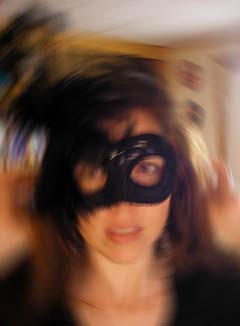
I tried on my favorite of Bette’s one-of-a-kind masks. The mask’s black plumage cascaded over one eye, its beaded trim outlining the top half of my face. As I peered at myself in the mirror, in that tiny shop on a narrow French Quarter street, I saw not an open-faced, 30-something Midwesterner, but someone less easily placed in time and place—not younger or older, exactly, but more knowing. My brown eyes were the same, though, and when I smiled, I gave myself away. It was me, after all. Familiar but strange—just as I’d felt for the past week.
Watching my masked self in the mirror, I remembered my first night in New Orleans, when I sat with Aubrey at dinner. As she stirred her gumbo in a noisy Cajun restaurant on Decatur Street, she remarked that although her graduation was but a few months away, she still didn’t feel like an adult. At the time, I’d laughed.
“You never feel like an adult,” I told her. “You keep waiting, but it never comes. Instead, one day you find yourself leading a group of students through New Orleans, hoping you don’t get everybody lost.”
As I left the Mardi Gras store, Bette’s handiwork in my bag, I realized travel has a way of showing us how close we all live to the boundaries of what we know. An unexpected storm—or a few steps beyond our education and experience—and we’re wandering aimlessly among signs that don’t always make sense. And the masks we wear—experience, familiarity, and education—cover us only partially. Our masks make us feel bolder or safer. They mark us: “teacher,” perhaps, or “adult.” Sometimes they make us feel like we know where we’re going. Even so, here we stand, our guidebooks wide open, gaping, for all the world to see, giving us away for who we are, tourists or travelers, it doesn’t matter which, in a place we are still learning to recognize.
 Email to friend
 Twitter
 del.icio.us
 Digg
Digg Facebook
 Furl
Furl Ma.gnolia
 Mixx
Mixx Reddit
 StumbleUpon
 Yahoo! Buzz