
The Truck Ride
Travel Stories: A muddy Bolivian road snagged the old Chevy, leaving Amberly Polidor stuck in the middle of the Amazon. Out there, amid the mosquitoes and the molten glass air, rescue took on new meaning.
09.17.02 | 10:57 PM ET
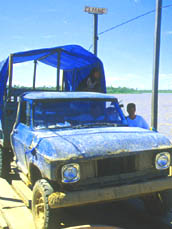 Photo by Wiley Davis.
The man sitting next to me holds a box slightly larger than his lap and about five inches deep. The flaps don’t cover the opening entirely, and inside I see something carefully wrapped in white cloth. A little girl on his opposite side reaches into the box, giggling, and pulls away the cloth to reveal two small stuffed caiman alligators. One is unnaturally posed, standing upright like a begging dog. Their eyes are cat’s eye marbles.
We are on our way to Trinidad, in the Bolivian Amazon, sitting on vinyl-covered wooden planks laid across the back of a 1974 Chevy truck that appears to have gone through as many modifications as its number of years. In addition to 14 snugly seated passengers, the truck is crammed with cargo, including a few large stereo speakers that are destined for a discotheque, I’m sure. I was told the journey would take eight hours, but the condition of the unpaved road leads me to believe that estimate should’ve been far more generous. It’s the end of the rainy season in this tropical region where the population is sparse and road maintenance is nonexistent. At least today’s parching sun means the roads can’t get any worse.
A boy seated in front of us sticks his finger in the begging alligator’s mouth and feigns injury. The man tells me he caught and stuffed the creatures himself. It occurs to me to ask how he caught them and what he plans to do with them, but I’m distracted by the rising fear that we may never reach our destination. The truck has just lodged itself in a pit of mud. Some of the men jump out with wooden hoes and start shoveling; wheels spin, mud flies, and we’re off again. The monotonous scenery—tropical trees, cows, grass, more cows—creeps by. I realize the truck’s not moving much faster than I normally walk.
Not that I’m in a mad rush to reach Trinidad. In fact, I’m currently traveling on the itinerary of my companion Wiley, who is on assignment to photograph what remains of a former Ford rubber plantation in the Brazilian state of Pará. He’s chosen to take the long and certainly less-traveled route, by land and river from La Paz, Bolivia, through the heart of Amazonia, to Fordlandia. With several months of nothing but loose travel plans ahead of me, I thought joining him would be an interesting way to pass a few weeks. In Trinidad, we’ll be boarding a riverboat for a five-day journey to the Brazilian border. But first we have to get to Trinidad.
The boy in front of me leans against his father, strokes his arm and looks up at him admiringly. Father and son are dressed alike: clean long-sleeved button-down shirts tucked into belted jeans and baseball caps. The boy’s hat says “No Fear.” Sure thing, kid, I think as the truck jolts over another huge rut and a speaker slides into my head. The boy offers me a cracker.
A man on the front bench—the one who told me we’d reach Trinidad in eight hours—sits content, sucking on a big wad of coca leaves tucked in his cheek. At the station in San Borja, where we waited on our blue tarp-covered truck, he’d offered me some leaves; it was my first time. Ignoring those junior-high school warnings against gateway drugs, I slowly added about 15 leaves to my mouth, letting them soften in my cheek. I then popped in a small chunk of ash, a catalyzing agent, and—BANG!—my saliva was numbing my tongue like novocaine and my blood was zinging. It was OK, but I thought if I were going to feel like I was at the dentist’s office, I’d prefer the laughing gas. Yet here on the truck, watching this man peacefully sway along with every jarring bump, I enviously wonder if coca is the secret to his success. Meanwhile, I’m obsessing over an airplane: the airplane that would’ve taken us directly from La Paz to Trinidad if we’d waited around a few more days.
I’m starting to lose myself in a reverie of what I’d be doing in La Paz at the moment—sipping coffee in the high Andean chill, free to stroll about and enjoy a variety of sights and sounds—when the truck lurches to a halt. The road in front of us is a vast expanse of thick mud. To our right is a bus, deeply mired. There appears to be some question as to whether to proceed along the left side, which looks especially soupy, or wait for the bus to dislodge and follow in its path with the hope of greater success. The men engage in an animated debate but ultimately decide the best course of action is simply to stand around and watch the efforts to free the bus. We’ve been on the road for six hours already, and the alligator man tells me we’ve yet to even reach our mid-way point; still, there seems to be no hurry to get moving.
Delays and discomforts are an unavoidable part of travel in developing countries. I know this. Our sufferings also add texture to the experience; they make the stories we tell our friends more interesting. But my water supply is dwindling and the truck’s plastic covering, while shielding us from the sun, is intensifying the heat and humidity inside. I’m sharing sweat with my neighbors, and even though the woman seated behind me has tossed her baby’s stinky diaper off the back of the truck, the odor remains. I remind myself, I’m not in a mad rush to reach Trinidad, but it doesn’t negate the fact that this journey is pushing me outside my generous but not infinite third-world travel comfort zone.
The father-and-son duo offer me more crackers and ask to see my South America guidebook. The father is impressed by how many pages are devoted to Bolivia. They pass the book along to an oily mustached man named Juán Carlos. “My name in inglés is John Charlie,” he informs me. John Charlie surveys the scene in front of us and cackles wildly. “The roads in the United States are just like this, eh?” His goofy grin compels me to play along with his joke despite my fading humor. “Igualitos,” I reply. Exactly the same.
 Email to friend
 Twitter
 del.icio.us
 Digg
Digg Facebook
 Furl
Furl Ma.gnolia
 Mixx
Mixx Reddit
 StumbleUpon
 Yahoo! Buzz