
Walking Off the Karakoram Highway
Travel Stories: On a winding route to Pakistan's Rama Lake, taunted and ignored, Jeffrey Tayler learns the truth of the saying, "All politics is local"
08.20.07 | 11:17 AM ET
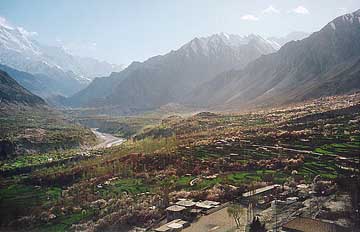 Photo by
 The road from the settlement of Jaglot, on Pakistan’s Karakoram Highway, to the village of Astore had been one long stretch of rock-strewn, slipshod track winding upward thousands of feet above the boiling, lime-green Astore river. Boulders and sun, granite walls and crumbling chasms, frigid winds and glacial torrents came crashing down from vertical heights to drum on the roof of the van in which I rode. Every time I looked out the window I had to look away, feeling fear in the soles of my feet, waves of nausea, a shortness of breath. The van was crammed with men of the local Shiite Shina tribe, among whom hooked noses, scraggly toes, turbans and Islamic beards predominated. Their features were peppered with faults—missing teeth, glaucomaed eyes, goiters, protuberant ears—and awakened a sort of primitive revulsion in me, but the revulsion seemed to be mutual. Although I had greeted them upon boarding with salam alaykum, not one responded or even looked my way—the Shina were famously hostile to Westerners.
Shina notwithstanding, I had good reason for heading to Astore: Rama Lake, supposedly a three-hour hike away. One of the most awesome sights of the Karakoram, Rama is a 10,000-foot-high oval of sapphire-colored glacial water, the very image of crystalline purity, and I had been obsessed with the idea of seeing it. After arriving, I asked the hotel receptionist, a friendly Pattan man, to find me a trekking guide (a necessity—Westerners hiking alone had disappeared in the past, possibly the victims of Shina robbers) and he told me he knew a Shina who would take me up.
The next morning I learned no trekking guide was available; but the Pattan had found me a jeep and driver. We hadn’t driven a hundred yards before we came upon a chest-high pile of gravel blocking the road up to the lake. “Not my fault,” said the guide. I gave him a few rupees and got out. Because of my schedule I couldn’t wait another day, so I would risk a walk to Rama alone.
I circumambulated the gravel and set out on the road up the valley. The sun was hot but the wind was cold, pouring down from the empyrean heights of the lake. My breath grew short from the altitude, I began sweating through my shirt. Veiled women passed by, carrying firewood on their heads. “Dadada! Dadada!” they jeered at me, imitating foreign speech. Soon I was trailed by five or six boys shouting, “Give me one pen! Where is my pen? One pen!” I ignored them. Now and then one would toss a rock that would fall astray of me.
“Sir! Sir!” a young Shina man called out to me from a promontory. The boys scattered. “Your country, sir?”
The U.S., I told him. He came running down to the road and offered to walk with me to keep the children away. Hamid was his name. He wore a clean blue shalwar qamize and sandals; his features were Shina but without blemish.
Hamid said he had just graduated from a university in the Punjab, and he had something to tell me. “Forgive me for striking your country, sir, you are my guest. But your country is doing many wrong things to my country.”
“Like what?”
“India is exploding bombs but your country is telling us not to explode ourselves. Yet explode we must, for our own security. Can you not understand?”
“I can.”
“I am a Shiite. Your country kills many Shiites.”
The higher we walked, the more Rama Lake began to feel like a fantasy. Each winding stretch of trail led up to a new plateau, a new ascent. Hamid kept up his monologue, a steady stream of facts, dates and points of history—all basically correct. “The U.S. was Pakistan’s great friend…We helped you fight the Soviets in Afghanistan…We helped Kissinger arrange his visit to China for dÃ(c)tente…China is our great friend…But your government now kills many Shiites…Your government hates Iran and turns its back on Pakistan…”
I asked him if most Shinas knew history as well as he did.
“Certainly they know the main points. For us history is local news. Muslims are our brothers in every country. My people know this. But they cannot talk to you because they know no English. They believe you hate them.”
Two hours later, a Shina in a dirty smock, leading a donkey loaded with firewood, stopped and told Hamid (he would not acknowledge my presence with so much as a glance) that from the next ascent the road onward to the lake was snowed under and impassable on foot. Hamid shrugged sympathetically at me. Then rather abruptly he wished me well and walked off toward the slopes.
I turned and began heading back to Astore. As disappointed as I was not to see the lake, I was impressed by Hamid’s talk, and I started thinking about it. He had received a university education, and this had allowed him to learn the history behind the cultural rifts between his world and the West, rifts felt on a gut level by his people. Even Astore, high in the Karakoram Mountains, had been touched by politics, presidents and secretaries of state. Despite all the cant in the West about globalization, Americanization, the information revolution, new world orders, the end of history and so on, politics remained local and people polarized. Reconciliation seemed impossible; in fact, judging by what I saw in Astore and elsewhere along the Karakoram Highway, it looked as though differences between the East and the West were growing and hostility increasing.
I neared the village and the women came out again, laughing “Dadada!” as I passed; the “one pen” children renewed their taunting assault; the men, as before, lashed their laden donkeys down the dusty roads and ignored me. Looking for geographic idylls amid a human landscape that breathed hostility in my face, I felt like a rank intruder on a selfish, even ridiculous, mission, and the image of Rama Lake lost its grip on my imagination.
I walked into the ramshackle huddle of huts that made up Astore’s center, booked a seat out on the van for Jaglot the next day, and returned to my hotel to pack.
 Email to friend
 Twitter
 del.icio.us
 Digg
Digg Facebook
 Furl
Furl Ma.gnolia
 Mixx
Mixx Reddit
 StumbleUpon
 Yahoo! Buzz
Jeffrey Tayler is a contributing editor for The Atlantic and the author of six books, including River of No Reprieve: Descending Siberia's Waterway of Exile, Death, and Destiny. His latest is Murderers in Mausoleums. His second book "Facing the Congo"
RUTH ANN DAVIS 08.21.07 | 5:04 AM ET
Jeffrey, I can relate to how the people of Pakistan treated you. I lived there one month in 2oo3. I was careful of small village people as they seemed to be very uneducated, not all but some. They are the ones who are going to taunt and ridicule a person from u.s.a. The more educated the better the treatment, although I did find some extremely poor families that were very kind in Lahore. I was lucky to have two men with me at all times and knew the areas of where I went. Otherwise my trip was fabulous and a wonderful experience. Outside the cities the land is from one extreme to another. The northern province Peshawar was very pretty in the mountains. I only stayed one night as the people were scary to me and I was afraid of my safety as tensions in that country are up and down daily. I will see that I read your other books. You must read some of Dervla Murphy’s books. She is 76 and lives in Ireland. She travel in these parts of the world in the 60-90’s. She has some pretty rough areas to conquer. Ruth Ann Davis, Tulsa, Ok
Tim Patterson 08.21.07 | 1:49 PM ET
What a terrific story. It reminds me of Rory Stewart’s instant classic “The Places in Between,” about his walk across Afghanistan. Ms. Davis - I’ll be sure to check out Dervla Murphy’s books.