
Time Traveler
Speaker's Corner: As a teenager traveling in Europe 35 year ago, Charlie Clark kept a diary. Now in his 50s and preparing for another trip abroad, he cracked open its pages, wondering whether that fumbling kid could teach him a thing or two.
06.23.06 | 4:24 PM ET
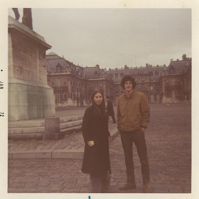 A recent chance to revisit youthful haunts in France prompted this middle-aged American to break out a personal travel diary that had been sitting in a trunk unopened for more than three decades. I wondered, could the philosophies of travel penned by a fumbling teenager be of counsel to the same guy in his world-weary 50s?
Travel diaries, of course, are a subjective mix of colorful travelogue, mundane arrangements, and lost-soul confessions. And personal styles vary. When my mother travels, she makes carefully detailed jottings every evening and then returns home to type the text up for mounting in a photo album. A high school classmate who became my first travel companion liked to record a daily voice account of his trip and then send the cassette home monthly to his parents (it was detailed enough to include such memorable lines as, “I was tired so I went to bed”). My sister, who is spending a sabbatical year in Europe, now blogs her adventures using a laptop, freely mixing daily descriptions of sightseeing with her thoughts about life’s true purpose—all to presumed ooh’s and ahh’s of a modest but far-flung Internet readership.
But face it, travel diaries can be a chore to keep regularly, given the inconvenience of finding the energy, time and artificial light. Few of us can re-create a trip with the durability of a narrative by a Mark Twain or a Gustave Flaubert, and it’s oppressive to feel that the only adventures worth experiencing are those you capture in your diary.
So, as I prepared for another week in France, the pleasing recollection of the existence of my personal account of a journey taken in 1971 piqued my curiosity: Would a modern-day reading of this long-shielded prose bring vindication or humiliation? Would it inspire me to keep another?
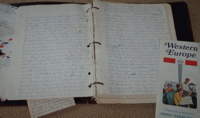 After decades in various basements, my diary survives in the form of a scuffed brown binder packed with rippled three-hole notebook paper that is crammed with handwriting in varying shades of ink written horizontally as well as sideways in margins. Accompanied by a folded color map published by the now-defunct “Esso Touring Service,” it preserves the observations of a cocky 18-year-old who, eager for a move more exotic than going directly from high school to college, spent nine months with a friend as a hippie backpacker hitchhiking through 15 countries in Europe and North Africa. The diary was mailed home in installments, with emphatic notes to my parents scribbled on envelopes, including admonishments that no one was to read the contents (a prohibition later relaxed). Though I began the trip with the discipline to mark the date for each entry, I eventually abandoned this in the name of creative freedom. (My mother went ahead and recorded the dates the installments arrived and updated our route’s progress on the map in maternal Magic Marker).
Our trip unfolded in an era when significant numbers of young Americans were beginning to interrupt their schooling to explore the Old World via its Youth Hostels, to see, as Arthur Frommer’s popular guide then had it, “Europe on Five Dollars a Day.”
The macho challenge we boys had taken on was to set foot in a slew of countries and devour an array of museums and historic sites, all on two meals a day, free or dirt-cheap lodging, and rare transport costs. Though we tried to deny any homesickness, the diary records our thrill at our periodic stops at the American Express offices, where, as travelers-check holders, we could pick up mail from home. (Today, that service is available only to cardholders.)
The diary documents our frustrations with slow hitch-hiking (on our first day at an entrance ramp we were competing with 30 other “autostoppeurs”), which occasionally forced us on to buses or trains. It records a couple of propositions from trollers of the wrong gender, our fear of theft (we asked our parents to send us money belts), and our indecision over whether, in defiance of the widespread anti-Americanism sparked by the Vietnam war, we should sew American flags on our backpacks. (Though Canadians seemed to get more rides, we finally went with Old Glory, and it often turned out to be a conversation-starter.)
As a greenhorn’s attempt at journalism, my diary remarks on some notable events, such as our viewing of Soviet leader Leonid Brezhnev in his limo in Paris, and a sighting of Pakistani President Ali Bhutto in a motorcade in Rabat, Morocco. Of more relevance to my generation was our witnessing in Montreux, Switzerland, the December 1971 fire at a Frank Zappa concert that was later immortalized in the Deep Purple song “Smoke on the Water.” Also detailed was my visit to the grave of rock singer Jim Morrison of the Doors in the Pere Lachaise cemetery in Paris. It prompted me to become one of the first to write of the pilgrimages being made by French and American fans who covered nearby graves with graffiti and relics. (It was the first article I ever sold, for $10, to the Washington Daily News.)
Boy, were we travelers serious. I read books entirely in French (not only Camus, but also the “Diary of Anne Frank” and “Wuthering Heights”). I fulfilled a longtime desire to visit a French school’s English class, and I read the New Testament to decode all the Renaissance art I was encountering. When our parents came over for a week, however, our feelings were mixed. Though we warmed to their taste in haute cuisine, their fancy lectures on Hemingway and El Greco made us feel like spoiled, detached Americans. “We’re picking up a lot of French, but we’re also here to get away from educational pressures,” I wrote. In retrospect, I wish we’d met more American women and partied.
Was the writing any good? I showed some eye for detail when I wrote of the Spanish coastal town of Peniscola, a rocky fishing village where the women sew nets and the citizenry parades down to the returning boats to help “sort all the squid, skates, sharks, lobsters and fish.” I also showed a wiseacre’s attitude: “I changed into dry clothes and took a hot shower—but not in that order.” But there were plenty of clunkers: “Notre Dame Cathedral really is a point of interest,” I declaimed.
After nine months on the road, during a week of depressing rain in Ireland, I was ready to tell the diary of homesickness so intense “you feel like your soul is hanging on the floor like spilled guts.” I wrote my parents a date for flying home and ended the treatise with a “graduation summary” about my decision to take a year off to learn that “the beauty in life can only be seen with some effort.”
The emotional task of re-reading this document led to at least three observations. Travel diaries are a handy source of examined detail about one’s own practical habits and style of making arrangements to travel, details that can be compared with one’s parallel tendencies in later life. Second, like an insect preserved in amber, a diary motivated by the daily thrill of a finite voyage contains vivid clues to one’s personality and state of mind at a given age. And third, a diary read years later can inspire pride in one’s earlier accomplishments—if one is willing to stomach the humiliation of the inevitable accompanying triteness.
In 2005, as I boarded the Air France flight from Washington Dulles Airport to cross the Atlantic once again, I was ready to rule on whether to keep a new diary and anticipate the joy of perhaps re-reading it when I’m in my 80s. Nah, I decided, I nailed this Europe story the first time around.
Top photo: The author and Jo-Ann Kwass, 35 years ago, at Versailles. Bottom photo: Charlie Clark’s journal.
 Email to friend
 Twitter
 del.icio.us
 Digg
Digg Facebook
 Furl
Furl Ma.gnolia
 Mixx
Mixx Reddit
 StumbleUpon
 Yahoo! Buzz