
Following Chekhov to ‘Hell’
Travel Stories: On Sakhalin Island, Robert Reid communes with the world's first "Gulag tourist"
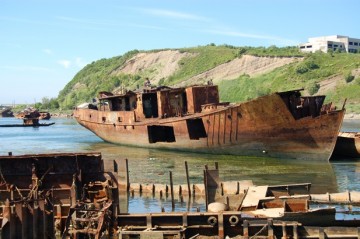 Photo by
 The bus bounced past dust-caked brush and trees for an hour and finally reached Aleksandrovsk’s sprawl of Soviet-era housing surrounded by shoulder-high weeds in a mountain-backed valley leading in wide, descending steps to the Tatar Strait coast. A sense of depression outweighed the natural beauty. Staring out my bus window, I spied a brick warehouse with freshly painted lettering (“USSR 1939”), and five scary guys (four shirtless) drinking beer by a Lenin statue, at the spot the jail had stood until 1904. When the bus parked, I realized I was the last on. The driver, seeing my reluctance to exit, guessed “American?” and offered to take me to the hotel—back by the topless drinkers. Inside a plain official building, I found a woman watching an action film on TV who checked me into a simple room with box springs for a mattress. Leaving me, she dryly announced, “Our town has no restaurants or bars.” Maybe this is hell.
Siberia and the Russian Far East are filled with dying towns like these—so-called “lost cities” as Fiona Hill and Clifford Gaddy call them in their damning book, “The Siberian Curse.” During Soviet times, the forcibly growing populace out here (spurred on by patriotic initiatives, and Gulags) required heavy subsidization to survive, and once Moscow’s funding stopped after the USSR’s fall, a rushed exodus and slow decay began. Visiting a place like this almost feels like time travel to the Brezhnev era. Just that the party’s clearly over.
After a short nap I looked out my room window and saw that a crew of grandmothers selling cucumbers and flowers had taken the sidewalks from the drunks, so I ventured out. A few peeling billboards stood nearby; the smallest told of Chekhov’s visit, others celebrated World War II. The central theater had a disco night scheduled, but no showings of “The Seagull.” I crossed a narrow plank bridge over giant water pipes and took steep steps down toward “Chekhov St,” a tree-lined road with a replica of the wood cottage where the writer stayed, now a museum.
The lone employee, Raisa, led me on a brisk tour of the just-mopped four rooms, pointing out a few photos of prisoners shackled to wheelbarrows and Chekhov’s desk. I asked what Raisa’s favorite Chekhov story was. “Oh, I’ve never read him.”
I had time to burn till the next night’s train, so I wandered about the town of 16,000. Across from the museum stood a sad Chekhov statue surrounded by cigarette butts. I wandered up a nearby bluff for a view of a mile of coastline littered with gutted warehouses and collapsing piers, then ventured back through town, over a Soviet pedestrian bridge on the Duyka River (where Chekhov met a 71-year-old hunchback ferryman called “Good-looking Can’t-remember-my-relations”) and peeked at plastic sandals and toilet parts at a dead-quiet Chinese market. Occasionally a Lada kicked up dust on the streets. Most passersby ignored the unusual presence of a foreigner. One gray-haired woman stopped to chat a bit, asking “Aren’t there more Russians than Americans in New York City?”
The next morning I met Anatoli, a plump 40-something native overseeing a flooring project in my hotel building. He couldn’t imagine why I had come. “It used to be so clean here! All the factories were working, then perestroika”—he spit it out like a bad word—“now, nothing.” I asked about Chekhov. “I don’t like him. He wrote about vulgar things, like prostitution. He didn’t think about the revolution.”
Still, I asked about seeing a lighthouse mentioned in “Sakhalin Island,” a popular retreat to break from the island’s unbearable ennui, and he offered to show me how to get there. We hopped into his Landcruiser and took a dirt road a mile to a gross coal-loading dock on a long stone beach backed by cliffs. He pointed toward a tunnel another mile away, then drove off. I was alone, but for a couple boys swimming offshore. I started walking, a bit uncertainly, down the coast till I reached a dead end: Waves slammed into a rocky outcrop blocking further passage, about 500 feet short of the tunnel.
I stuck a stick in the rocks at the shoreline to gauge if the tide was receding. After an hour, nothing had changed. A mom and her young son came, shook their heads at me, and walked back. It looked bleak, but I had to try. Aleksandrovsk had gotten under my skin a bit, and I hoped the lighthouse views might revive me. I kicked off my shoes and eased into the numbing temperatures, moving over jagged sea-floor stones towards the tunnel to the unseen paradise. But after a few painful steps, a couple brain-sized boulders tumbled off the cliffs and splashed next to me. I returned to my shoes.
But maybe it was appropriate. To fail here. Chekhov’s wide-eyed characters always ramble on about things they’ll never do. And if Chekhov had found peace at the lighthouse in 1890, it wasn’t everlasting. Sitting on the lighthouse bench, he had concluded, “If I were a convict, I would try to escape ... no matter what.”
Back at the hotel, Anatoli rocked unapologetically with laughter over my tidal misadventure and offered a seat to talk about European soccer, oil and family life. Anything but Chekhov. I guess just because a town has a hard time looking far ahead doesn’t mean it has to look back.
 Email to friend
 Twitter
 del.icio.us
 Digg
Digg Facebook
 Furl
Furl Ma.gnolia
 Mixx
Mixx Reddit
 StumbleUpon
 Yahoo! Buzz