
Paying Respect to Buddha in Boston
Travel Stories: At a Boston park, Shelley Miller learned that a little Cantonese will go a long way
03.03.10 | 10:11 AM ET
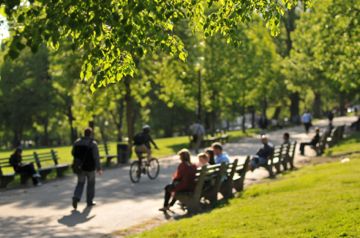 Boston Commons Public Gardens (iStockPhoto)
On my final day in Boston I walked down a cobblestone sidewalk at 6 a.m. and I was hungry. Not the kind of hunger someone feels in the stomach, but a desire. A yearning. During the past two days my family and I had walked the Freedom Trail, toured Paul Revere’s House, paid our respects at Sam Adams’ grave site, and ridden on a World War II amphibious vehicle called a Duck. The tours taught us a bit of history and made us laugh, yet I was famished, craving something more.
I decided to stroll through Boston Commons Public Gardens, with its leafy trees and undulating lawn. The August air was cooler and somehow fresher as I wandered past a black walnut tree and beneath the canopy of a sugar maple. White trumpet swans floated across a pond.
Around a corner I spotted four Asian women approaching a bench. They placed newspapers on it and settled their petite frames onto the paper. I recognized the sing-song sound of Cantonese, and offered a respectful smile. One of them looked me in the eyes. She patted the empty space next to her—the international sign for “this seat is for you.” What else could I do? I sat.
I looked over at my new acquaintances. We giggled—I was dressed in khaki shorts and a Padres baseball cap, and they wore polyester pants and mismatched tops. I thought of the child’s game, “Which one of these doesn’t belong?” I suddenly didn’t know what to do with my legs; my arms searched to find a natural position.
Then I said, “Ne ho ma?” How are you?
Their eyes widened and they raised their eyebrows, surprised that someone who would have been a gweilo (foreign devil) in their native country could speak their language. Then they laughed and showed their crooked teeth.
“I lived in Hong Kong,” I said in English.
“When you live there?” the leader asked in English with typical stern parlance.
“1986 to 1988.”
“Ohhh.” She translated the information for her friends.
“Are you from China?” I asked her.
“Guangzhou.”
“Ohhh, Guangzhou,” I nodded. I’d visited her hometown.
“Where you live?” the leader commanded—Cantonese language always sounds like an edict.
“California.”
All my bench friends understood.
“Sik zaw fahn may-a?” I asked. It was a Chinese greeting that literally means, Have you had your rice?
They giggled. We were pleased with ourselves. Five grown women, happy to make an unexpected friend.
I was running out of Cantonese phrases. All I had left was, “Tai gwai!” Too expensive! But that didn’t seem appropriate. We just sat together, friends on a bench, listening to the coo of a morning dove.
I asked, “Do you do tai chi?”
My friend in the flowered shirt said, “Tai chi. Yes, tai chi.”
With that, they jumped off the bench. So I jumped too.
We stood in two lines. Flowered shirt motioned for me to move back a little and straighten my row. I obeyed. And then I did something I had never done during my two years in Hong Kong: I joined a group of locals in morning exercise.
We stood with feet shoulder-width apart, turned our right feet out and shifted our weight to our right legs. In slow motion, we moved our left feet forward. We raised both arms to shoulder height, faced our palms towards our bodies, one crossed over the other. I think the position is called “Pay Respect to Buddha.”
I tried to mirror my tai chi master and felt as self-conscious as a football player performing ballet. But delight trumped insecurity, and I let myself go. We returned our feet to our starting position. She breathed in. I breathed in. She exhaled. I exhaled. With the grace of a cloud she lifted her left arm upwards, bent her elbow and held it across her body at chest height, palm down. She tucked her right arm underneath, leaving room for an imaginary ball between her hands. We carried the ball to the right. And then to the left. It was like we were waltzing.
Without warning I realized that the hunger I’d experienced earlier had subsided. I felt satisfied—sated by this human connection, something that was missing from the tours of the past couple days. I realized that for me, as it is for many, travel is as much about people as it is about sights, and making a human connection heightens the experience.
Our measured methodical movements continued for 10 minutes and then my friends returned to the bench and gathered up their newspapers. We said our goodbyes, but first I thanked my teacher.
“M’goy,” I smiled. She nodded. They walked off towards the bridge, and I headed back to my hotel.
 Email to friend
 Twitter
 del.icio.us
 Digg
Digg Facebook
 Furl
Furl Ma.gnolia
 Mixx
Mixx Reddit
 StumbleUpon
 Yahoo! Buzz
Travel-Writers-Exchange.com 03.04.10 | 11:12 AM ET
It’s amazing what you can find in your backyard. Some people feel traveling to distance places will give them the experience they’re looking for. In fact, the experience they’re looking for is probably in their backyard. America is a melting pot. All you have to do is look and you’ll discover treasures around every corner.
Levinson Axelrod 03.11.10 | 3:22 PM ET
Very interesting conversation. Enjoyed reading this article very much.