
Saying Goodbye in the Sierra Madre
Travel Stories: Jeff Biggers was living among the Tarahumara in Mexico's Copper Canyon when he was invited to a funeral for a local woman. Amid the sorrow and song, he peeked at "the other side."
The service at the mission lingered for hours. It appeared as if the village couldn’t bear to part with the young woman. When it started to drizzle, everyone hovered by the towering wood doors, as if they had received a slight reprieve.
About halfway through the service, I entered the mission, took off my hat, and chose a spot on the men’s side of the sanctuary. I spotted my companion Carla sitting in a quilt of women on the right. The Mexican carpenter was finishing the rosary. Haggard and long faces rejoined in groans. The fiddler and guitar players slumped in the one pew to the side of the altar, barely able to pull themselves together to play a pascol song at the carpenter’s urging. The young woman’s husband, a close cousin of the guitar player, wept by his side.
Then I caught Cornelio’s eye. Or rather, he picked up on my appearance in the mission. A grin rippled across his crooked face and propelled him from his kneeling stance.
“Pancho,” he screamed. “Country, country, we need some country!”
I tried to flee, but it was too late. Cornelio snagged my arm, chiding me for leaving my banjo at the cabin.
“Get it,” he shouted.
I felt like running away. Instead I saw the guitar player who waved me on.
By the time I returned, the distraught villagers flanked the procession led by the carpenter, the desperate young husband clutching a blaring boom box. A band of guitar players, a fiddler and soon my banjo straggled along, attempting to play a ranchera love song. Splashing through puddles, we swept the mission plaza with our shuffle and marched around the corn fields and then slowly made it across the arroyo. The procession reached the cemetery rock walls, with the carpenter and sober adults and children in front, fracturing into multiple ceremonies.
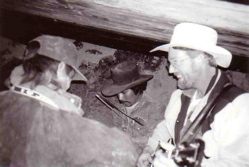 We marched up and down the graveyard, which had more tequila bottles than headstones. Some of the bereaved stumbled onto graves and even fell atop the coffin when we arrived at the young woman’s burial ground. We received our cue to crank up the tunes. Martin, the lead guitar player, nodded for me to follow. We didn’t manage to play more than a couple of cumbias, all out of tune, the dazed husband singing verses from other songs, still clutching at his boom box.
There was more than one burial ritual taking place. An elder called out orders in Raramuri while the coffin was being prepared. The Mexican carpenter and several others continued to recite prayers and the rosary in Spanish. The fiesta for the dead spirits bantered around the edge of the crowd in laughter and song.
While the elder intoned a speech, family members opened the coffin one more time. Two women wailed and clutched the body, while a younger cousin stuffed in additional clothes, a bottle of Coke, and a package of cookies. The coffin had already been stockpiled with specific portions of corn, beans and tortillas.
An aunt suddenly collapsed, overcome by the booze, a sleepless night on a bus from Ciudad Juarez, and the tragedy of the death. A few turned and watched her crumple onto the ground. Within a short time, a couple of teachers from the local boarding school were fanning her, holding her legs in the air.
The elder then led family members in a circular ritual procession, sprinkling drops of esquiate, a roasted corn mixture, and Coke and bottled fruit juices on the coffin and themselves, in order to satisfy death and ward off evil spirits. As the coffin was finally lowered, children pitched four handfuls of mud onto the grave.
After a moment of silence, people veered off to the rock walls, supporting each other’s stumbles. I wandered toward Alfonzo and Cornelio and a couple of other men. They all possessed the weary looks of sorrow and deprivation. They passed around an unmarked bottle.
“I’m happy you are with us in these moments,” Alfonzo said.
“One more song,” Cornelio bellowed.
I smiled and kept the banjo slung on my back. Alfonzo raised his hand again as if to make a pronouncement. “We, Raramuri,” he said, “have a hard life.” He couldn’t hold back the tears. His voice had long since broken, his lower lip quivering. “I have been on the other side,” he said, “but we Raramuri…” He unraveled, weeping, as another man comforted him, offering him the bottle.
I stood quietly, watching him, trying to understand what he wanted to say. His allusion to “the other side,” I assumed, referred to the United States. Within a couple of minutes, Alfonzo tried again to speak, but he was too upset, and shook his head and walked away.
Cornelio staggered over and leaned against my shoulder for support, grinning his riddled grin, and quietly said, “Pancho, we’re all leaving for the other side one day.”
 Email to friend
 Twitter
 del.icio.us
 Digg
Digg Facebook
 Furl
Furl Ma.gnolia
 Mixx
Mixx Reddit
 StumbleUpon
 Yahoo! Buzz