
Unlocking Beirut
Travel Stories: When Catherine Watson left Lebanon's capital city in the 1960s, she carried home the key to her former apartment. Forty years later, she returned with her prized souvenir and found it could still open doors.
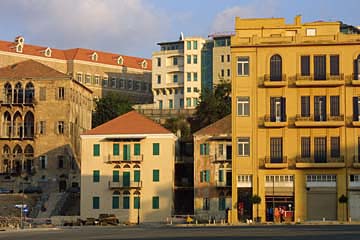 Photo by Catherine Watson
Beirut always wore summer colors—newer buildings in blazing white, older ones in the warm weathered yellows of provincial France, the country’s former colonial master. Our apartment was on the ground floor of one of the old yellow buildings. It belonged to a woman whose family owned a jam and jelly factory and who was going to Europe for the summer; her son let us have the place cheap.
The apartment had inlaid tile floors, a dining-room table that could accommodate all of us, a decent kitchen (we learned to enter it slowly and loudly at night, to give the cockroaches a chance to hide), and a living room furnished with comfortable old club chairs and a gray daybed. The other women claimed the bedrooms, and I camped on the daybed when I wasn’t at the dig.
I was helping to exacavate the kind of hill that Arabic labels a tell—a flat-topped, man-made hill, as opposed to a jebel—a natural, roundish, God-made hill. Tells look like layer cakes when you slice into them, each layer a mud-brick town: they get older the farther down you dig.
For a few hours each morning and fewer in the afternoon, I stood with the director on top of the tell and watched a line of women—farmers’ wives and daughters dressed, despite the heat, in heavy skirts and long-sleeved sweaters—filing down into a wide pit and filing back out again. They were hauling dirt.
Each carried a black rubber basket made out of an old tire. One by one, at the bottom of the pit, they went up to the local men who were doing the actual digging, held out their baskets and received a shovelful of earth.
Then they hoisted the black baskets onto their heads and swayed up and out of the pit and over to a refuse tip, dumped out the dirt and started back down again. It was stately—classic, even. And very, very slow.
It had taken 10 years of digging to get down to where the Iron Age met the Bronze. The director figured it would take another 10 before he got through the last of the villages below.
“Give me a dozen American graduate students,” I muttered patriotically into my journal, “and I could knock this thing off in a couple of summers.”
Occasionally, I was allowed to jump down into the pit and dig too. Somewhere in an A.U.B. storeroom, there is a clay oven in a cardboard box that my hands lifted free from its grave.
And somewhere, I suppose, is the time-fractured pot I was assigned to glue back together, shard by shard. Gradually, its shape emerged, and I realized it was an amphora, a tapered jar that would have stood about four feet tall. All I had managed to reassemble was its rounded shoulder and part of the neck. It had taken me a month.
“I cannot do this,” I finally admitted to my journal. “I cannot spend my life doing this.”
The problem was, I didn’t know what else to spend it on, and I felt bereft and scared. Years would pass before I realized that the summer hadn’t been a failure—before I saw that it had done exactly what it should have, turning me away from archaeology and onto a path that was a better fit.
These were the summer’s real lessons: That no path is permanent. That roads, however chosen, always lead somewhere. That sometimes the hardest lessons stick the best. And that sometimes—if you live—you get a second chance. By the time I understood all that, Beirut would need those lessons, too.
When work ended on Friday afternoons, I flagged down one of the old Blue Bird school buses that were Lebanon’s Greyhounds and rode south through the Bekaa, up over the coastal mountains and down into Beirut.
If I got a seat on the left side of the bus, there was always a moment when the road curved around a last shoulder, and I could see the hazy city, with the blue Mediterranean beyond, flowing out into the distance like a land of dreams.
The bus took me to the Bourj, the heart of downtown. Trams, buses, taxis, people—everything in the city started or ended there. The streets were a permanent State Fair, and the busiest were the awning-shaded souks, Beirut’s equivalent of Istanbul’s Grand Bazaar.
You could get anything in the souks, from baklava to brassieres. I was drawn to the Arabian Nights stuff: Daggers, curved and jeweled and harmlessly dull. Gaudy, gilded sandals, glittering with rhinestones. Hammered brass trays and thimble-sized coffee cups. Tables and chairs inlaid with mother-of-pearl. And Lebanon’s trademark silverware, its black handles carved in the shape of resting nightingales.
The crowds were just as varied. On any afternoon, I’d encounter peasant women in jet-black robes that left only their hands and faces bare; old farmers with long moustaches and baggy Ottoman-style breeches; impeccable businessmen in French-cut suits, striding between office buildings, and city women as elegantly dressed and coifed as any on the Champs-Elysees.
There were other differences, of course—dangerous ones that didn’t meet the eye. More than a dozen religions were afoot in those crowds, and the tensions between them had already triggered conflicts. But on summer afternoons in the human whirlpool of the Bourj, real war seemed unimaginable.
From downtown, I caught the little tram that ran west along Rue Bliss—named for a person, not my state of mind—to the Moorish arch of A.U.B.‘s main gate. Then I walked a few blocks along Jeanne d’Arc to a candy store called Chantilly, ducked around it into a dead-end alley, stepped into our tiny front garden, put the key in the lock and let myself in. It always felt like coming home.
As archaeology faded, my summer took on an end-of-the-world recklessness, something Beirut knew how to cater to. What I liked best were the evenings at our apartment—long salon-like evenings when it seemed as if every person we’d met in Lebanon would drop by for beer and Chantilly chocolate, cigarettes and conversation.
We attracted American expatriates and teachers from the international schools, A.U.B. medical students, people we’d interviewed and a lot of young Lebanese guys irresistibly drawn to this nest of Minnesota girls.
We were only college kids in wash-and-wear dresses, but those evenings made me feel glamorous and sought-after. They allowed me to think I knew Beirut, and that Beirut had nothing better to do that summer than shine its spotlight right on us.
All this sounds silly now: Beirut was a big city, more than a million even then, and we knew only a tiny corner of it. But that corner felt open and free and safe. It was my first real taste of adult life. I felt intensely alive, and something different happened every day.
One day it was simply a cloud in the sky—an event so rare in a Beirut summer that one of our new friends came over to make sure we didn’t miss it.
Another day it was the U.S. Navy’s entire Sixth Fleet, stopping by on a training mission. The embassy sent out messages to all the young American women in town, encouraging us to date sailors and help keep them out of trouble.
There were so many uniforms ashore that the streets near the port looked like rivers of white. We dated them in groups. By the end of fleet week, one of my roommates had been out with 23 sailors; I’d been out with 18. But—in the classic phrase of the time—nothing happened. It was 1963, after all, and the sexual revolution hadn’t arrived. None of us slept with anybody.
My most intimate moment, in fact, came when one sailor showed me the last letter he’d gotten from his girlfriend. I had not known until then that nations are defended—and torn apart—by armies of homesick boys. I learned it earlier in Beirut than I would have at home: The Six-Day War would not happen for another four years; Vietnam was lurking in the future, and Beirut’s long self-destruction would not begin until the Vietnam War was over.
The guy I fell in love with that summer wasn’t among the sailors. Bob was a student from Northwestern, making up a chemistry class at A.U.B. He had black hair and hazel eyes so light that they shone like gold when the sun hit them.
He had grown up in Saudi Arabia, in the sheltered enclaves of Aramco, the Arab-American Oil Company—exactly the kind of ex-pat upbringing I envied. Every time I saw him, my heart turned over. I never knew if his did, but Bob took to dropping by the apartment too, and I spent my weekends trying to be fascinating.
My journal devotes an embarrassing amount of space to the details of this romance—going to downtown discos together, sharing hamburgers at an A.U.B. hangout called Uncle Sam’s, our failed attempt to smuggle Marlboros out of the free port, sunbathing on the stony campus beach. One night we skipped through the marble halls of the grand Phoenicia Hotel, holding hands. And once, by our apartment’s front door, he kissed me goodnight.
Bob left Beirut before I did, and I went down to the airport with a farewell bottle of champagne and talked a Middle East Airlines flight attendant into taking it to him on board. Just before the passenger door closed for take-off, Bob leaned out and waved goodbye. I never saw him again.
When the rest of us scattered for home, I took my Beirut house-key with me, more as talisman than souvenir. Someday, I promised myself, someday when I had my life figured out, I’d go back, find my old apartment, unlock the door as if I still lived there, hand the key to the startled residents and say thanks.
For years afterward, when the Minnesota winter finally broke and real spring warmed the air at home, there would be a night when I stepped outside and felt the soft, sweet air of Beirut swirl around me again, and I would grieve for the city, missing it, unable to find a way back.
By the time I’d finished a degree in journalism, gotten a job at a newspaper and could afford to return, Lebanon was in the middle of its civil war. When the fighting finally stopped, 15 years later, the heart of the city had been devastated, and it seemed too late.
Then, early in 2003, some from my old student group got serious about an anniversary reunion in Lebanon. It still seemed dangerous, but we were running out of time. “The way I see it,” one man said, making the clinching argument, “it’s never going to be safe.”
We went back that June. As I’d always intended, I retrieved the apartment key from my jewel box and took it with me.
 Email to friend
 Twitter
 del.icio.us
 Digg
Digg Facebook
 Furl
Furl Ma.gnolia
 Mixx
Mixx Reddit
 StumbleUpon
 Yahoo! Buzz
Didi 12.21.08 | 4:36 PM ET
Beautiful article!
Jillian 12.02.09 | 2:26 PM ET
What a beautiful piece. I’m about to make my first trip to Beirut this weekend and have been eating up as much travel writing about the city as I can…but this is by far the most beautiful and personal piece I’ve found. Thank you for writing it.