
How to Wear a Sari in India
How To: It's not as complicated as it might appear. Anita Rao Kashi reveals what it takes to get the elegant traditional Indian dress just right -- and to get the right one for you.
11.08.07 | 10:43 AM ET
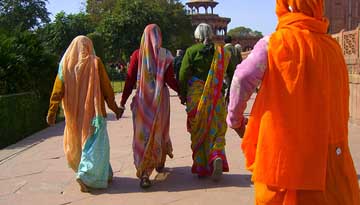 The situation: You’ve just set foot in India and are overwhelmed by the sights, sounds and smells. Among the things that mesmerize you: the dress worn by Indian women, the sari. A combination of wrap and pleat with a loose end over one shoulder, the sari is at once fascinating, seemingly complicated and elegant. If you’re a woman, it’s something you’d like to wear to get a true taste of India. Don’t worry about offending anyone. Foreigners wearing a sari won’t raise a local’s eyebrow, except maybe in pleasant surprise.
The basics: The sari dates back a few millennia. It’s an unstitched garment, but it requires two stitched accessories: a petticoat, which is actually a straight skirt that reaches the ankles, preferably in a color that suits the sari, and secondly a tight blouse which reaches just above the waist and matches the sari. A sari is usually about 10 times as long as it is wide. Of the two ends, one is more ornate. It’s called the pallu.
Choosing a sari: A special occasion like a wedding, festival, feast or commemorative event merits a silk sari. For home, it’s usually a cotton or synthetic sari. For work, it could be a combination of these.
Different regions are known for different types of saris. Kanjeevaram, Dharmavaram, Pochampalli and Mysore are all traditional silk sari varieties from the south, while Benaras, Lucknow, Bengal and Tussar are some of the silk varieties from the north. Many of the styles have been adapted for synthetic and cotton saris, too.
Shops such as Kala Niketan and Roopkala in Mumbai, Kumaran Silks and Nalli in Chennai and Deepam and Vijayalakshmi in Bangalore offer a wide variety of saris, from cottons to chiffons and silks. For long lasting silks, branded shops are a good choice because they guarantee the silk and zari (intricate work using gold and silver thread) used in the borders. The more reputable ones will even exchange the sari if the color fades, the border loses its luster or the sari crumples after a wash.
A synthetic (nylon, terrycot, polycot) sari can cost as little as $2.50, while a simple cotton sari runs about $9. A good silk sari sells for about $60. Delicate cotton saris with exquisite embroidery and embellishments can sell for as much as $375, while some silk saris are worth upwards of $12,500. Selection of a sari depends on personal taste, budget and aesthetics.
Put it on: There are more than 80 recorded ways to wear a sari. The most common: Drape the pallu across the chest and hang it behind your left shoulder. In some tribal communities, it is worn exactly the opposite, with the pallu draping back over your right shoulder. In Gujarat and Rajasthan, there’s a slight variation: the pallu is brought from behind the right shoulder and spread across the chest and tucked again into the petticoat, with the pallu displayed in a modified arc. In Kodagu, a district in Karnataka in South India, the pleats are tucked at the back and the pallu shortened considerably, freeing your hands and offering complete mobility. The sari is also worn by women in Pakistan, Bangladesh and Sri Lanka, though some of the styles and methods are slightly different.
For the most common style, don the petticoat—it should rest just below your navel—and the blouse, then tuck the opposite side from the pallu into the petticoat, making sure the lower end reaches your toes. Turn once, tucking the upper end firmly into the petticoat (that is, between your body and the petticoat) and ensuring the sari has completely covered the petticoat. Now make six or seven pleats of about the width of your palm—hold the ends between your fingers and tuck them firmly into the petticoat just near your navel. With the remaining bit of sari, turn once more, tucking the sari again between the body and the petticoat. Bring the pallu diagonally over your left shoulder and let it hang behind. Voila! It’s done. If you have trouble, most salespeople will be happy to help.
Avoiding embarrassment: The pleats and the pallu pose the biggest problems. You may step on the pleats and unhinge them, for instance, or the pallu may slide off and unravel the sari. But there’s an easy solution for both: the safety pin. After pleating the sari and tucking it in, take a large safety pin and firmly pin it to the petticoat. This will ensure that the odd misstep does not untie the sari. The pallu can also be pleated and pinned to the blouse, which will leave your hands free and the garment fixed firmly. You can also decide how much of midriff you want to bare and position the petticoat and pallu accordingly.
Walking the walk: At first, walking in a sari can pose a challenge. Remember: fear is only in your mind. Choose elegant, preferably open-toed and slightly heeled shoes. When taking your first steps, gently kick the pleats and make room to move. Try it for a few steps to get the hang of it. If the going gets tough, try any of these tips: Hitch the petticoat together with the sari a little higher; take smaller steps; or bunch the pleats in your hand while walking. Also, while climbing stairs, hold the pleats in one hand, but lift them only a few inches above ground.
Sari etiquette: An innate grace comes with wearing a sari, but keep in mind that it’s considered uncouth and inelegant to lift the sari bottom above the ankles. Never sit with the legs wide apart. In many communities, in the presence of elders, the women cover their head with the pallu, as a mark of respect.
Now that you have mastered the art of draping a sari, it is time to go out and dazzle. A sari is welcome anywhere—so enjoy.
 Email to friend
 Twitter
 del.icio.us
 Digg
Digg Facebook
 Furl
Furl Ma.gnolia
 Mixx
Mixx Reddit
 StumbleUpon
 Yahoo! Buzz
Apurvo Rao Parthasarathy 11.10.07 | 1:18 AM ET
A splendidly written piece, equally for men (to critically appreciate) and women (to drape it right), to know. Gettin’ the Sari perfectly right is much of an ordeal for the Indian Woman too! Am sure this piece outlines every intricate detail, more or less, with indispensable pointers!
Marilyn Terrell 11.12.07 | 12:24 AM ET
Some of the most splendid sari material comes from Rajasthan. Laura Morelli writes about the different kinds of Rajasthani textiles you can buy, and what to look for, in her column “The Genuine Article,” for National Geographic Traveler’s Authentic Shopping Guide:
http://www.nationalgeographic.com/traveler/extras/shoppingguide/morelli0710.html
Kango Visalia 11.13.07 | 2:36 AM ET
Do Indian-American women here wear it too? I ‘ve seen a few in Sunnyvale, I think. It’s like a huge garment wrapped round and round, if I’m not mistaken. Does look kind of attractive.
Cool homes 11.29.07 | 4:57 AM ET
Do Indian women wear sari in every day life?
anisha sharma 01.05.08 | 1:50 AM ET
Yes, Indian women are quite ok wearing saris in everyday life. It is what most women wear. But salwar-kurta is the next most popular dress. Salwar kurta is kind of a loose trousers and long shirt. Of course, western wear is also gaining popularity, especially among young people.
Ashi 03.19.08 | 9:27 AM ET
Indian women looks best in sari than salwar-kurta.
New Cars 04.26.08 | 7:40 AM ET
Yes, definitely. Me to agree on this. What my thinking is instead of wearing jeans, t-shirts and that stuff, every women should try wearing saree atleast for once. What say you all guys?
India Holidays 05.05.08 | 4:12 AM ET
very useful information for those who do not know how to wear sari.
Appu 05.27.08 | 6:21 AM ET
Well this is an explicit piece of information.Every source which describes The situation,the Basics, Avoiding embarrassment, Walking the walk etc..has a relevant way of practically drapin’ in today’s world.Its from the very past that this kind of culture is flowing in the country everywhere in and out due to the elegance of graceful foldings of the sari that is posed.
abcd 05.27.08 | 8:13 AM ET
Good one!!
Gardenia Couture 07.15.08 | 5:20 AM ET
I’m so glad with the india’s womens, they can keep their tradition till now, no matter how and what happen to the world. World is always change everyday with new design, new clothes, new fashion, new trends but they never change their dress to others.
Sari is great fashion and longlasting fashion at India.
Alex 09.24.08 | 11:59 AM ET
Can one buy a sari on-line?