
Bernard-Henri Lévy: Suffering From “American Vertigo”
Travel Interviews: Terry Ward asks France's rock star philosopher, BHL, about his journey in Tocqueville's footsteps and the value of traveling par hasard
02.10.06 | 12:38 AM ET
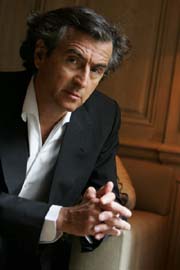 Photograph of Bernard-Henri Lévy by Thierry Dudoit/L’Express/Editing.
Bernard-Henri Lévy’s new book American Vertigo
“[I]n reality,” Lévy writes in the book, “no large modern nation today is as uncertain as this one, less sure of what it is becoming, less confident of the very values, that is to say, the myths, that founded it; it’s a certain disorder; a disease; a wavering of points of reference and certainties; a vertigo once again that seizes the observer as well as the observed.”
I spoke with Lévy—or BHL, as he’s known—by phone recently, shortly before a book tour appearance in Portland, Oregon. Later, when I listened to our recorded conversation, I was struck by the differences in the way we spoke. The Frenchman sounded so debonair, even in a language that wasn’t his langue maternelle—often interjecting the odd French word. Meanwhile, I—the ebullient voice of stereotypical American friendliness—filled in pauses with “like” and “cool.” Was it just my own sense of American vertigo, some form of inferiority complex, coming through? Perhaps. But I was most interested in Lévy’s observations about America and what he sees as its collective vertigo.
World Hum: How are you, Monsieur Lévy?
BHL: Well.
When I was in Toulouse, a Frenchman gave me his impression of America, in a nutshell. He called it a melting pot, but one that doesn’t mix outside of its borders. What do you think of that?
(Sounding exasperated) This is absurd. All the countries in the world—all the countries in the world—are mixing in America. America is a sort of “country-cosmico”—every country in the world has a sort of reflect in America, so how could America not mix with the rest of the world? America is as itself.
I think we Americans understand the richness of our diversity, but there’s still, perhaps, a general insecurity, a sense that we’re less worldly than Europeans, less in touch with the rest of the world.
I don’t see a reason for this insecurity. America is the country where the level of the culture is the highest, where you have the biggest—the most sophisticated—museums, the richest libraries. All the artists of Europe took refuge—found a shelter—in America. So how could America feel shy, or a sort of inferiority, regarding France, Europe? It’s absurd.
You’ve traveled to many places around the world. What do you think are the fundamental differences between the ways the French and Americans travel?
Hmmm. I think that Americans are born travelers. They travel in their own country. They travel from the beginning of their life. They spend all their life traveling, even inside America. I have not one American friend, of my generation, who has spent all of his life in the same place. They were born in a place, raised in another, they begin to work in a third, they continue to work in a fourth and sometimes they will die in a fifth or in a sixth. So they are born travelers. We are, in France, much more rooted in our birthplace. America is the country of the permanent-keep-moving. So you are born travelers.
We Americans are aware of the reputation abroad, in some places, of the “Ugly American.” Have you heard that term?
No. I have heard something else, I have heard of the anti-Americanism all over the world. Anti-Americanism is a sort of strange, foolish, mad passion, which has nothing to do with the real America. It has to do with something else, with ideology, with very deep and dark passions of the people—nothing to do with the real America.
In a recent radio interview in Boston, you said that the French might find “American Vertigo” too easy on America.
Ah, this is possible. We carry in Europe a powerful trend of anti-Americanism, and of course they will find that my book is too indulgent, is too kind, is too gentle on America. And it is true, that this book, even when there are criticisms—and there are a lot of criticisms, of the ways in America today—the main point of view is friendship, love, proximity. Even when I criticize, it is a critique from a man who loves America.
Was this your first long trip in America?
No, I did a coast-to-coast when I was a very young man. When I was 16 or 17. By bus and car. With my girlfriend of this time.
Were you comparing your recent trip with your previous visit?
America has changed a lot, of course, it’s so different.
In your travels across America, you talked to politicians, movie stars, death row inmates, the bartender, a home school supporter, people from many walks of life. To whom would you direct an American who wanted to do a similar voyage in France?
Impossible to say. I would advise a traveler in France to let him do as I did, to let himself guide by hasard—by chance—by improvisation, by one encounter leading to another one. You can’t plan.
Traveling as you did, who did you meet that surprised you the most?
A good surprise? The bartender of Grand Junction who, working so hard to survive, to make it, to feed her family, and to overcome her distress, and giving to me such a lesson in courage and dignity.
How did you get her to open up? Or do you find Americans open up easily?
They open up easily, and I believe that she just thought that I was friendly. That I was a natural friend. When people see that—that they have in front of them a candid man or woman, an honest person—they open up.
Your travels took you to many American cities: Las Vegas, pre-Hurricane Katrina New Orleans, Baltimore, Detroit, Atlanta, Memphis, Birmingham. What French cities might make up an itinerary for an American attempting a similar voyage?
(Laughing) I cannot give an itinerary to the American traveler. He has to set the itinerary. It’s a principle.
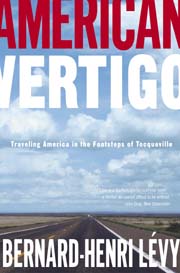 Fair enough. In “American Vertigo,” you wrote that one of the most mysterious aspects of the American ethos, for Europeans, is our relationship to nature—how, rather than seeking to tame nature, we push it back. In another chapter, you wrote, regarding what you saw as the deterioration of Buffalo, New York, “That a city could die: For a European, that is unthinkable.” These differences in the way we see nature and cities seem to say a lot about the differences between Americans and Europeans.
Definitely!
How much do you think we are influenced by our geography?
About the nature being pushed away and not controlled completely, the difference in the geography is evident—you have so much space. You have such a huge space that you don’t need to economize. You don’t need to use every single square centimeter. You can just push. This is the effect of nature. About the cities which die, I don’t know if it is an effect of nature. I think it is something else. Probably a backlash of this keep-moving way of being. You know, this pioneer spirit, this way of pushing always a border a little farther—this applies to the cities. If the city is broken, OK, we leave it. We go away. We go farther. You did that with the ghost towns—you find so many ghost towns on the American road today. The gold mine was finished so the city was abandoned in one night and you make another one.
The idea of these ghost towns—these abandonded cities—sitting unused, is that unthinkable to Europeans because of the idea of wasted space, or because of a sentiment of a city as a living being?
I think so, I think so. But you also in America have this love of cities. You have the two. You have this idea of the city being abandoned, but you have also the love of the cities. In Boston, in Chicago, in Seattle, in Portland, in Savannah.
Near the end of your book, you write about America as “an other that talks to us about ourselves.” You use the metaphor of a mirror. Rather than reflecting the past, you write that mirror sheds light on the future. As a Frenchman, how did this country hold up a mirror to you and your country?
I think America gives that, gives an image sometimes of the beginning, and sometimes of the future. The morning of the world and the following step of the world.
Do you feel you learned about yourself during your travels here?
Of course, of course. This is the virtue of travel in America, it always tells you a lot about yourself. It tells you more—as much—about yourself, as about America. Travel in America is always a meeting with yourself.
Isn’t this true of travel everywhere?
In a way, but I think that it is more true in America.
Why?
Because the link is very strong, and because there is such a community of being—of flesh—between Europe and America. What is America, after all, if not a breaking with Europe, and a rupture with Europe, and a reinvention of Europe? So, we are so close.
Do you read any American travel writers? Are there any that you like in particular?
The one whom I quote so much at the beginning of “American Vertigo” is Jack Kerouac. For me he was a model. This book was placed under the umbrella of Tocqueville and Kerouac. They are so different.
I appreciate you taking the time to talk to me.
Oh no, no please. It was a pleasure for me.
(In elementary French) The next time we’ll speak in French, I hope.
Bravo!
 Email to friend
 Twitter
 del.icio.us
 Digg
Digg Facebook
 Furl
Furl Ma.gnolia
 Mixx
Mixx Reddit
 StumbleUpon
 Yahoo! Buzz
Terry Ward is a Florida-based writer and a long-time contributor to World Hum.