
Sean O’Reilly: The Journey Inward
Travel Interviews: Michael Yessis speaks with the Travelers' Tales editor about the spiritual and tribal-busting nature of travel
03.28.02 | 7:25 PM ET
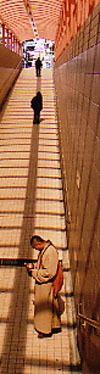 Sean O’Reilly has co-edited many of Travelers’ Tales award-winning books, including The Road Within, Pilgrimage and the recently released compilation, The Spiritual Gifts of Travel. It’s the eleventh Travelers’ Tales book about spirituality and travel, and it features stories by Richard Halliburton, Don George, Jan Morris, Phil Cousineau and many other writers.
O’Reilly’s interest in spiritual matters stems from a lifelong interest in philosophy, theology and, of course, travel. “Travel can take us out of the deadly grip of habit and the narrow focus of culture and cast us upon the great road of spirituality - sometimes whether we wish it or not,” he writes in the introduction to Spiritual Gifts. O’Reilly recently returned from a trip during which he, his wife and their then five children (they now have six) traveled 18,000 miles around the U.S. in a van. He spoke to me about The Spiritual Gifts of Travel and the link between travel and spirituality from his home in Phoenix, Arizona.
World Hum: A three-month, 18,000-mile van odyssey sounds like a blast, but it could probably also drive you nutty. How was it?
It was really quite wonderful. We originally set out to visit relatives in Washington state. We had a little bit of free time afterward and we decided, ‘Oh, let’s go visit my sister Kate in Chicago.’ And then we figured if we’re going to do that we might as well drive down to Virginia. Then somebody sent us an invitation to stay in a condo in Florida, right near the beach, and we said, ‘How can we turn this down?’
Naturally. Do you travel with your family often?
Yes. My wife’s a real traveler, and she makes the distinction in a way I think a lot of mothers can relate to. She says, ‘I have to be with the kids whether or not we’re on a trip,’ so she makes a difference between vacations and trips. A vacation is when you go without the kids. Trips are when you go with the kids. And for her a trip is an upgrade from being at home.
Have you found spiritual nourishment when you travel with your family? Is it something you look and hope for when traveling?
I find that all kinds of travel, whether you’re going on a trip up to the next town or you’re going 10,000 miles away, disposes you to spiritual encounters in a really unique way.
What way is that?
I find that all travel causes me to look at things from a bigger and less restrictive perspective. Human beings have the ability to get sort of locked into habitual ways of thinking and habitual ways of acting. I particularly noticed this when I moved to Arizona from a house I lived in for about 15 years in Virginia. I was really shocked at how living in one place for so long had conditioned my mind to thinking along certain pathways. I guess you can extrapolate from that and say that anytime you change your circumstances and your environment it affords you the ability to change your perspective more readily than if you’re in a habitual mode, and when that happens you can open up a little more to things that you might not normally open up to. One becomes a little more disposed to change as a whole. At Travelers’ Tales, we had a writer who described travel as a way of changing your ecology. All ecology means is the links you have with your environment. So, as human organisms, we have a relationship with a particular ecology. When you travel you shift ecologies, and that enables you to dialogue with something slightly different. And I think there’s a little bit of Zen in all of this. Travel can be like a koan, designed to break down the logical mind so that your inner being steps forward and says this is the answer. Or it’s an answer that can’t be answered with the mind. What really happens is that you become the answer to your own questions and problems or you stay locked into them. There’s a fair bit of that kind of transformative and personal change in traveling. It enables you to shift spiritual gears.
Spirituality can mean different things to different people. You even break down Spiritual Gifts into five categories: Ignition, healing, mystery, consciousness and encounter. What were you looking for in the stories you selected?
The primary thing that interests me is how people change. What makes somebody become a very creative and interesting person as opposed to being a boring drone, and that kind of change can occur in many different ways. It can occur through religion. It can occur through politics. It can occur through social activism. It can occur through family life. It can occur through taking drugs and it can occur through sexual encounters. There are a million different ways that people can suddenly wake up, so I’m particularly interested in what I call, for perhaps a lack of a better phrase, what it takes to wake somebody up to their own inner nature, their own reality. So one of the things we looked at in the Spiritual Gifts of Travel was to try to pick stories that resonated with some kind of unusual change, some window that opened up for people where they saw something that was bigger than themselves, where they experienced something that they couldn’t quite necessarily wrap their heads around but they were in dialogue with.
Sure. I’ve had that feeling while traveling. And I also had that feeling reading Laurie Gough’s story, “Naxos Nights,” in the book.
I think everybody knows it to some extent, but the mechanism is somewhat unclear. We at Travelers’ Tales view The Spiritual Gifts of Travel and some of our other books about traveling as a way of exploring these ideas. Travel is fundamentally about understanding yourself better and becoming a human being with a bigger and more improved perspective in the process.
You write in the introduction of Spiritual Gifts about how travel and spirituality have been linked since the beginning of human history. What are some of the classic spiritual travel texts that you recommend?
Far Away and Long Ago by W.H. Hudson is one of the most lyrical. The author recounts his days as a young boy on the pampas of Argentina. It is utterly evocative of a lost world and so utterly rich that it still trembles on the edge of my memory and imagination, as if it were my own. The Royal Road to Romance, a book Travelers’ Tales recently reprinted, was way ahead of its time in some ways. Richard Halliburton would have been right at home in today’s world. He was a man who could see the world in a grain of sand and ride the time waves of the past in present encounters. Another wonderful travel classic is In the Steps of the Master by HV Morton, which covered his journeys in what was then Palestine. Morton wrote in the 1920s and 30s, and it was just the best stuff imaginable. It’s a marvelous fusion of history with incredible observations of human nature illuminated by the author’s own rich interior landscape. Now I must also say with some trepidation that the Bible is very much a travel book. One learns a great deal about the locale of the Bible by reading closely. The biblical injunction to go out and preach to all nations is literally the first spiritual travel mandate.
In the months since September 11th, particularly here in America, many people seem to have taken a step back and reassessed the way they are living. Do you think there will be some sort of spiritual awakening in American travelers?
That’s a tough question. I went to Israel two months ago. My family had some misgivings, but I felt that I had a narrow window of opportunity so I took it. I feel that the world is probably going to become more dangerous in the short run. But in the long run, as a species, there’s going to be more travel. All of the statistics indicate that travel has been growing exponentially. One has only to imagine China loosening its restrictions on travel. Should they do so, they could automatically increase the number of new world travelers by a half million a year without even batting an eye. As people become more prosperous, one of the first things they want to do is travel. I think that part of the renaissance that can occur in the world in the future is a world that recognizes that travel, commerce, spirituality and change are inextricably linked. It’s an artificial barrier to think that people only have spiritual experiences in the context of a religion. It’s simply not true. The essence of spiritual experience, the foundation stone of all religious experience, is the waking up to an eternal identity in the present. So I think what we need to do, and this is part of how we view our jobs at Travelers’ Tales—at least it is part of our dharma here on earth—is to open people up to the possibility of a more natural spirituality that is probably not predisposed toward any one religion in particular.
Where will that lead us?
I think that we are evolving as a species toward a more planetary citizen mentality. People are just not going to think of themselves as being Americans or Africans or Asians, but as international citizens.
Well, few pursuits are going to do that for you the way travel does. Exactly.
 Email to friend
 Twitter
 del.icio.us
 Digg
Digg Facebook
 Furl
Furl Ma.gnolia
 Mixx
Mixx Reddit
 StumbleUpon
 Yahoo! Buzz
Michael Yessis is the cofounder and coeditor-in-chief of World Hum.