
Travel Blog
Travel Movie Watch: ‘The Trip’
by Eva Holland | 06.16.11 | 8:47 AM ET
NPR notes that British comedians Steven Coogan and Rob Brydon have put together a travel-themed comedy that sees them playing themselves (or, versions of themselves) on a restaurant tour of northern England. The film is mostly improvised and, says Coogan, “what makes it interesting is that there’s an edge to it and a discomfort to it that makes it engaging. It’s not just a couple of actors saying, ‘Get a load of me. I’m laughing at myself.’ There are a couple of moments where I find Rob irritating—genuinely—and I respond naturally, but not the way that I would in reality.”
I’ve been a fan of Coogan’s since his Alan Partridge days, and the movie will take place in my old expat stomping grounds, so I’ll hope to catch this one when I can. “The Trip” went into limited North American release last weekend.
 Email to friend
 del.icio.us
 Digg
Digg Facebook
 Furl
Furl Ma.gnolia
 Mixx
Mixx Reddit
 StumbleUpon
 Yahoo! Buzz
Christopher Hitchens Remembers Patrick Leigh Fermor
by Jim Benning | 06.15.11 | 1:01 PM ET
Christopher Hitchens recalls the legendary travel writer who died last week at 96.
Now the bugle has sounded for the last and perhaps the most Byronic of this astonishing generation. When I met him some years ago, Leigh Fermor (a slight and elegant figure who didn’t look as if he could squash a roach; he was perfectly played by Dirk Bogarde in Ill Met by Moonlight, the movie of the Kreipe operation) was still able to drink anybody senseless, still capable of hiking the wildest parts of Greece, and still producing the most limpidly written accounts of his solitary, scholarly expeditions.
And finally:
To his last breath, he remained curious and open-minded to an almost innocent degree and was a conveyor of optimism and humor to his younger admirers. For as long as he is read and remembered, the ideal of the hero will be a real one.
R.I.P. Patrick Leigh Fermor
by Jim Benning | 06.10.11 | 9:58 AM ET
Reports are trickling in that Patrick Leigh Fermor, one of travel writing’s greats and the author of “A Time of Gifts,” has died at 96.
In a 1996 profile of Leigh Fermor in The New Yorker, Anthony Lane argued that the writer lived one of the most compelling lives of the 20th century—so fascinating, in fact, that it makes the rest of our lives “laughably provincial in their scope.”
We fret about our kids’ S.A.T. scores, whereas this man, when he was barely more than a kid himself, shouldered a rucksack and walked from Rotterdam to Istanbul. In his sixties, he swam the Hellespont, in homage to Lord Byron—his hero, and to some extent his template. (He once hunted down a pair of the poet’s slippers, “their toes turning up at the tip,” in Missolonghi.) In between, he has joined a cavalry charge, played a game of polo on bicycles outside a Hungarian castle, observed a voodoo ceremony in Haiti, and plunged into a love affair with a princess. He has feasted atop a moonlit tower, with wine and roast lamb hauled up by rope. He has dwelled soundlessly among Trappist monks. He has built himself a house on the soutehrn coast of Greece, where he still resides. He has written seven travel books and a novel, though which is which one cannot readily say, for the travel books pass from fiercely empirical to the fantastic without drawing a breath.
Leigh Fermor’s book, A Times of Gifts, made our list of the top 30 travel books of all time. Tom Swick wrote of the book:
This is a glorious feast, the account of a walk in 1934 from the Hook of Holland to what was then Constantinople. The 18-year-old Fermor began by sleeping in barns but, after meeting some landowners early on, got occasional introductions to castles. So he experienced life from both sides, and with all the senses, absorbing everything: flora and fauna, art and architecture, geography, clothing, music, foods, religions, languages. Writing the book decades after the fact, in a baroque style that is always rigorous, never flowery, he was able to inject historical depth while still retaining the feeling of boyish enthusiasm and boundless curiosity.
From Mandalay to Timbuktu: Great Names, Lousy Places
by Jim Benning | 06.09.11 | 12:31 PM ET
In an excerpt from his new book, “The Tao of Travel,” Paul Theroux recalls a number of places that just didn’t live up to the romance evoked by their names:
Mandalay: an enormous grid of dusty streets occupied by dispirited and oppressed Burmese, and policed by a military tyranny.
Tahiti: a mildewed island of surly colonials, exasperated French soldiers and indignant natives, with overpriced hotels, one of the world’s worst traffic problems and undrinkable water.
Timbuktu: dust, hideous hotels, unreliable transport, freeloaders, pestering people, garbage heaps everywhere, poisonous food.
I was always drawn to Kuala Lumpur because of its name. I loved just saying the words, and I loved the way they sounded. I loved the way they evoked lumpy koala bears, or something even more exotic that I couldn’t even begin to imagine.
When I finally went there, I was initially underwhelmed. The Petronas Towers are impressive, but they’re not lumpy koala bears. After exploring the city for a couple of days, however, getting lost in Indian neighborhoods with sari shops and aromatic cafes, and even spending a couple of hours in an elegant old theater watching a Bollywood movie I couldn’t understand, I decided Kuala Lumpur had its lumpy charms.
Ever gone to a place that didn’t live up to its great name? Or that did?
Rapping About Travel in Kenya, Mzungu-Style
by Jim Benning | 06.08.11 | 3:03 PM ET
Afar magazine sent filmmaker Jorma Taccone to Kenya, where he co-wrote a travel-related song with a Nairobi rapper named Rabbit and shot a video. Considering its mzungu origins, it’s not half bad.
Bernard-Henri Levy: ‘Hortatory Adventure Seeker’?
by Jim Benning | 06.08.11 | 1:54 PM ET
A piece in BookForum makes that case, among others, about the French celebrity philosopher sometimes known as BHL.
It is false to say, as some do, that “only France” could produce such a figure as Lévy. He is a type of journalist recognizable in any country—the hortatory adventure seeker, prescribing foreign travel as a moral tonic for an enervated West. The New York Times columnist Nicholas Kristof, who tours the world harvesting the grievances of suffering humanity and cooks them into a meal of moral authority for his untraveled readers, is engaged in a similar project. So were the late Italian reporters Oriana Fallaci and Tiziano Terzani. The writing that results from Lévy’s public activism is sometimes entertaining and sometimes even admirable. But it is hard to see anything philosophical about it.
BHL spoke to World Hum in 2006 about his philosophical travelogue, “American Vertigo.”
Book Lovers, You Have Three New Reasons to Spend More Time in Airports
by Michael Yessis | 06.08.11 | 10:55 AM ET
Just tweeted a Wall Street Journal piece about authors promoting their books at airport bookstores. The appearances are known as “fly-bys” and, apparently, nobody does them like second-tier celebrity authors such as Ice-T, Rob Lowe and Joan Collins.
David Roth writes:
Airport book signings won’t supplant traditional book tours anytime soon, but maximizing publicity opportunities, even during an author’s travel layover, makes sense for publishing houses as marketing budgets shrink and traditional bookstores vanish. Hudson News’s transit locations make up 10% or more of total sales for some books that the retailer keeps in heavy stock, said Sara Hinckley, a company vice president.
The story brought to mind a couple literature-goes-to-the-airport pieces I liked in recent months. Taiwan’s Taoyuan International Airport recently opened the first airport library for ebooks. And The World profiled the real-world library that opened last summer at Amsterdam Airport Schiphol.
Here’s the video that accompanied The World’s report:
Paul Theroux, V.S. Naipaul and the End of a Feud
by Jim Benning | 06.07.11 | 4:00 PM ET
Paul Theroux’s long-running feud with Nobel laureate V.S. Naipaul has apparently come to an end. The two authors shook hands in the green room at the Hey Festival late last month in Wales. Writer Reza Aslan was there. He not only posted a message on Twitter about it—“Holy Cow! I caught first face to face reconciliation of Paul Theroux & VS Naipaul. Magical moment.”—but he just happened to capture it on video:
What caused the feud? Accounts vary. According to The Telegraph, Naipaul suspected that Theroux had seduced his first wife. A New York Times report, however, emphasized Theroux’s anger over a book he’d signed: “His decades-long friendship with Mr. Naipaul imploded some 15 years ago when he discovered that a copy of one of his novels, lovingly inscribed to Mr. Naipaul, had been put up for sale.”
Whatever the cause, Theroux went on to write a great book exploring their friendship and its demise, Sir Vidia’s Shadow.
Amazingly, Naipaul was back in the headlines days after the handshake, offending countless people, when he told the Royal Geographic Society that he doesn’t think much of women writers: “I read a piece of writing and within a paragraph or two I know whether it is by a woman or not. I think [it is] unequal to me.”
World Hum: The Journey Continues
by World Hum | 06.06.11 | 1:32 PM ET
It’s been a little quiet around here lately. Now we can tell you why, and share some good news.
As you may know, we started World Hum as a labor of love in May 2001. While working full-time, we built the site during early mornings, late nights and on weekends, publishing travel stories and blog posts. In 2007, the site was acquired by Travel Channel, which employed us full-time to edit it. We did that until last November, when we were laid off.
Since then, we’ve been working on our own writing projects and enjoying a little time off, and even traveling a bit. We’ve also been in talks with Travel Channel about the future of World Hum.
The good news is that we’ll be partnering with the company, which still owns the website. We’re going to edit the site on our own, however, and experiment with running it as an independent business. We’ll continue to publish great stories, and we hope to do some experimenting, too. In a way, it’s taking the site back to its roots.
Thanks to everyone who reached out to us as we’ve gone through this transition. Over the years, a thriving community of readers and writers has developed around World Hum: people who love to travel, are curious about the world and appreciate high-quality storytelling. It’s this community of engaged readers that keeps us going.
We’re happy to report that Eva Holland will continue to work as the site’s senior editor.
We hope you’ll join us for this next phase of World Hum. We’ll begin updating the site more often this week. As always, we welcome your feedback.
—Jim and Michael
‘Back to the Wild’: More on Christopher McCandless
by Eva Holland | 04.01.11 | 12:44 PM ET
The Fairbanks Daily News-Miner reports that members of the McCandless family recently traveled to Alaska to visit the old school bus where one of their own, Christopher McCandless, died. The visit was part of a promotional effort for a new book (and accompanying DVD), Back to the Wild, which will showcase McCandless’ photos and writing. Profits from the book will go to a non-profit aimed at helping “new mothers in need.”
As always, McCandless and his bus are a contentious subject in Alaska. After describing the parents’ visit, News-Miner writer Dermot Cole adds:
I have long believed that the junked bus ought to be moved, largely because it’s an attractive nuisance. With people ripping off additional parts of the bus as time goes by, it makes more sense to move it closer to Healy or somewhere else.
Year after year, a steady stream of unprepared people risk their lives trying to get to what would otherwise be seen as an example of environmental blight instead of a shrine.
Explore Magazine’s 30th Anniversary Issue
by Eva Holland | 03.25.11 | 11:53 AM ET
Up here north of the border, Explore (“Canada’s outdoor magazine”) is celebrating 30 years in print. Last weekend I picked up the anniversary issue, a best-of selection of National Magazine Award winners from the last several years, and read it cover to cover—it was packed full of really solid outdoor travel narratives.
I’m not sure how readily available the magazine is outside of Canada, but if you can get your hands on it I’d highly recommend it. Standouts, for me, included “27 Funerals and a Wedding,” “The Story of Bear 99,” “The Boys and the Backcountry,” “Here Be Ogopogo” and “Hammering Away at Eternity.” Unfortunately the stories don’t appear to be available online.
‘Traveling to Europe Didn’t Change My Life’
by Michael Yessis | 03.23.11 | 3:28 PM ET
A contrarian take on the power of travel at Thought Catalog. Caitlin Rolls writes:
Travel is supposed to be this other-worldly experience. People always start looking all moony when they mention their travels, like suddenly they’re back in that musky tent in Morocco wrapped up in the paisley sarong they bought because they just, you know, really wanted to live it. They’ll explain that it was a really amazing experience that they can’t exactly put into words so why don’t they just show you the slide show they set to the music of Ravi Shankar? Super moving stuff but maybe the reason they don’t want to talk about it is because they’re afraid to admit that they came home exactly the same person they were when they left.
Of course, the sentiment has polarized the commentariat.
Happy 200th Birthday to the Manhattan Grid
by Eva Holland | 03.22.11 | 12:33 PM ET
On March 22, 1811, city officials in New York certified a proposed grid plan of 11 north-south avenues and 155 east-west streets—the building blocks of modern Manhattan. Here’s the New York Times on the impact of the plan:
The grid was the great leveler. By shifting millions of cubic yards of earth and rock, it carved out modest but equal flat lots (mostly 25 by 100 feet) available for purchase. And if it fostered what de Tocqueville viewed as relentless monotony, its coordinates also enabled drivers and pedestrians to figure out where they stood, physically and metaphorically.
“This is the purpose of New York’s geometry,” wrote Roland Barthes, the 20th-century French philosopher. “That each individual should be poetically the owner of the capital of the world.”
I agree: The grid has always made me fearless as a tourist exploring New York City. I never feel lost for more than half a block—regaining my bearings is as easy as walking to the nearest intersection.
The Times also has an interactive map of the original plan laid over today’s city streets. (Via @douglasmack)
Pico Iyer: The Japanese ‘Have More Resolve and Fortitude Than Almost Anyone I’ve Seen’
by Jim Benning | 03.15.11 | 12:38 PM ET
Like everyone, I’ve been horrified by the news out of Japan following the earthquake, tsunami and nuclear power plant explosions. Among other things, I’ve been wondering how author and World Hum contributor Pico Iyer is doing, and whether he has been home in Japan or traveling as the disaster unfolds.
I just heard from him via email:
By curious chance, and with rare good timing, I actually flew out of Japan last Thursday night, hours before the earth began to move, and so I’m just sitting in placid Santa Barbara now, where nothing seems to move at all. But everyone I know in Japan sounds fine, and is going about her life as usual, for now at least a safe distance from all the horror.
He added:
Let’s hope the Japanese, who have more resolve and fortitude than almost anyone I’ve seen, can put their land together again very soon.
Let’s hope.
This is What Hundreds of Overlapping Photos of Chichen Itza Look Like
by Michael Yessis | 03.10.11 | 12:48 PM ET
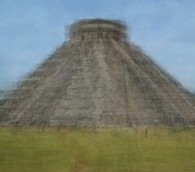
Swiss artist Corinne Vionnet combined hundreds of digital images of the same famous landmarks to create what Boing Boing calls “metaportraits.” Like Chichen Itza above. Madeline Yale looks deeper into the project:
What is remarkable about Vionnet’s findings is the consistency in online iterations of the travelers’ gaze. It makes one wonder, how do we determine the optimum spot to photograph landmarks? Maybe we stand at the gateway to the Taj Mahal to render its architectural façade in perfect symmetry, or we stand where we can frame all four American presidents in equal scale at Mount Rushmore. Perhaps we instinctively choose how to photograph known monuments as we are socially conditioned to take pictures we have seen before—images popularized through film, television, postcards, and the Internet.
I found Vionnet’s project goes hand-in-hand with Doug Mack’s audio slideshow, Not-So-Flattering Views of Famous European Landmarks.
