
Travel Blog: News and Briefs
Fear and Loathing in a Chevy Aveo
by Eva Holland | 10.04.11 | 10:03 PM ET
On the 40th anniversary of “Fear and Loathing in Las Vegas,” The Daily’s Zach Baron climbs into a modest rental car and hits the Hunter S. Thompson trail. Here’s the introduction to his sharp and funny story:
Writers only go to Las Vegas for one reason, really. It is our World Series of Poker, except more pretentious. But the process is not dissimilar. You train, get your weight up. A semi-competent feature here, a not-totally-botched essay there, and then, one day, when your editor is particularly distracted, downtrodden or simply in need of something to believe in, you push your meager pile of chips to the center of the table. You look your mark in the eye and bluff. “It is the 40th anniversary of Hunter S. Thompson’s ‘Fear and Loathing in Las Vegas,’” you say, your face calm, confident, “and I want to go there, to write a piece on the book, and the American Dream.”
You don’t expect him to say yes. Pitching stories on the American Dream is what writers do when their hearts are empty, their minds blank. It is the equivalent of stalling for more time, throwing a Hail Mary down eight with time expiring, a way to mark your commitment and plucky optimism before admitting defeat and moving on to something with an actual chance of success.
This is part one of a series. I’ll be following along. (Via @alexanderbasek)
 Email to friend
 del.icio.us
 Digg
Digg Facebook
 Furl
Furl Ma.gnolia
 Mixx
Mixx Reddit
 StumbleUpon
 Yahoo! Buzz
Pilar and Ernest Hemingway’s Prose
by Jim Benning | 10.03.11 | 12:54 PM ET
Ernest Hemingway bought his beloved boat, Pilar, in a shipyard in Brooklyn in 1934. Could the ensuing time he spent on the boat have altered his writing style? At least one writer thinks so. Paul Hendrickson is the author of the new book, Hemingway’s Boat: Everything He Loved in Life, and Lost, 1934-1961.
NPR’s Rachel Martin interviewed Hendrickson and asked, “What did he [Hemingway] want from the boat?”
Hendrickson had an intriguing reply:
I think he wanted escape. I think he wanted to get away from shore. In fact, I make the case in this book that Pilar helped broaden out, so to speak, his prose line. When you say Ernest Hemingway, what do you think? You think of these simple declarative sentences, these magical and yet very short sentences, free of the subordinate clause. What happens, Rachel, from the mid-‘30s onward, the Ernest Hemingway sentence gets longer and longer and longer. Why is this? I like to make a case that aboard Pilar, getting away from shore, getting away from the sniping critics, getting away from all the petty little literary games, he can get out there in the Gulf Stream and he can free himself in some way.
Cross-posted from JimBenning.Net.
Seeing Australia Through Australian Crime Novels
by Michael Yessis | 09.28.11 | 10:55 AM ET
B. R. Myers looks Down Under through the eyes of an American reading Aussie crime fiction. From the Atlantic:
It is a rare crime novel that doesn’t seem better in the first part, when we are still trying to find our bearings. Perhaps we want to feel the way we did as children, when the genre was so much more thrilling for being slightly over our heads. This is the good thing about Australian crime fiction: as an American, you are never completely at home in it. True, the suburban backdrops appear very familiar, and on the printed page the Australian variant of English is almost identical to our own. But the characters in these novels behave much more differently from Americans than do the Swedes in those Stieg Larsson books, and this never stops feeling odd. Among male friends an intensity of joshing camaraderie is in evidence that even our frat boys would find stifling.
Previously, we noted Reggie Nadelson’s essay on the importance of place in crime novels, and Sarah Weinman’s piece on “international crime novels based in places as unlikely as Laos, Gaza and North Korea.”
Electronic Surveillance Abroad: ‘Sophisticated and Pervasive’
by Michael Yessis | 09.27.11 | 5:16 PM ET
Also: A little scary. Ellen Nakashima and William Wan illuminate the conditions business travelers and government officials are presumed to face when traveling to China and some other countries. From the Washington Post:
Security experts also warn about Russia, Israel and even France, which in the 1990s reportedly bugged first-class airplane cabins to capture business travelers’ conversations. Many other countries, including the United States, spy on one another for national security purposes.
But China’s brazen use of cyber-espionage stands out because the focus is often corporate, part of a broader government strategy to help develop the country’s economy, according to experts who advise American businesses and government agencies.
“I’ve been told that if you use an iPhone or BlackBerry, everything on it—contacts, calendar, e-mails—can be downloaded in a second. All it takes is someone sitting near you on a subway waiting for you to turn it on, and they’ve got it,” said Kenneth Lieberthal, a former senior White House official for Asia who is at the Brookings Institution.
One anonymous security expert buys a new iPad when s/he visits China, then never uses it again.
‘127 Hours’ Fan Rescued in Canyonlands National Park
by Eva Holland | 09.26.11 | 11:13 AM ET
Move over, McCandless pilgrims: With the success of last year’s 127 Hours, there just might be a new breed of death-defying travel movie fans on the block. The Guardian reports that a solo hiker was attempting to retrace Aron Ralston’s route through Little Blue John Canyon when he fell and broke his leg. The hiker, Amos Richards, hadn’t told anyone where he was going—he crawled in search of help for four days before being found by park rangers who’d noticed his abandoned campsite. Richards was treated at a hospital and has, thankfully, been released with all four limbs still attached. (Via Gawker)
Buzkashi, Revisited
by Michael Yessis | 09.13.11 | 10:57 AM ET
The Lunatic Express author and World Hum contributor Carl Hoffman looks at how buzkashi, Afghanistan’s goat-based national sport, has changed since 9/11.
What was originally a pickup game played at weddings and festivals has become a game of one-upmanship between rich big men getting richer and bigger every day. Who has the most horses? The most expensive horses, which can cost $50,000 in a country where the average annual wage is $370? The best stable of chapandazan? Players have always been sponsored—given good horses to ride for the glory of the horse’s owner and small profit for the rider—but now a few have made themselves the world’s first professional, full-time buzkashi players.
We published David Raterman’s story about buzkashi, aka buskaschee, in 2002. He recently drew from the story for a scene in his novel, The River Panj.
A World Hum Story is Novelized
by Jim Benning | 09.09.11 | 10:20 PM ET
David Raterman drew from his 2002 World Hum story Down by the Buskaschee Field about Tajikistan while writing “The River Panj,” described as “the first thriller to open in Afghanistan on 9/11.”
From a press release:
On Sept. 11, 2001, ex-Notre Dame football star Derek Braun is doing relief work in Afghanistan when his fiancée and elderly colleague are kidnapped along the border with Tajikistan. With no one to help, he goes in search. On this dangerous journey, he faces Islamic terrorists, heroin smugglers, corrupt Russian soldiers, Iranian spies and helpless CIA agents, witnessing an assortment of terrible acts that culminate in his own kidnapping.
The novel, which promises to be the first in a series, is available in paperback for $10.99 here and as an e-book for $2.99 on Amazon and iTunes.
By the way, you have to love a writer who devotes a section of his website to publishing rejections. They’re enough to give any aspiring novelist serious pause.
R.I.P. Notting Hill’s Travel Bookshop
by Jim Benning | 09.09.11 | 1:03 PM ET
Despite a last-minute campaign by editors and even celebrities, London’s Travel Bookshop has closed.
USA Today’s Laura Bly received an email from the founder yesterday: “The shop is currently closed—but I am going to open it and be there myself this Saturday 10th - for a final day’s sale. Then sadly, that’s it for the Travel Bookshop.”
The store was featured in the 1999 Hugh Grant movie “Notting Hill.” As we noted recently, Alec Baldwin, who appeared in the film, was among those Tweeting his support for efforts to find a buyer.
Travels Through the Wreckage of Japan’s ‘Triple Disaster’
by Michael Yessis | 09.02.11 | 7:59 AM ET
World Hum contributor Daisann McLane’s Well-Traveled dispatches about her travels to Sendai, Fukushima and Tokyo four months after the 9.0 earthquake, tsunami and nuclear disaster struck Japan has concluded at Slate. It’s an amazing series, powerful and heartbreaking and beautifully written. From the first of three parts, Sendai Rising From the Wreckage:
Even after four months, it’s a mess of Augean proportion: uprooted pine trees, splintered wood beams, crumpled abandoned cars, wooden fishing boats tipped on their side, trying to sail away on a sea of mud. Your first reaction is to throw up your hands in desperation—how on earth do you begin cleaning this up? But the Japanese have passed that shock stage, and have whipped themselves into action: a squadron of earth movers is busy, steadily organizing the endless wreckage into tidy haystack-like hills. “This was the town of Natori.” Akawa-san points over to a spot on the eastern, coastal side of the highway. There’s nothing there but a solitary house without walls, its soggy furnishings and books spilling out the way junk tumbles from an overstuffed closet.
McLane, whose extraordinary writing career has ranged from contributing to Rolling Stone during its heyday to her current spot as the Real Travel columnist for National Geographic Traveler, explained how writing about the triple disaster affected her in an email to friends and colleagues:
The experience overcame me. Those of you who are writers, photographers and editors will understand: Sometimes you find yourself in the middle of an extraordinary story that makes you want to write your heart out. This was one of them.
Alec Baldwin: ‘Save the Travel Book Shop!!!’
by Jim Benning | 08.31.11 | 4:32 PM ET
Actor Alec Baldwin is among those lending his support—or Tweets, at least—to a campaign to save the Travel Bookshop, the three-decades-old British bookstore made famous in the 1999 film “Notting Hill.”
The film starred Hugh Grant, who played the owner of the shop specializing in travel writing. Julia Roberts also starred, and Baldwin made an appearance.
The bookstore’s owner put the shop up for sale in May. Poet and journalist Olivia Cole launched a campaign last week to find a buyer, but some fear it’s too late. It could close in early September.
The news prompted Michael Jacobs to reflect on the state of travel writing in The Observer:
Some people might conclude that the Travel Bookshop is doomed because travel writing itself is doomed. Such pessimists tend to point to the internet as the final factor in the genre’s potential extinction. The internet has certainly made redundant a Victorian type of travel book bringing together a lot of factual and statistical information about a country. It is also likely to do away soon with the need for guide books and the travel pages of newspapers (at least in their present form).
But, despite the rise of the internet and all the recent negative attitudes towards travel writing, to predict the death of the genre seems to me as nearsighted as believing that this country’s pioneering travel bookshop has come to the end of its useful life.
Video: ‘The Sinner’s Grand Tour’
by Jim Benning | 08.31.11 | 3:39 PM ET
Traveler and historian Tony Perrottet discusses his latest book, The Sinner’s Grand Tour, and one of his most exciting discoveries:
David Brooks on Travel and the Haimish Line
by Jim Benning | 08.30.11 | 4:32 PM ET
The New York Times columnist recently took his family on safari to Kenya and Tanzania. They stayed in simple camps where they got to know people and more luxurious camps where they did not.
The more elegant camps felt colder. At one, each family had its own dinner table, so we didn’t get to know the other guests. The tents were spread farther apart. We also didn’t get to know the staff, who served us mostly as waiters, the way they would at a nice hotel.
I know only one word to describe what the simpler camps had and the more luxurious camps lacked: haimish. It’s a Yiddish word that suggests warmth, domesticity and unpretentious conviviality.
It occurred to me that when we moved from a simple camp to a more luxurious camp, we crossed an invisible Haimish Line. The simpler camps had it, the more comfortable ones did not.
Brooks goes on to extrapolate larger lessons about how we live. It’s a well-worn theme in travel—see Rick Steves and a thousand other sources. But the message never gets old, undoubtedly because most advertising continues to insist we’ll be happier if we just spend more money.
Ai Weiwei’s Beijing
by Michael Yessis | 08.30.11 | 12:37 PM ET
The Chinese artist has broken his post-detention silence in a piece for Newsweek. He writes of Beijing:
I feel sorry to say I have no favorite place in Beijing. I have no intention of going anywhere in the city. The places are so simple. You don’t want to look at a person walking past because you know exactly what’s on his mind. No curiosity. And no one will even argue with you.
None of my art represents Beijing. The Bird’s Nest—I never think about it. After the Olympics, the common folks don’t talk about it because the Olympics did not bring joy to the people.
There are positives to Beijing. People still give birth to babies. There are a few nice parks. Last week I walked in one, and a few people came up to me and gave me a thumbs up or patted me on the shoulder. Why do they have to do that in such a secretive way? No one is willing to speak out. What are they waiting for? They always tell me, “Weiwei, leave the nation, please.” Or “Live longer and watch them die.” Either leave, or be patient and watch how they die. I really don’t know what I’m going to do.
National Parks, as Seen from Space
by Michael Yessis | 08.25.11 | 11:14 AM ET
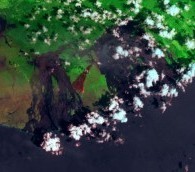
That’s Hawai’i Volcanoes National Park on the Big Island. Over at Wired, Betsy Mason pulled stunning images of 20 more parks.
Elisabeth Eaves Talks Wanderlust on ‘Q’
by Jim Benning | 08.23.11 | 7:36 PM ET
Nice interview with World Hum contributor Elisabeth Eaves on Canada’s public radio interview program, “Q.” She discusses her new book, Wanderlust, and reflects on the women travel writers of yore.
I’ve been listening to podcasts of “Q” pretty regularly since I downloaded the CBC’s iPhone app. It’s a great show. In my book, it rivals NPR’s “Fresh Air.”
