
Purple, Pasty and Protected: Poi
Travel Blog • Pam Mandel • 03.09.09 | 2:45 PM ET
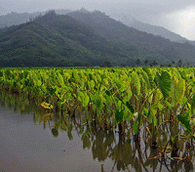 Photo by
 I headed to Hawaii intending to learn to like poi, but I never did acquire much of a taste for it, finding the texture too much like that of a mushy apple. I don’t mind the flavor, it’s not like I’m offended by it, but I wouldn’t go out of my way to eat it. When I mentioned to a host at dinner—she was an immigrant to Hawaii— that I was determined to master the purple paste, she gave me this advice: “Don’t bother. It’s like oatmeal or grits or any other staple food—if you didn’t grow up with it, it’s never going to taste that great.” I’m guessing she’d done some time herself trying to master this essential part of the traditional Hawaiian diet.
Poi is in the news. More accurately taro is the news-maker, or kalo—that’s the Hawaiian name for the crop and it’s what poi is made from—because of Native Hawaiian efforts to protect the plant from genetic modification.
Supporters want taro, or kalo in Hawaiian, to remain pure. Generations of Native Hawaiians consider it disrespectful to even consider messing with the genetic make-up of the sacred plant.
Legend has it Kalo sprouted from Haloa, the stillborn child of Wakea, the sky father, and Ho’ohokukalani, the star mother, to become the first taro plant thousands of years ago.
Kalo provides the kanaka maoli’s life-giving sustenance, poi, and is seen as the older brother of mankind, according to Senate Bill 958, which would impose the temporary ban on genetically modified taro.—The Garden Isle
Hawaiians are passionate about their poi—I feel bad that I failed in my attempts to fall in love with it, but a less tropical upbringing sent my palate in a completely different direction. Even if you can’t eat the stuff, you have to learn about it because it’s such a critical part of Hawaiian history. There are plenty of weird and wonderful websites devoted to poi—Poi to the World is a good place to start, and it features some rather healthy looking humans showing off packaged poi. You have to try it when you’re in Hawaii, it’s going to show up on a buffet somewhere, probably at a luau after the huli huli chicken and before the haupia.
I like both of those things just fine.
 Email to friend
 Twitter
 del.icio.us
 Digg
Digg Facebook
 Furl
Furl Ma.gnolia
 Mixx
Mixx Reddit
 StumbleUpon
 Yahoo! Buzz
Dominic Kealoha Aki 04.23.09 | 3:50 PM ET
Aloha Pam,
It seems like you didn’t get to sample the “preferred” grades of kalo poi. The Hawaiians had over 300 varieties of kalo, the best of these were reserved for the ali`i. Among the few that exist today, my favorite is the Lehua variety. A blood red corm that produces pink kalo poi.
Also it is noteworthy that poi is actually a method of preparation. Poi can be made from any one of our staples (uala; sweet potato, uhi; yam, ulu; breadfruit or kalo; taro.) It’s taking that tuber, corm or fruit and steam cooking it in the imu, mashing and then mixing with water to a pudding consistency
If you didn’t like the kalo poi then maybe next time you could try one of the others.
Me ke aloha.
Dominic K. Aki