
New Immigration Museum in Paris Confronts, Celebrates a Changing French Society
Travel Blog • Eva Holland • 10.17.07 | 11:55 AM ET
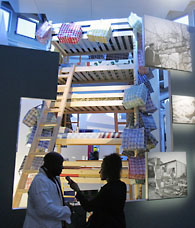 Photo of the Museum of Immigration History, AP.
 The Museum of Immigration History in Paris seeks to tackle one of the most incendiary subjects in France, and, according to a story in The Globe and Mail, its creators certainly don’t see themselves in an impartial role. “Ever since the word ‘immigrant’ appeared in our vocabulary in the late 19th century, it has had a negative connotation—connoting a menace, an inassimilable foreigner, a potential criminal, a polygamist and now a terrorist,” Gérard Noiriel, one of the curators, told the Globe. “Our job is to change that point of view.”
The museum’s exhibits mix occasional moments of humor about the immigrant experience with serious commentary about what the curators view as the country’s longstanding xenophobia. Its opening comes after several years of immigration-related controversy in France, from the 2004 debate over the banning of headscarves (and other visible religious symbols) in schools to the riots in Paris in fall 2005, and now President Sarkozy’s proposed tightening of entry requirements, along with the creation of a Ministry of Immigration and National Identity.
Museum visitors interviewed agreed that there was a lot of work to be done before the attitudes documented in the exhibits were really relegated to French history.
“I’m a French citizen,” said one. “I was born in France. Yet I’m still referred to as someone ‘of immigrant origin’ and not as a real Frenchman.”
“My great-grandfather was a French colonial official and he received a Legion d’honneur,” said another. “But I will always be considered here as a foreigner. The French have all these words about universalism and such, but it’s not something they act out in daily life.”
France is certainly not the only country struggling with questions of identity and immigration. Debate over the vast undocumented workforce in the United States continues to rage, while here in Canada a small Quebec town recently adopted a “code of conduct” for prospective immigrants that included, among other things, an admonishment not to stone women to death.
As a traveler, I’ve never quite understood all the fuss. If we put in time and money to travel so that we can meet people from other cultures, try new foods, and experience the fascinating differences and surprising similarities found in communities around the world, why struggle so hard against having some of those same experiences in our own hometowns? I’m grateful to be able to chow down on my Ukrainian roommate’s home-made perogies, attend a Hindu wedding or stuff myself at a Filipino Easter dinner—all without the cost of a plane ticket.
 Email to friend
 Twitter
 del.icio.us
 Digg
Digg Facebook
 Furl
Furl Ma.gnolia
 Mixx
Mixx Reddit
 StumbleUpon
 Yahoo! Buzz
Marilyn Terrell 10.17.07 | 2:28 PM ET
Another new museum in Paris, not nearly as incendiary, is La Cité de l’Architecture et du Patrimoine located in the Chaillot Palace, and covering 800 years of French building design: http://intelligenttravel.typepad.com/it/2007/10/city-of-archite.html
avis 09.19.08 | 7:18 PM ET
Immigration ought not be confused with travel. A traveler does not claim to become part of the polity, as an immigrant does. A traveler does not vote in elections or, if he has the slightest sense of his own lack of cultural understanding, seek to advise his host on their form of government. Multiculturalism is not ethnic restaurants, it may be among other things an acceptance of honor killing and female circumcission; authoritarianism over democracy (if one has a revealed truth, what is the point of democracy?); tribalism over public interest. It is not appreciated how much liberal democracy depends upon shared values, the ability of people to interact without reducing all relationships to legal ones, whose final arbiter is the State. We know from the American experience that cultural assimilation works, that subjects may be turned into citizens; we have rather few examples of successful multicultural liberal democracies. Some nations might define themselves in such a way that assimilation is probably impossible; in theory it ought to be possible in republican France, but then the theoretical Frenchman may not be the same as the real one.