
Remembering Kapuscinski: ‘He Was a Deity’
Travel Blog • Jim Benning • 01.31.07 | 2:13 PM ET
 Fittingly, the death of acclaimed Polish journalist and travel writer Ryszard Kapuscinski last week prompted a number of remembrances and appreciations. “He was a deity in Poland, where I lived and reported for about half of the 1990s, and he was a deity among correspondents in Africa, where I spent the rest of the decade,” recalled Neely Tucker in the Washington Post. “Correspondents in Africa have two authors on their shelves: Graham Greene and Kapuscinski.”
Writer Andrew Nagorski saw Kapuscinski’s passing as the end of an era. He wrote in the Wall Street Journal:
Kapuscinski’s death on Tuesday at age 74 marked the passage not just of a gifted writer who mesmerized readers with his tales of far-flung travels and near mystical powers of observation of mood and place. It also symbolizes a troubling transformation in the world of journalism, which was a subject he fretted about over one of our dinners last year. During a talk with a group of young Italian journalists, he recounted, he urged them to go out to see the world. Afterward, a couple of them came up to him and complained that they were never allowed to leave their desks and their computers. He was profoundly saddened by that encounter: “When I was starting out, my editor would get angry if he caught anyone at his desk. He wanted to know why you weren’t out reporting.”
In another tribute, Alvaro Vargas Llosa celebrated the author as a one-of-a-kind correspondent:
Whatever one calls the genre cultivated by acclaimed journalist Ryszard Kapuscinski, who passed away in Poland a few days ago, no imitator came close to his art. To say that he was a masterful chronicler of the revolutions, famines, civil wars and imperial breakdowns of the last half-century in Africa, Asia and Latin America is to state the obvious. He did more than that.
Kapuscinski once described his work with a Latin phrase—silva rerum, the forest of things. It’s an appropriate metaphor. His tale of the fall of Ethiopia’s emperor Haile Selassie, his description of the end of the Shah of Iran and his journey across a Soviet Union at the point of collapse—three of his books—have no real beginning or ending. The author does not attempt to convey the totality of the events he is narrating; he is interested only in the details he personally experiences or hears from those who experience them. No one, he seems to be saying, can grasp the enormousness of any historical event.
Meanwhile, The New Yorker published a piece Kapuscinski himself had written about his first trip abroad, to India, featuring a lovely passage about an awe-inspiring moment during his flight:
Looking through the little window, I was able to gaze for the first time on an enormous expanse of our planet. The world I had known until then was perhaps five hundred kilometres in length and four hundred in width. And here we were, flying forever, it seemed, while the earth, very far below, kept changing colors—burned brown, then green, and then, for a long while, dark blue.
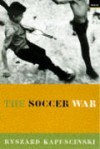
Kapuscinski wrote The Soccer War
 Email to friend
 Twitter
 del.icio.us
 Digg
Digg Facebook
 Furl
Furl Ma.gnolia
 Mixx
Mixx Reddit
 StumbleUpon
 Yahoo! Buzz
Jim Benning is the editor and co-founder of World Hum.
