
Stop the Presses: Tunisian-Born Chef Makes Rome’s Best Carbonara
Travel Blog • Joanna Kakissis • 04.09.08 | 1:50 PM ET
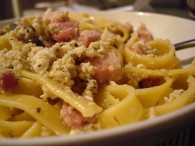 Nabil Hadj Hassen, who arrived in Italy at 17 and went on to train with some of the country’s top chefs, won the heart of highly regarded reviewer Gambero Rosso with his dish of pasta, eggs, pecorino cheese and guanciale (cured pig cheek) at the restaurant Antico Forno Roscioli. But The New York Times recently explored how his triumphant carbonara also flagged a question looming over Italy’s revered cuisine: Is the food still Italian if the chef is not?
Food purists say foreigners can be trained only to mimic the cuisine but will never truly get it like natives, who learned from mamma and nonna. And what if non-Italian chefs start introducing extraterrestrial spices such as coriander and cumin into famously minimalist Italian cuisine? Dare I utter the word “fusion”?
I’ve seen disastrous attempts at culture-morphing food in Greece (think tacos with oregano and tzatziki and, Zeus help us all, eggplant spring rolls in an apparent barbecue sauce). Then, of course, there’s the U.S., where gyros are made of gray slices of mystery meat and pan-Asian restaurants are frequented by people who believe “sushi salad” is a viable entree. (No wonder the “sushi police” are worked up.) I agree that if you don’t understand the culture, you won’t understand the food. That’s apparently why Italians are disgusted by 60 percent of Italian restaurants abroad. If they have eaten at some of the places around the world that insist on making carbonara with a mysterious canned ham-like product, I feel their pain.
But the idea that only native chefs and foodies can truly understand a cuisine? I don’t agree.
Globalization is changing cultures everywhere, and it has frightened those who equate identity with birthplace. Many Italian mammas who see their cuisine as an extension of their very being are troubled by the idea of a Tunisian making carbonara, especially if it turns out to be the best in Rome. It’s like a microcosm of the heady and complicated immigration debate, of the idea that identity is a bloodline rather than an embrace of principles and culture. I don’t know who is right, but I do know this: I’m a Greek-born woman who considers herself American. I’ve met Ethiopian-born men and women here in Athens who consider themselves Greek. I’m moved by the idea of a Tunisian spending his adult life in Italy, learning the language and embracing his adopted country’s “food is beautiful” mantra.
Besides, food has its own language, and those most fluent in it—no matter where they come from—know its architecture. Those who do not are condemned to make carbonara with pancetta or (insert scream) spam.
Related on World Hum:
* The Pasta Nazi
Photo by su-lin via Flickr (Creative Commons).
 Email to friend
 Twitter
 del.icio.us
 Digg
Digg Facebook
 Furl
Furl Ma.gnolia
 Mixx
Mixx Reddit
 StumbleUpon
 Yahoo! Buzz
Eva 04.10.08 | 10:58 AM ET
Great post, Joanna!
I especially liked this thought: “Besides, food has its own language, and those most fluent in it—no matter where they come from—know its architecture.”
I went to grad school with a guy who made “carbonara” using chopped-up sandwich meat, mayo and tinned peas.
Bill W, NH 04.10.08 | 11:40 AM ET
I think I’ll run out and get some guanciale, but where?
http://www.nimanranch.com/control/keywordsearch;jsessionid=4CE0612BCE54AFC8DFF0F8E1EBBFCED4.nrpus1?VIEW_SIZE=10&SEARCH_STRING=guanciale&SEARCH;_CATEGORY_ID=&SEARCH_OPERATOR=AND