
‘Human Horses’ Defy Calcutta Rickshaw Ban
Travel Blog • Eva Holland • 09.13.07 | 12:00 PM ET
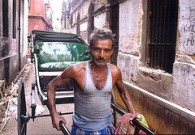 For more than a century, hand-pulled rickshaws have rolled through the busy streets and narrow alleys of Calcutta—or Kolkata (yes, we got the memo). But last month the BBC reported that the state government of West Bengal would be banning Calcutta’s famous human-powered transport. Now, the AFP has released this video report showing both rickshaw pullers and regular customers voicing their opposition to the ban. One customer noted that they were the only affordable transport for the injured or the sick, and wondered about compensation or re-training for the pullers. One rickshaw-puller said simply, “I have never done anything else.”
The video lists tuberculosis and blistered feet among the many health problems suffered by the pullers, and state officials have argued the move is for their benefit, calling the rickshaw tradition “inhuman” and “little more than slave labour.” The BBC quoted the chief minister of West Bengal in its initial report: “Nowhere else in the world does this practice exist and we think it should also cease to exist in Calcutta.”
I have to respectfully disagree with the chief minister on that last point. Hand-pulled rickshaws exist in several North American cities, including my own hometown of Ottawa.
I spent two summers in college pulling a rickshaw part-time and had plenty of people tell me that I was being exploited, or that my job was slave labor. But aside from the occasional slavery references, I doubt my experience held much in common with that of the pullers in Calcutta. For one thing, we ran with the latest Adidas or Nike technology on our feet. And for another, I’d be shocked if any of Calcutta’s 18,000 rickshaw-wallahs have ever earned a dollar a minute.
If West Bengal follows through with the ban, it will be strange to see the last of the original Asian rickshaws fade away, leaving only North America’s bizarre tourist-driven parodies to carry on the tradition.
Photo by Achakladar via Flickr, (Creative Commons).
Related on World Hum:
* In India, an Antidote to Monsoon Hair Drama
* Western-Style Supermarkets Threaten Traditional Indian Vendors
* Where in the World Are You, Eva Holland?
 Email to friend
 Twitter
 del.icio.us
 Digg
Digg Facebook
 Furl
Furl Ma.gnolia
 Mixx
Mixx Reddit
 StumbleUpon
 Yahoo! Buzz
Anil 09.14.07 | 12:14 PM ET
All I can say - necessity!
glorydassi 10.08.07 | 11:50 AM ET
how sad to remove these men from the only way they have to support their families. i suggest the government get them some health care coverage and a new pair of Nikies. when i travel , i love to ride the rickshaws..they are close to the city, the people and they are reasonable way to transport. they are pollution free.
keep the rickshaw wallas.
Syed Saiful Alam Shovan 06.29.08 | 8:19 AM ET
Most trips in Dhaka are short in distance, usually one to five kilometers. These trips are perfect of Rickshaws. Rickshaws are cheap and popular mode of transport over short distances. Rickshaws are safe, environmentally friendly and do not rely on fossil fuels. Rickshaws support a significant portion of the population, not only the pullers, but also their families in the villages, the mechanics who fix the rickshaws, as well as street hawkers who sell them food. From the raw materials to the finished product the Rickshaw employs some 38 different professions. Action needs to be taken to support the Rickshaw instead of further banning it in Dhaka. The combined profits of all Rickshaws out earn all other passenger transport modes (bus, rail, boats and airlines) combined. In Dhaka alone, Rickshaw pullers combine to earn 20 million taka a month.
We think that over the coming holiday of Eid du Ajah, new Rickshaw bans will be put into action on roads in Dhaka. Eid was used in the past to place new bans on roads in Dhaka. Last Eid many roads were declared Rickshaw free without public support or approval. By banning Rickshaws roads are clogged with increased private car use as well as increased parking by cars. Banning of Rickshaws on major roads increases the transportation costs for commuters. Not only due to longer trips to avoid roads with bans in effect, but also due to actually having to take more expensive forms of transport such as CNG or Taxi, where in the past a Rickshaw would suffice. The environmental impact of banning Rickshaws is obvious because it exchanges a non-motorized form of transport for a motorized form of transport, thus increasing the pollution and harming the environment. Rickshaw bans harm the most vulnerable in society, mainly the sick, poor, women, children and the elderly; generally those who can not afford or do not feel comfortable on other forms of public transport. To ban Rickshaws also hurts small businesses that rely on them as a cheap and reliable form of transporting their goods. Rickshaws are ideal for urban settings because they can transport a relatively large number of passengers while taking up a small portion of the road. In 1998 the data showed that Rickshaws took up 38% of road space while transporting 54% of passengers in Dhaka . The private cars on the other hand, took up 34% of road space while only transporting 9% of the population (1998 DUTP). This data does not include the parking space on roads that cars take up in Dhaka . If included this would further raise the amount of space taken up by private cars. Every year the Rickshaw saves Bangladesh 100 billion taka in environmental damage.
The government makes many efforts to reduce traffic congestion in Dhaka but with no success. Blaming Rickshaws for traffic congestion and subsequently banning them from major roads has not had the desired affect. Traffic is still as bad now as it was before the Rickshaws were banned on major roads. Rickshaws thus can not be seen as the major cause of traffic congestion. Instead one should look towards private cars and private car parking on roads as the major cause of traffic congestion. The space gained by banning Rickshaws is often used for private car parking. The current trend in transport planning reduces the mobility of the majority for the convenience of the minority. The next time a ban on Rickshaws on another road is discussed please take into consideration who is being hurt and who is being helped. For a better transport system in Dhaka we need to create a city wide network of Rickshaw lanes. If this is done Dhaka can reduce its fuel usage dramatically as well its pollution. We ask your help in our fight to keep Dhaka a Rickshaw city. Any information or help is very much appreciated and sought after. I writeyou this letter to describe the difficulties we are facing and some solutions but they are by no means exhaustive and we look forward to your help and input.
Author is the Volunteer of Save Environment Movement৷
Email: .(JavaScript must be enabled to view this email address)
Poribesh Bachao Andolon
58/1 Kalabagan, 1st Lane,
Dhaka-1205
K Jambulingam 06.30.08 | 3:06 AM ET
The famous MGR goverment of Tamil Nadu helped the Rickshaw pullers wih cycle rickshas and later even helped them by providing simple motors to drive the rickshas.Even they ere provided with rain coats.The community of rickshaw pullers even to-day remember MGR as their saviour. The Hero on the silver screen brought a sea change in the lives of poor.
horses for sale 08.22.08 | 12:49 AM ET
This does seem to be quite inhuman and close to slave labour but what alternative do these rickshaw pullers have? They obviously have very few choices to gain an income from.
Instead of placing a ban, how about giving them a minimum wage or something respectful? A ban may do more harm then good.
Thanks,
Sarah.
Asif K Shams 09.29.08 | 3:41 AM ET
Why blame rickshaws only?
Asif K Shams, Banani, Dhaka
http://www.thedailystar.net/story.php?nid=56472
Being a disabled person I am seriously inconvenienced by the ban on rickshaws on important roads. I am a mid-level employee so cannot afford CNGs , even if I can find one. Taxis and private cars are unthinkable. For this reason I am very pleased to see that your fearless newspaper has highlighted the acute problems caused by traffic jams on a daily basis. However, the police authorities are relentless in blaming rickshaws for the jams and even force me to walk (I use a crutch) in the heat and in the rain.
Over the last 2/3 weeks you are printing revealing pictures of gridlock on the road, when not one rickshaw can be seen. The actual cause is apparent to all (except perhaps, the authorities). There are too many private cars on Dhaka’s roads that are too narrow to accommodate them all. Most of these cars are huge requiring lots of octane, cause pollution and park anywhere they like without any difficulty to obstruct traffic in all directions. Moreover, their incessant honking on hydraulic horns is turning most of Dhaka people deaf, as the police sergeant confessed in your paper recently.
In this connection, I have been following the writings of Sikander Ahmed and others who are giving many useful suggestions. He claims that if existing traffic laws are strictly followed and implemented, both motorized and non-motorized transports can ply on the roads with ease. Why isn’t someone listening, instead of constantly putting the blame on those who cannot fight back.- usually the poor rickshawallas and those who use them.