
Destination: Mexico
The World Hum Travel Zeitgeist: From Chocolate to Kaiseki
by Michael Yessis | 05.18.07 | 5:09 PM ET
Or, in other words, travelers’ interests this week range from Hershey, Pennsylvania to the streets of Japan. Here’s the Zeitgeist.
Most Popular Travel Story
Netscape (this week)
Magnificient Trees of the World
* The Lone Cypress in Pebble Beach, California (pictured) makes the list.
Most Viewed Travel Story
Los Angeles Times (current)
A Tour of Japanese Cuisine With Spago Chef Lee Hefter
* From the same writers: A look at kaiseki
Most Read Weblog Post
World Hum (this week)
Japan’s Latest Budget Accommodation: Internet Cafes
* The nation that brought us the capsule hotel has done it again.
Most E-Mailed Travel Story
USA Today (current)
Hershey Honors its Past, Looks to the Future
Most Viewed Travel Story
Telegraph (current)
Amsterdam: Telegraph Travel Guides
Most Popular Page Tagged Travel
Del.icio.us (recent)
Farecast
Most Read Feature Story
World Hum (this week)
Mark Ellingham: Rough Guides and the Ethics of Travel
“Hot This Week” Destination
Yahoo! (this week)
Playa del Carmen
 Email to friend
 del.icio.us
 Digg
Digg Facebook
 Furl
Furl Ma.gnolia
 Mixx
Mixx Reddit
 StumbleUpon
 Yahoo! Buzz
Thousands Get Naked in Mexico City’s Zócalo
by Jim Benning | 05.07.07 | 11:30 AM ET
An estimated 20,000 people disrobed in the main plaza, all for the lens of photographer Spencer Tunick. Reports the Washington Post: “His arrival was preceded by weighty philosophical battles about public nudity. The prominent Mexican art critic Raquel Tibol declared that Tunick’s photos would be ‘an antidote to Mexican prudishness,’ while the Spanish critic Roman Gubern sniffed that the photographer’s work is redundant and doesn’t appear artistic.” Tunick’s first choice for the photo shoot was Teotihuacan, with its ancient ruins, but the government refused him that.
Border Stories: Why Do Nations Build Walls?*
by Michael Yessis | 04.26.07 | 8:53 AM ET
Because of fear and the desire for control, writes Charles Bowden in a terrific story in the May issue of National Geographic. Bowden primarily focuses on the barriers between the United States and Mexico, but he ties them to a historical trend—a trend, generally, of failure. “Walls are curious statements of human needs,” he writes. “Sometimes they are built to keep restive populations from fleeing. The Berlin Wall was designed to keep citizens from escaping from communist East Germany. But most walls are for keeping people out. They all work for a while, until human appetites or sheer numbers overwhelm them.”
Deadly Dengue on the Rise in Mexico
by Jim Benning | 04.10.07 | 11:45 AM ET
Mexican officials are concerned about an alarming rise in dengue fever—cases have risen 600 percent in the country since 2001—and they recently dispatched teams to coastal resorts to spray pesticides and clear pockets of standing water where mosquitoes multiply. It’s “one of the primordial public health problems the country faces,” one Mexican health official told the AP.
Life’s a Beach in Mexico City
by Jim Benning | 04.05.07 | 2:33 PM ET
Sort of. Mexico’s landlocked capital now boasts a $200,000 fake beach, complete with real beach sand and palm trees. The inspiration? Not a real beach, but a faux beach that opened in Paris in 2001.
Tijuana: Beyond Avenida Revolución
by Jim Benning | 03.12.07 | 6:40 PM ET
Because it’s so close to Southern California and Americans don’t need a passport to visit or return (at least until next year), Tijuana remains a popular destination for many Americans, even if they stay for only a few hours. Given that nearly three-quarters of Americans don’t have a passport, that means for many, Tijuana is the only experience of a foreign country they’ll have. Which is all the more reason why they should consider venturing beyond Revolution Avenue, with its strip clubs and curio shops. If all you saw of the rest of the world was Revolution Avenue, you just might never want to leave the U.S. again. Tijuana locals I know avoid Revolution Avenue like the plague, yet tourists flock to it, generally because they have no idea where else to go. So where else to go in Tijuana?
Alex Espinoza: A Return to Michoacán
by Michael Yessis | 02.26.07 | 8:46 AM ET
The youngest of 11 children, Alex Espinoza never felt the same connection as the rest of his brothers and sisters to his family’s native Mexico. They mostly grew up in a village called El Ojo de Agua in Michoacán; he was raised riding his BMX bike, watching cable TV and collecting “Star Wars” action figures in Los Angeles. “Their connection to Mexico was close, deep and also painful, something I simply could not grasp,” he writes about his family in a terrific Lives essay in the New York Times Magazine. “Growing up, I felt no ties to El Ojo de Agua. I traveled into Mexico with my family as a child a few times, but I felt disconnected and uninterested during those trips—and was always eager to return to my American life.” Recently, however, he returned to El Ojo de Agua with his mother to see if he could connect with a place that, over the years, had become “mythic” in his mind.
Introducing Xuani, Tijuana’s New (Sigh) Tourism Mascot
by Jim Benning | 02.21.07 | 1:53 PM ET
You have to feel for Tijuana tourism officials. The Mexican border city is plagued by murders and drug trafficking. And what of the city’s police force? Officers recently had their guns taken away from them by federal officials investigating organized crime. Yes, visiting Tijuana is a tough sell these days, especially for families on holiday in San Diego. But Tijuana officials think they’ve come up with a way to spit-shine the city’s image: a mascot. Meet Xuani, a cuddly costumed character representing a mix of Mexico’s native Indians. With his bright smile and fuzzy red-and-hello hat, Xuani will stroll along touristy Revolution Avenue, past the sad painted zebras and strip clubs, and, as the San Diego Union-Tribune put it in paraphrasing one official, “provide a more positive representation of the city’s offerings.”
The World Hum Travel Zeitgeist: Bali, Bargains and Jet Blues
by Michael Yessis | 02.16.07 | 9:20 AM ET
The Silk Road, Mexican beach towns, Chiang Mai and those poor passengers stuck on the tarmac at JFK were on travelers’ minds this week. Here’s the Zeitgeist:
World’s Best Travel Value: Island
Travel + Leisure Readers’ Poll (March 2007 issue)
Bali, Indonesia
* The rest of the top five: Phuket, Thailand; Ko Samui, Thailand; Langkawi, Malaysia; and Borneo.
World’s Best Travel Value: City
Travel + Leisure Readers’ Poll (March 2007 issue)
Chiang Mai, Thailand
* The rest of the top five: Kathmandu; Mendoza, Argentina; Hanoi; and Bangkok.
Most Read Story
World Hum (this week)
Armrest Seating, Anyone?
* Perhaps those stranded JetBlue passengers can relate.
Most E-Mailed Travel Story
New York Times (current)
Viewing Two Chinas From a Stop on the Silk Road
Most E-Mailed Travel Story
USA Today (current)
Check Out Under-the-Radar Mexican Cities and Beach Towns
Top Travel and Adventure Audiobook
iTunes (current)
A Walk in the Woods
Best Selling Travel Book
Amazon.com (current)
1,000 Places to See Before You Die: A Traveler’s Life List
Most Popular Page Tagged Travel
Del.icio.us (recent)
Mobissimo
Most Read Weblog Post
World Hum (this week)
JetBlue Apologizes for Stranding Passengers on Planes at JFK
* It makes this seem not so far fetched.
Mexican Migrant Theme Park: Homage or Crass Attraction?
by Jim Benning | 02.05.07 | 9:07 AM ET
Last September, we noted the bizarre theme park of sorts outside Mexico City that aims to recreate the experience of crossing the border illegally, complete with a long hike, fake migra and sirens. The New York Times took a crack at the story Sunday, sending a writer along for the experience. Since operators began offering the four-hour nighttime hikes (or caminatas) a few years ago, about 3,000 tourists, mostly Mexican, have paid about $18 a pop for the experience, writes Patrick O’Gilfoil Healy. “The idea of tourists’ aping illegal immigrants can seem crass, like Marie Antoinette playing peasant on the grounds of Versailles,” he writes. “But the guides describe the caminata as an homage to the path immigrants have beaten across the border.”
Saying Goodbye in the Sierra Madre
by Jeff Biggers | 01.23.07 | 1:00 PM ET
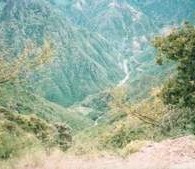 Photo by Carla Paciotto.
 Jeff Biggers was living among the Tarahumara in Mexico's Copper Canyon when he was invited to a funeral for a local woman. Amid the sorrow and song, he peeked at "the other side."
It’s Jan. 23. Do You Know Where Your Passport Is?
by Jim Benning | 01.23.07 | 8:05 AM ET
If you’re an American flying from the U.S. to Canada, Mexico or the Caribbean and want to return home, we hope so. The new passport rule, otherwise known as the Western Hemisphere Travel Initiative, goes into effect today, requiring that you carry one. Predictably, many travelers are now rushing to get their own little blue book, prompting newspaper headline writers to break out their favorite egg-related verb. Meanwhile, U.S. territory Puerto Rico stands to gain from the new rule: Passports are still not required of U.S. citizens, a fact that Puerto Rico is spending $36 million to promote. So how many new passports do officials expect to issue this year?
State Department Relaxes Warning for Oaxaca City
by Jim Benning | 01.18.07 | 9:54 PM ET
Instead of completely avoiding the Mexican city of Oaxaca, travelers should use caution there, the U.S. State Department now says. Translation: The place is beginning to return to normal after the protests and violence of last year. For those Oaxaca visitors ordering tasty mole in restaurants, we say: Exercise no caution. Go crazy. That stuff is good.
Related on World Hum:
* In Oaxaca, a Different Kind of Day of the Dead
Photo: Moody75, via Flickr. (Creative Commons License.)
Honoring ‘Babel’
by Jim Benning | 01.16.07 | 9:41 PM ET
I’ve done a bit of complaining about some travel-related films recently, but I have no qualms with Babel. In fact, I was happy to see it win the Golden Globe for best dramatic movie last night. While it doesn’t depict world travel in the most favorable light—among other calamities in the film, Cate Blanchett’s character is shot during a trip to Morocco—it does movingly show how interconnected the world is becoming, and how that doesn’t necessarily make communication across borders (or even within families) any easier. Filmed in rural Morocco, Tokyo and Tijuana, it’s the kind of movie that somehow simultaneously shrinks the world and expands it. It’s ambitious, with a global perspective, and how many movies can you say that about?
Jeff Biggers on NPR
by Jim Benning | 01.05.07 | 1:52 PM ET
World Hum contributor Jeff Biggers appears on NPR’s Latino USA this weekend to discuss his latest book, In the Sierra Madre. In fact, Maria Hinojosa’s interview with Biggers—or “Pancho,” as the Tarahumara called him—is already available online.