
Tag: Airplanes
Watch: Louis CK Puts All of Your Air Travel Complaints Into Perspective
by Jim Benning | 06.09.14 | 6:08 PM ET
This Louis CK rant isn’t new, but it never gets old, either. As one person commented: “They should play this looped in the terminals and on the aircraft all day 24/7.”
 Email to friend
 del.icio.us
 Digg
Digg Facebook
 Furl
Furl Ma.gnolia
 Mixx
Mixx Reddit
 StumbleUpon
 Yahoo! Buzz
Interview with Brendan I. Koerner: Love and Terror in ‘The Skies Belong to Us’
by Eva Holland | 07.02.13 | 10:40 AM ET
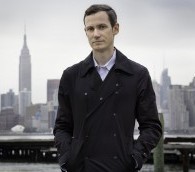 Photo by Will Star
 In the late 1960s and early 1970s, hijackings in American skies were routine. Eva Holland talks to the author of a new book about one young couple's wild long-distance heist.
The ‘Airport’ Movies: The ‘Best Kind of Guilty Pleasure’
by Michael Yessis | 11.07.11 | 7:12 AM ET
Gerardo Valero finds the cheesy disaster movies of the ‘70s had something important to say.
There’s nothing quite like the movies if you want to learn what people’s hopes and dreams were during the period in which they were made. Take for instance the recent “Up in the Air”. In the present when air travel has turned into something to be endured, George Clooney’s Ryan Bingham showed us how it can become an enticing way of life. The same subject was also portrayed extensively, under a very different light, some forty years as the “Airport” movies dealt with our fears of dying in new and horrible ways, while glamorizing our dreams of flying first-class, surrounded by a movie star in every seat. As the trailer for one of these features once put it: “on board, a collection of the rich and the beautiful!” They also marked the advent of a new genre (the Disaster Film) as well as the “Ark movie” which Ebert’s Little Movie Glossary defines as “mixed bag of characters trapped in a colorful mode of transportation”. How many films can claim to this kind of impact?
I made a similar point in my look back at the 25th anniversary of “Airplane!”
Qantas and Singapore Airlines Ground All A380s
by Eva Holland | 11.04.10 | 2:48 PM ET
 REUTERS/STRINGER Singapore
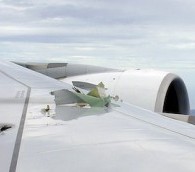
 The two airlines made the decision after a Qantas A380 engine exploded above Indonesia earlier today. The plane landed safely, and investigations are ongoing. The much-hyped, long-awaited super jumbo jet debuted three years ago, and according to the New York Times story about the explosion, there are 37 of them currently in use.
How Airplane Background Noise Affects our In-Flight Taste Buds
by Eva Holland | 10.15.10 | 2:42 PM ET
New research suggests that the white noise of airplane cabins could be contributing to the infamous blandness of in-flight meals. Here’s the Independent’s Steve Connor:
White noise consists of random collections of sounds at different frequencies - such as the muffled noise of aircraft engines - and scientists have demonstrated that it is capable of diminishing the taste of salt and sugar.
The findings could explain a phenomenon well known to airline companies: passengers tend to lose their sense of taste when they are in the air.
Interesting stuff—but I’m a little surprised to find researchers putting serious time into studying airplane food, considering the in-flight meal is nearly extinct.
Airplane Air: ‘No Worse Than the Office You Sit in Every Day’
by Eva Holland | 10.06.10 | 9:37 AM ET
That’s from a New York Times story about recent studies showing “that, in general, an airplane is no more a health threat to occupants than any other enclosed environment, like a theater or subway.” Dr. Mark Gendreau, an “aviation medicine expert,” explains:
Cabin air, he said, is refreshed about 15 times an hour, compared with less than 12 an hour in an office building. On most full-size jets, the air is also circulated through hospital-grade HEPA filters, which are supposed to remove 99.97 percent of bacteria and the minuscule particles that carry viruses. The cabin air is also divided into separate ventilation systems covering every seven rows or so, limiting the ability of germs to travel from one end of the plane to the other.
The story also notes a couple of caveats, like the possibility of germ-laden bathroom doorknobs or tray tables, so don’t ditch your travel-sized hand sanitizer just yet.
Do the FAA’s ‘Silly Rules’ Accomplish Anything?
by Michael Yessis | 10.01.10 | 12:26 PM ET
Not really, writes Willy Stern in the Weekly Standard. To Stern, the silly rules include mandatory seat belt fastening, the cell phone ban and requiring seats upright for landing.
What’s at work here is society’s unhealthy fear of risk—a problem that is compounded by scaremongering in the press and the prevalence of lawsuits over the most minor injuries and actions—and a reluctance to assume personal responsibility in the face of the ubiquitous Nanny State. But there’s also simple inertia.
“In 21 years of flying, I never once heard a flight attendant complain about enforcing these rules,” says Candace Kolander, now coordinator of air safety for the Association of Flight Attendants. “It’s not an annoyance for us. You hear the bongs and you go through the ritual. It’s ingrained.” Indeed, it is ingrained, and that’s part of the problem. Luke Froeb of Vanderbilt University’s Owen Graduate School of Management explains that institutions like the FAA fall victim to what behavioral economists call a “status quo” bias, where rules—no matter how ridiculous—are almost impossible to change once in place.
Fun fact from the piece: The regulation that requires seats to be upright for takeoff and landing runs 1,382 words, more than double the amount of words in the U.S. Bill of Rights. (Via The Morning News)
Video: Man Builds Vintage First Class Pan Am Cabin in His Garage
by Michael Yessis | 07.23.10 | 11:33 AM ET
76-Second Travel Show: The Airline Logo Awards
by Robert Reid | 05.13.10 | 1:11 PM ET

Robert Reid honors the world's best-looking airlines
A Love Letter to the Window Seat
by Michael Yessis | 03.26.10 | 10:01 AM ET
Some evocative writing by Mark Vanhoenacker:
But for me, it’s all about the views, especially those entrancing last few minutes before touchdown.
It’s how the details of the world are summoned again, how gracefully scale and shadings resolve into trees and fields and subdivisions. It’s the steady, lyrical motion of a silvery wing over a new place—an entirely unique geography and history that appear simply and perfectly beneath you.
He nails the description of flying into Los Angeles at night: “The city looks like an ad for a computer chip, a kinetic vision of light and energy spilling over the continent’s edge.”
A Pilgrimage to SkyMall
by Bill Donahue | 01.26.10 | 9:12 AM ET
 Graphic by Doug Mack
 Can a trip to its headquarters make for documentary art, or just a closer look at solar-powered mole repellers? Bill Donahue journeys into the soul of SkyMall.
Interview with Jason Reitman and Walter Kirn: ‘Up in the Air’
by Michael Yessis | 12.11.09 | 10:26 AM ET

Michael Yessis asks the men behind the book and its movie adaptation about Airworld
Should Airlines go Nascar?
by Bob Ecker | 11.12.09 | 10:29 AM ET
 iStockPhoto
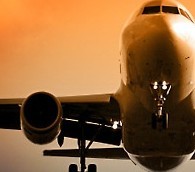
 Bob Ecker has a modest proposal for the airline industry
Video You Must See: ‘Frequent Flyer’
by Michael Yessis | 11.02.09 | 10:32 AM ET
Photo You Must See: Flying Before the Shanghai Sun
by World Hum | 10.07.09 | 11:52 AM ET
 REUTERS/Aly Song
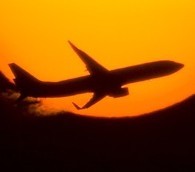
 A passenger jet cruises past the setting sun in Shanghai yesterday.
How Bad is the Air Quality in the Air?
by Michael Yessis | 07.17.09 | 11:42 AM ET
It’s “basically adequate,” writes Scott McCartney. Not very comforting. The airline industry knows that, so last year it put together a panel of experts to recommend changes—changes that, of course, haven’t been implemented.
McCartney investigates further and does a good job explaining what we really need to worry about when it comes to air quality on planes. As one expert told him, “In general the air on an airplane is not too bad, but when things go wrong, they can get really bad. And it happens in a hurry.”
AirTran Presents ‘Internetiquette’
by Eva Holland | 07.14.09 | 4:29 PM ET
As we’ve noted, AirTran has been leading the charge on in-flight Wi-Fi service—and now it’s pioneering in-flight internet protocol too. The airline’s new seat pocket guide, “Internetiquette: A Guide to Keeping Everyone in Line, While They’re Online,” is no dry list of rules, either. Take, for instance, Tip #10 on personal photo galleries:
SFF, or Suitable For Flights: family vacation photos, graduation photos, birthday party photos.
NSFF, or Not Suitable For Flights: the photos from Vegas. You know the ones.
Sometimes humor can be the best way to get a point across. Here’s hoping AirTran’s passengers take note, and that e-card jingles and musical MySpace pages are kept to a minimum on future wired flights.
Study: Long-Distance Travel Triples the Risk of Deep Vein Thrombosis
by Michael Yessis | 07.07.09 | 1:41 PM ET
The dangers have long been suspected. Now, apparently for the first time, there’s research to support the theory. A report in the Annals of Internal Medicine says anyone flying for longer than four hours has increased risk of blood clotting known as deep vein thrombosis. The risk is three times greater than it is for someone not traveling. USA Today and Reuters explain the science.
Experts suggest long-distance travelers lessen the risk by, among other things, drinking water and getting up and walking around the plane every now and then, lest they suffer like Dick Cheney.
Another Reason for Air Rage?
by Eva Holland | 07.01.09 | 2:11 PM ET
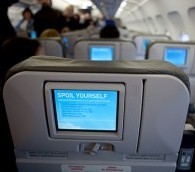
Sure, we all love those nifty seat-back entertainment systems—but as Jaunted astutely points out, the personal TV screens come with a major downside: a long-haul flight’s worth of punches to the back of the head.
I’m assuming that when they’re not busy making air travel greener and/or finding a way to remain afloat in this brutal economic climate, the industry’s brightest minds will be working on the problem?
The Perfect Gift for the Airplane House Owner in Your Life
by Michael Yessis | 06.23.09 | 3:27 PM ET
If you know someone who has one of these, here’s a gift idea: Furniture made of old airplane parts.
- « Prev Page
- Next Page »