
The Sleaze of ATM and Credit Card Fees
Rick Steves: Exploring Europe, exploring travel as a political act
09.29.09 | 11:50 AM ET
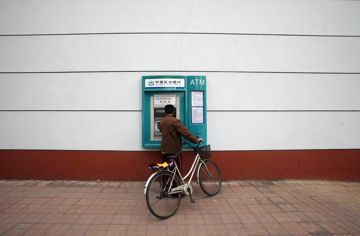 David Gray/Reuters
On my last trip to Europe, I didn’t bring my usual $200 cash reserve. With just a few bucks in my wallet, I landed in Madrid, relying entirely on two ATM cards and no cash safety net. It turned out OK. At the airport, I withdrew some euros from an ATM machine, and tucked the bills into my money belt. After decades of traveling to Europe, I have found that the cheapest, safest way to go is to pay with cash for most items, and withdraw money as I zip from one place to the next. The reason? To cut down on fees and fraud.
I realize fees aren’t an exciting topic…at least not until you get your bank statement after your trip. Over the last few years, banks have dramatically increased the fees they charge for overseas transactions involving credit and debit cards. While these fees are legal—and some are even understandable—many are contrived simply to wring a few more dollars out of tourists. But by traveling smart and doing a little research up front, you can cut back on these extra expenses.
There are different types of fees. Banks may levy a flat $2-5 transaction fee each time you use your ATM card, plus an additional 1-3 percent for currency conversion. The machine you use might charge you, too. Visa and MasterCard impose a 1 percent fee on international transactions, and the issuing banks may tack on an additional currency conversion or foreign transaction fee of 1-2 percent.
Before your trip, call your bank or credit-card company to find out what you’ll pay when using their card overseas. If they charge exorbitant fees, either ditch them, or consider getting a card just for your trip. Bankrate has a helpful comparison chart of major credit cards and their fees. Most credit unions have low-to-no international fees. Capital One has a good reputation for no-fee international transactions on both its credit cards and its ATM-accessible money market accounts.
If your bank charges a flat fee per transaction, cut down on ATM visits in Europe by withdrawing larger amounts. If the machine refuses your request, try again and select a smaller amount (some cash machines limit the amount you can withdraw—don’t take it personally). If that doesn’t work, try a different machine. Be sure to stow your cash safely in a money belt. Because businesses must also pay fees to credit-card companies, some merchants and hoteliers—particularly in southern Europe—may give you a better deal if you offer to pay cash with their currency (which also allows them to avoid reporting—and being taxed on—all of their income).
When you’re paying for hotels, meals, or that Prada bag, some merchants will ask if you want to be charged in dollars (a service called dynamic currency conversion, or DCC). Politely refuse. Usually the dollar price is based on a lousy exchange rate, plus your credit-card issuer may still impose a foreign transaction fee. The result: You could pay up to a 6 percent premium for the “convenience.”
Anytime you use a debit or credit card, beware of scammers—just as you should at home. When entering your PIN, cover the keypad so that thieves can’t see what you’re typing. Shoulder surfing is a common problem. Also, use your credit card sparingly. Restaurant servers and shop clerks might try to steal your information, sometimes by swiping your card through a special machine that reads it (a technique called “skimming”) or by surreptitiously snapping a photo of it with their cell phone.
In order to protect against fraud, some European countries, including Britain, France, the Netherlands, and those in Scandinavia, have started using chip and PIN technology for their credit and debit cards. These smartcards come with an embedded microchip, and cardholders must enter a personal identification number (PIN) instead of signing a receipt. Though most merchants should be able to run transactions without a PIN, some might insist on one. For this reason, it’s smart to know the PIN for your credit card; ask your credit-card company before you go.
When traveling, I only use my credit card for booking hotel reservations by phone, making major purchases (such as car rentals and plane tickets), and paying for things near the end of my trip to avoid another visit to the ATM. A dependence on plastic reshapes the Europe you experience. Pedro’s Pension, the friendly guide at the cathedral, and most merchants in the market don’t take credit cards. Going through the back door requires cold, hard local cash.
 Email to friend
 Twitter
 del.icio.us
 Digg
Digg Facebook
 Furl
Furl Ma.gnolia
 Mixx
Mixx Reddit
 StumbleUpon
 Yahoo! Buzz
Rick Steves writes European travel guidebooks and hosts travel shows on public television and public radio. He is the author of Travel as a Political Act.
Chris 09.29.09 | 5:02 PM ET
Solid advice here. I once had a charge show up from France more than a year after I was there and 6 months after I CLOSED THE ACCOUNT!
Carlo 10.01.09 | 6:14 AM ET
My bank in Canada had a premium account that cost $25 per month but allowed unlimited overseas ATM withdrawls. If you kept a minimum $5000 balance the entire month, that $25 fee was waived. We used a low interest line of credit to make sure we never dipped below that minimum and then paid it off as soon as we got home. Waived bank fees, free overseas ATM withdrawls. Bingo.
jason ayala 10.07.09 | 3:59 AM ET
Sometimes banks have agreements with other banks. I use Bank of America in the states because I can withdraw cash from Santander ATMs in Mexico with no fees.
Iain 10.27.09 | 1:22 PM ET
banks - you would think they would be a little humble these days. Sad that these usary practises come so naturally to them.
I am curious about carlo’s bank… Canadian banks are not known to be so obliging… what bank is it ?
Carlo Alcos 10.27.09 | 5:04 PM ET
Iain, it was/is TD Canada Trust.
Iain 10.27.09 | 5:11 PM ET
thanks -
did you have to make a 2 o’clock appointment - like the 2 old guys on the TV ad :)
Serious though - that $5k must be in a non-interest bearing account.
BTW Scotiabank is free of all charges if you use any of their branches anywhere in the world. I have tried to get an answer if that covers their subsidiaries or majority owned banks but to no avail.
Does anyone know of a US bank that offers comparable world service?
Jeff 10.28.09 | 10:08 AM ET
Within Europe at least there’s also a large difference if you use credit card or a debit card (directly linked to your bank account) when using ATMs. Credit card ATM use is always much more expensive.
Simon 10.29.09 | 1:05 PM ET
We have to be careful and should be aware of complete details before we do any transactions. Nice post.
iain 11.10.09 | 8:29 PM ET
lets not forget the merchant. I’ve run into as most people have the merchant who tacks on his service charge for you using a ATM/CC - I just had 1.5% added to my hotel bill. No prior notice. Grrrrrrr
Carlo Alcos 11.10.09 | 9:05 PM ET
Merchants pay for the service so they charge back to the customer to recover that cost. I don’t have much problem with that, unless they are adding % to what they actually pay. It was actually news here in Australia that merchants weren’t passing on a decrease in bank rates, thereby making profit from this! That chaps my hide.