
War Zones for Idiots
Travel Stories: The "World Series of Journalism" had begun in Afghanistan, and Tom Bissell didn't have to qualify to play. He just had to show up.
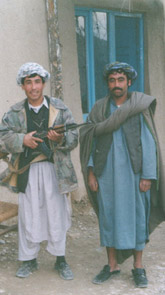 Photo by Tom Bissell
In the popular imagination, the war correspondent chain-smokes, exhales fatalistic mots, and wears a gritty layer of sweat. In contrast, the war correspondents lodged in the Barat Hotel appeared defiantly normal. Most had girlfriends and wives, though no one seemed terribly eager to talk about that. Whether this was because of the peril of the situation or the almost overwhelming maleness in the air—everyone was dressed a bit like we were about to choose sides for touch football—I was not sure. In tones more evocative of trumping sportswriters, they kept insisting the city was more or less secure. A New York Times photographer claimed Mazar was the safest war zone he had ever covered. But a normal person would not be here. Whereas I had wandered into Afghanistan almost by accident, these reporters had taken the speediest, most direct route available. Ravi was able to come only after securing a flak jacket from AP Moscow. (My biggest deliberation had been whether to pack my Marine Corps T-shirt.) Several seemed to enjoy a little too much arriving at the Barat a few careless minutes after curfew, while I was already steeling myself to leave again when the sun was high.
Like many Americans, I had spent the months of September, October, and November 2001 devouring wire reports from Kabul and Kandahar and Herat watching khakied, spotless television reporters declaim before docile Afghan crowds. Bylines and corner-screen logos somehow provided these men and women with the seeming invulnerability of a moonsuit. But every astronaut knows that each step is in defiance of the surrounding vacuum of death. An hour of tooling around Mazar had disclosed physics as unforgiving as those of space. This was a quickly thrown-together war being waged by a patchwork of unpredictable, often unreliable guerillas. Even the American Special Forces squadrons putatively in charge of these guerillas were having trouble discerning whom they could trust. Despite the epidemic of nonchalance, no one standing in this hotel—virtually no journalist in this country—had any real protection save for the goodwill of Afghanistan’s people. It occurred to me, then, that I had no reason to be here. Not one. As realizations go, this was curiously undramatic.
While Michael squared away our room, I walked out onto the hotel’s fifth-floor porch and looked across the street at the Tomb of Ali, one of the holiest sites in Afghanistan. Ali was Mohammed’s son-in-law and regarded by Shia Muslims as his true successor. It was surprising that the vehemently Sunni Taliban—to say nothing of al-Qaeda’s 55th Brigade, which had called Mazar home—had not defaced the structure. What had happened was chilling enough. In July 1998, the Taliban attacked Mazar for the third time. Mazar’s outlying soldiers fought to their last man, and the hell-bent Taliban entered the city driving Saudi-provided Datsun pick-ups. The massacre that followed must rank as one of the worst in modern history. While Mullah Omar Mohammed granted his talibs a judicious—if highly un-Islamic—two hours of killing, the slaughter did not end for two days. During the ordeal a Taliban mullah entered the Tomb of Ali and announced over the muezzin’s loudspeaker: “Now we are here to deal with you.” No one knows how many Mazaris were killed. The U.N. later estimated between 5,000 and 6,000. Taliban figures the number as closer to 8,000.
“What do you think?” Michael asked, he and Solim joining me on the porch. “We have an hour before curfew. Shall we try visiting some of the aid agencies and arranging a visit to the camps?”
I could not think of an activity at that moment I would have liked less to try. Perhaps cruising Mazar in voluble search of buggery. “Sure,” I said.
I followed them down the hotel’s spare twisting staircase as Michael inquired after Solim’s feelings about the American bombing. Solim said he was very, very pleased and overjoyed that the Taliban was gone. Michael reminded Solim that he was Danish, not American; Solim did not need to feel guarded. Solim said he was very, very pleased and overjoyed that the Taliban was gone. Michael’s head tipped forward with chagrined laughter. How about during the bombing near Mazar, then, which came to pass in late November? How did Solim feel? Had he been frightened?
“Oh, a little,” Solim said, “a little. But we were sure that we wouldn’t be hurt because Mr. Bush himself announced the U.S. does not bombard residential areas.”
Even at 4 p.m. Mazar was emptying. The unarmed rushed home, the armed did not move, and whole neighborhoods lay beneath long, toppled blocks of shadow. A far-off explosion, like damp thunder, filled the air. As I prepared to leap from the car and cower in a roadside ditch, Michael reminded me of the French and American soldiers out at Mazar’s airport detonating unexploded ordnance.
Our first stop was Unicef’s compound. Here a Canadian and two Europeans wearing heavy winter clothing pecked at glowing laptops. They barely looked up at us when we walked in, though the locally employed Mazaris smiled and happily pumped our hands. Camps? A spot of trouble with the camps. They were mostly trying to figure out where to put the relatively small amount of aid that had already come in. They did not have the jurisdiction to authorize anything by way of a camp visit, sorry. Nice to see us, though. At the compound of the World Food Program we found no one but a few drivers. At the United Nations Joint Logistics Center—which sought to coordinate the activities of the various U.N. agencies in Mazar—Michael and I chatted inconclusively with a genial Dane who was working solitary, clock-spanning hours to make the Center “operational.” Any aid situation with “military assets,” he said, rubbing his eyes and smiling behind a desk littered with paper and maps and printed-out E-mail, “are at first a little chaotic.”
Finally, minutes before night had fallen completely, we arrived at the offices of Médicins Sans Frontières. Unlike the offices of MSF in Tashkent, the compound was unmarked. Its Head of Mission was young Belgian doctor whose lidless and permanently open eyeball moved in a socket of scarred, glass-smooth flesh; how this happened I could not bring myself to ask. He did say, however, that he thought a camp visit could be arranged for us tomorrow. But we could not ride in any MSF vehicles. Journalists getting killed under MSF’s watch was not a problem this doctor wished to have. Could he tell us about the camps? Michael asked. Were people really starving? In the camps MSF could reach, the doctor explained, the mortality rates were still “very low.” As for those no one could get to. . . He shook his head.
By the time we made it back to the hotel it was too close to curfew for Solim to try to make it to his house across town. The three of us sat down to a light supper in the hotel’s canteen when a journalist we hadn’t met before—a tall and staggeringly pompous Brit—blustered in. He ignored us, making straight for a table of young, star-struck, English-speaking Mazaris. Soon he was loudly dropping the names of numerous global hot spots with gloomy familiarity. I walked over and asked him how long he’d been in Mazar. “A month,” he said challengingly.
I headed upstairs and from our room looked out upon Mazar’s lawless nocturne. The Taliban were vanquished, and yet five stories below me warlords cruised the city’s alleys and thoroughfares, already working out their new vectors of influence. Swords of headlight cut through the murky night and I watched two four-by-fours pull up on opposite sides of the street, their soldiers climb out and then just stand there, holding their Kalashnikovs and eyeballing one another in the dark. Everyone agreed that the presence of the few hundred American and French soldiers out at Mazar’s airport was the only thing holding these brutes short of total urban war.
Michael and Solim walked in, then. “I’d get away from that window if I were you,” Michael said absently, having a seat on his bed and pulling off his socks. “I don’t think any arrests would be forthcoming if someone decided to take a shot at you.” I closed the curtains. Michael turned to Solim, who sat on the floor with a slumber-party smile, and asked him if he could ever remember a time in his life when there was no war.
“Since the beginning of my birth,” Solim said, “the only thing that I heard was war.”
Michael wondered if Solim was more optimistic about Mazar’s future. “The political situation is changing every day,” Solim said. “We don’t have a good remembrance from the Northern Alliance because they are repeating their past reactions. The only thing that they enjoy is killing, abduction. So we really, really welcome the new government.”
Did Solim, I asked, want British or American soldiers to police Mazar?
“Oh!” he said instantly. “Literate men warmly welcome all of them. Because those forces would be the only ones who would bring peace and security in our country.”
I looked at Michael, hoping he would not say what he said next: “Do you know tomorrow morning the West will fly forces into Kabul?”
“We will welcome them,” Solim said with a hard nod.
“But they’re not going to come here,” Michael said, not without sympathy. “They’re only going to be in Kabul. For six months. Then they’re leaving.”
“We’ll welcome them,” Solim said again, more quietly.
 Email to friend
 Twitter
 del.icio.us
 Digg
Digg Facebook
 Furl
Furl Ma.gnolia
 Mixx
Mixx Reddit
 StumbleUpon
 Yahoo! Buzz