
Matt Gross: Reflections From a ‘Round-the-World Journey
Travel Interviews: The New York Times told him to make the full circle in 90 days -- as a budget traveler. Upon his return, Michael Yessis spoke to him about "interactive travel" and why he's in no hurry to get back to Croatia.
08.23.06 | 12:30 PM ET
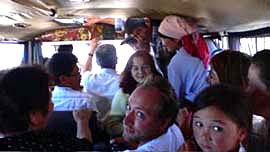 Photo by Matt Gross.
Earlier this year, Matt Gross’s editors at the New York Times came to him with a pitch: How would he like to travel around the world? He would have to do it on a budget, his editors told him, and in about three months. Gross, the Frugal Traveler columnist for the Times, didn’t take long to say yes. On May 11, he hopped a cheap flight out of Newark, New Jersey and embarked on a budget trip on a trip that, as he put it, spanned “3 continents, 17 languages and approximately 900 varieties of dumplings.” Gross’s weekly dispatches became mainstays on the Times’s most e-mailed list, and thousands of readers worldwide offered travel tips and recommendations on the newspaper’s Web site as he made his way around the globe. He recently returned home to New York City, where I spoke to him on the phone.
World Hum: Welcome back.
Thanks.
Toward the end of your last story about your trip, you write that it was too early to expect any end-of-the road wisdom from you? How about now?
Another 48 hours later? [Laughs] I’m not sure there’s all that much wisdom, or that I’m the one to dole it out. I travel a lot and I probably treat most places the same.
In what sense?
I guess in terms of curiosity, I don’t have any particular preference about where I go. I feel lucky just to be able to go anywhere. And if there’s any wisdom I’ve gained, it’s that United States citizens have passports that let them go to most countries fairly easily and if you can afford it, if you could be lucky enough to get to travel, you should be happy and grateful.
There really is a joy in movement, isn’t there?
Yeah, one of my favorite moments of every trip is just getting to the airport and getting on the plane, not having landed yet, just having made that first movement into another space where everything is before you and everything could go really well or everything could go very badly, but either way you’re going to have a story to tell.
One of the things I enjoyed about your stories was their interactive nature. You had people on the New York Times Web site recommending where you should go and people criticizing you. You worked some of it into your stories. How did you like that interactivity?
I liked it a lot. I wish that I had more time to sort of participate in the discussion and respond to the comments. A lot of the time I was fairly rushed and it was all I could do to keep up with what people were saying about it. And, you know, I would have loved to answer people and start more of a dialogue to draw people into the stories afterwards.
To what degree did you follow the recommendations of your readers? Did you skim through what people were saying and take some and leave some?
It was maybe a little more desperate than that because, for more than half the trip, I didn’t have a guidebook so I really didn’t know exactly where I was going to be eating or sleeping. I could search for things on the Web but if someone recommends a restaurant that sounds decent I might as well go there. I don’t really know anywhere else. One of the tough parts about that, however, is that people who make comments don’t necessarily think like writers of stories. So there might be something really great, and it might be cheap as well, but it might not really be an exciting part of the story or it might not contribute to whatever theme I’m trying to establish in a particular trip.
If you weren’t writing the weekly dispatch, having this kind of collective intelligence dictate what you’re doing could be a really great experimental travel experience.
I would love to do that. It would be interesting to see what would happen in less traveled places like Central Asia. How many readers know a really good barbershop in Tashkent?
Were you surprised how savvy some of the readers were?
The savviness didn’t really surprise me. People get around, and, as you said, the Times has a worldwide reach. So people said, “Hey, there’s a great place in my hometown and you should go check it out.” What surprised me was that there were so many comments and people reading everywhere. It’s sort of shocking to me that people are actually interested in what I’m doing. [Laughs]
I saw someone post a note saying “I want to be you.” How do you react to that?
It’s really bizarre. I’d be reading these things as I’m going along on the road. It’s amazing to have the audience but it doesn’t change the day-to-day traveling. I may have 100,000 people reading my story every week but I still have to cross a hot city to an address of a restaurant that may or may not exist and may not be in my budget range. All the comments in the world don’t necessarily make you feel like a superstar traveler. I’m still trying to get through every day. I don’t know if all the readers quite realize how it’s hard work all the time.
It was like a three-month sprint. What’s it like to travel so fast? Did you feel like you got a sense of these places?
 Photo by Matt Gross.
I definitely got a sense of these places. You can’t be surrounded by foreign people and foreign languages and not get a sense of the country or the city. There were plenty of times where I really wanted to stay longer. There are so many places and sights I missed seeing just because I had to keep moving. I was not only moving fast, sprinting as you said, but my movements were very regularized. The column came out on Wednesdays, so on Mondays and Tuesdays I’d be writing and editing, which means I couldn’t really be on the road and do a whole lot of stuff and work with the editors and send in the photos and get everything done. So in a way it wasn’t even a seven-day week. It was a five-day week. But at the same time there were times when I’d be staying put in a place for a few days. All of a sudden I’m a guy who has to live and work in Bishkek. And that’s also quite a different experience from being a tourist or looking at the sights.
Any place in particular at the top of your list to go back to?
Uh, everywhere? [Laughs] The only place I don’t really want to go back to is Croatia.
Any reason?
I just wasn’t all that excited about anything that I saw or did there. I had a fairly good time and I’m curious to maybe go back three or four years from now to see how it’s developed, but that’s more an intellectual curiosity rather than from-the-heart desire to return. Everywhere else I felt like I left with so much more that I wanted to do, people I wanted to spend more time with, food that I didn’t get a chance to try. Everywhere else seemed so limitless, yet Croatia’s ... Croatia. Every town on the coast has it’s beautiful little old town with a hill and a church and white marble and terra cotta roofs. I spent two weeks there—and then I was ready to leave. But you know what? If you wanted to send me back there, I’d go in an instant.
Where are you going next?
Well, my wedding takes place on Cape Cod, but I’m not sure if that really counts as a travel destination. As for my next story, I have no idea whatsoever. Why not let your readers decide?
Matt Gross is the Frugal Travel columnist for the New York Times and the editor-at-large for Tripmastermonkey. A recap of his three months on the road will appear in the Travel section of the Sept. 3 edition of the New York Times.
 Email to friend
 Twitter
 del.icio.us
 Digg
Digg Facebook
 Furl
Furl Ma.gnolia
 Mixx
Mixx Reddit
 StumbleUpon
 Yahoo! Buzz
Michael Yessis is the cofounder and coeditor-in-chief of World Hum.
Zvonimir Mandekic 08.29.06 | 3:45 AM ET
I didn’t really understand mr. Gross.
First he says: “The only place I don’t really want to go back to is Croatia.” and then: “But you know what? If you wanted to send me back there, I’d go in an instant.”
I hope anyone could explain me what he ment, because Croatia is still in a transition period, and this kind of contradictions don’t really help :(
Igor Melic 08.29.06 | 10:13 AM ET
Could anyone tell me what mister Gross wanted to say in this article: The only place i don’t want to go back is Croatia but I would go there instantly if you send me there?
ivo formal 08.30.06 | 7:23 AM ET
ok, to whom it may concern:
i live in croatia and understand mr. gross completely. it is a nice, sometimes beautiful country, but as hell uninspireing as well.
Henry 09.06.06 | 5:59 PM ET
Hmm. More evidence as to why the media is chock-full with people with limited analytical capabilities—as evidenced by their non-analytical educational backgrounds.
Quoting directly from the article:
“Any place in particular at the top of your list to go back to?
The only place I don’t really want to go back to is Croatia.
Any reason?
...I had a fairly good time and I’m curious to maybe go back three or four years from now to see how it’s developed, but that’s more an intellectual curiosity rather than from-the-heart desire to return. ...But you know what? If you wanted to send me back there, I’d go in an instant.”
Sounds like the NYT has a penchant for hiring unabashed morons! “Intellectual curiosity” indeed. So, would he rather go back in an ‘instant’ because of his stupidity trumping his over-arching intellect lol?
This reporter-chimp has all of the intellectual rigor of a Jayson Blair! lol…
Posted by Henry on 8.30.06 at 06:28 AM