
Killing Yourself to Make a Living
Speaker's Corner: Jeffrey Tayler, who has undertaken harrowing expeditions in remote Africa and Siberia for books like "Facing the Congo," explains how to turn "thrilling inklings" into epic journeys -- and live to tell the tale.
09.20.06 | 9:51 PM ET
 At various times I’ve been asked if I’m assigned subjects for my books and articles. No, I originate my own ideas, and if you want to write for a living, I believe you’ll have to do so too. Editors at big magazines and publishing houses don’t have the time or the inclination to do their authors’ work for them; they’re deluged with story proposals, manuscripts, and queries. Competition is keen, and the best ideas, editors will tell you, usually come from writers themselves.
So where do we find these ideas? We turn both inward and outward, in search of subjects both personally inspiring and, we hope, intriguing to the reading public and to the editors we’d like to sell our work to. I won’t presume to tell you what your ideas should be, but I’d like to explain how one particular genre of travel writing—the description of expeditions—has worked for me, and given me the subjects for three of the five books I’ve written so far.
I’m not referring to expeditions embarked upon to gather facts for science, but, rather, odysseys that blend remote travel with exploration of a historical or social subject and a personal quest. Examples from my work include my doomed ordeal on the Congo River for Facing the Congo
In a practical way, expeditions make for solid story material, because, to produce a coherent work of prose, it’s easier, though not always necessary, to have a segmented subject. Expeditions have a definable beginning, middle, and end, and carry an intrinsic element of suspense: will you succeed or not?
 Here I’ll make a short but crucial detour about writing. It’s up to the author to make the expedition come alive on paper and convey the suspense, terror, wonder, and drudgery of it all. This has everything to do with writing skills. Editors are in the business of buying good writing, and no feat of travel will compensate for failed prose. No matter how thrilling your idea, your verbal execution of it must succeed if you’re to sell your work. This means no airy sentences, loose paragraphs, clichés, redundancies, or clumsy wordings. You must stand behind every word of every line; each graph and chapter must do new work. Never show your work to a potential buyer until it’s the best you can make it. A bad impression left by an amateurish piece may stick in the mind of a hurried editor, and prompt him to read no farther than your name the next time you send him something.
For guidance, at least initially, you should study reputable style books. My favorites are The Elements of Style by Strunk and White; Karen Elizabeth Gordon’s The New Well-Tempered Sentence; the second edition of Fowler’s “Modern English Usage”; and Barbara Wallraff’s Word Court. But most of all, you need to hone your ear by reading and absorbing the classics of literature. Literature, both prose and poetry, offers us structural models; tapestries of verbiage that show us patterns and techniques; examples of how to pace scenes, develop narrative arc, and describe people, places, and events. I’m thinking, for example, of the works of Dickens and Flaubert, Hawthorne and Twain, and Byron and Whitman, to name a few. But I’m not advocating imitation. Your voice must be your own, but read the classics and reread them, relax, and then write as you can, and read more. You’ll see, if you’re observant, that the wordsmiths of the past struggled with many of the same artistic problems facing you today, and you’ll learn a lot by studying how they resolved them.
All that said, I agree with Robert Louis Stevenson’s statement that, “Books are good enough in their own way, but they are a mighty bloodless substitute for life.”
Expeditions are one way of acquiring life experience worth putting down on paper. Voyages entailing great physical and psychological duress give us a means of sating wanderlust with action, of slaking a thirst for knowledge with peripatetic accomplishment. Crucibles of the self-imposed kind allow us to burn away our old selves and forge ourselves anew. Such exertions also clear our minds and let us transcend our cares, and help us achieve something of the deeper understanding of ourselves and others that hardship imposes and that characterizes the best writing. An artist’s life doesn’t have to be an existential floundering between four walls, in front of a computer screen. An artist can go out into the world and accomplish something, and even, in rare circumstances, be a hero. Expeditions give us a chance to become something new and better through an act of volition, and a willful becoming is the essence of being human.
All around us, in our daily life, we see what is. An expedition gives us a chance to break free from routine and glimpse what can be, how we can be, how we need to be to survive and succeed. We can be better, and in extremis, we have to be better.
The key rule in choosing an expedition-worthy endeavor is that it fascinate you and energize you, so that it seems, during its execution, worthy of your pain and travails.
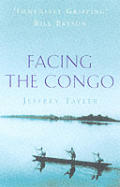 There will be travails, and you have to prepare for them. Before I went to Zaire (now the Democratic Republic of the Congo), in 1995, hoping to recreate Stanley’s descent of the Congo in a dugout canoe, I knew I had a lot to learn. I had never even been to sub-Saharan Africa before. Health seemed an urgent matter, so I studied malaria and its prophylaxis, sleeping sickness and its mode of transmission, plus dysentery, yellow fever and even Ebola—whatever I could potentially come down with. Weather would effect my journey, so I pored over meteorological charts, and learned about the rainy season, la saison sèche (the dry season) and la petite saison sèche (the little dry season). I studied Lingala, the main African language spoken along the river, and read up on history and recent events in Zaire. All this preparation (which, as it turned out, still wasn’t enough) I recount in the prologue to “Facing the Congo,” and, from what I hear, people enjoy reading about it. In any case, don’t skimp on research. To write a book or an article, you may not need to complete your itinerary—“Facing the Congo” was about a failed expedition—but you do have to survive it. Your best survival tool is knowledge acquired beforehand.
Though adversity is frequently a writer’s friend, there’s no need to court it. No matter how diligent your preparations, enough will go wrong, so problems, too, will form part of your story. For “Glory in a Camel’s Eye,” I trekked six hundred miles down the Drâa Valley in Morocco, on foot and by camel, having chosen to set out in the cool months, and expecting the cool, at least a relative cool, to last till the end. I was wrong; the weather charts I had consulted were just not detailed enough to give me an accurate picture of the climate from start to finish. Throughout the final, torrid month, I staggered through the desert behind my Bedouin guides, step by unsteady step, dizzy and nauseated, halfway lost in hallucinations, stricken with heat exhaustion. Late in the expedition, I found a partial remedy in oral rehydration salts. A year afterwards, pains of a different sort beset me while on a two-month trek in the High Atlas Mountains of Morocco, for a National Geographic Magazine story on the Berbers. The soles of my feet blistered and peeled, my toenails blackened and fell off, and two tumbles from my mule left my head scarred and my back in spasms. Yet in both cases, fearing failure, I persevered, and, as a result, I passed into an almost altered state of consciousness. I came to sympathize more than ever with those who suffer—and admire those who, like my guides, suffered in silence. Suffering in silence, hopeless silence, is, after all, the lot of the larger part of humanity, and so it behooves us, as writers, to partake of it.
By the way, I found in this altered state a trove of material. As I trudged across the sands or along the mountain path, I could, to distract myself from pain and preserve my sanity, return to childhood memories, ponder the events of the day (I always travel with a shortwave radio, to keep up with the news), and solve vexing problems in my head. I benefited from, of all things, the luxury of time. Consider this: how often in life do we have nothing else to do but think, for eight hours a day, for weeks on end? The desert also taught me to appreciate sleep in a new way, for only at night did the temperature drop, and only in sleep, through dreams, could I escape the misery every sunrise brought. Dreams also have formed part of my writing.
But of course there’s much more to expeditions than pain. This past winter, for Men’s Journal, I traveled to the Republic of the Congo to attempt something like a reprise of my 1995 pirogue venture. This time, I put to use what I had learned from past mistakes, and I succeeded. And I discovered that I never wanted to leave the river that had so terrified me in 1995. For a month, my two African guides and I paddled with the current, slept in the jungle, and ate the fish we caught fresh, facing dangers and pleasures together and enjoying a camaraderie I had not expected. I was intoxicated with joy; it seemed that this was how I was meant to live, barefoot and tanned and well-fed on a great African river, subject to nothing more than the caprices of the weather and the exigencies of survival. The latter are manageable, at least for the well-prepared. I’ll admit that at first I wondered how much of a story I had, given the lack of colorful disaster. Then it occurred to me: anyone can sail down a jungle river and run into trouble. But when everything works out, now there’s an original tale.
Objectivity plays a role in telling our story, but it’s tough to be dispassionate in writing about ourselves. Writing truthfully about ourselves may not be pleasant or flattering. We care about how we look when we walk out of the door in the morning, and, in what we write for publication, we may be inclined to present our best side. But we must pen the truth. That means showing our bad days, our mistakes, our dumb decisions, and our foibles as well as our strengths. Readers will appreciate the honesty, and you’ll sleep well at night, with nothing to hide. So, whatever your weaknesses are, write about them, and be explicit. Don’t be hubristic: tell your readers how you really felt, not how you wished you could have felt.
Now for some practical matters concerning, specifically, writing for publication. You submit your expeditionary story to an editor, and it’s accepted. Are you finished? No. Major magazines stipulate in their author contracts that you provide them with sources and back-up information for what you’ve written. That means annotating your text, fact by fact, citing sources used; and you have to send in these sources with your manuscript so that a researcher can check them. You also have to submit the phone numbers and e-mails of the people described, as far as is possible. The magazine may not call everyone, but they do need to know that they exist.
Keep accurate notes. For me, this has meant taking along a pocket notepad to record observations by day, which I transcribe into a journal at night. A computer would be no good on the Congo or in the Sahara, where there’s no electricity, so I mean a paper journal, something that can’t crash and won’t tempt thieves.
There’s one thing that will help you remember what you saw, and that may in fact persuade an editor to buy your work: pictures. Magazines used to prefer 35mm slides, though digital photography is now prevailing. But digital cameras consume a lot of batteries, a drawback on a long expedition; and extreme heat and humidity may wreak havoc with digital technology. As a rule, for expeditions stick to film. Since shooting slides isn’t easy, consider either taking a course in photography, or studying one of the excellent how-to guides available from National Geographic.
 You’ll need to invest time and money in photography. Nikon and Canon are the best and most reliable brands of equipment, as you probably know. They can be repaired in big cities all over the world. When I set off on an expedition, I take along, as a rule, two camera bodies, two Speedlight flashes, four or fives lenses, plus an array of filters. Slide film is expensive, but less expensive than a missed opportunity, as they say, so I take a lot. A roll a day is often a bare minimum. Once out in the field, you’ll need to shoot pictures of yourself in action. That often means using a tripod and a remote-control cord—more equipment to put on your list. Once you’re back home, choose the best of your slides, number them, and slip them into archival sheets marked with your name, copyright, and story title. Submit a caption list with the slides explaining who and what is in each. Your magazine will compensate you according to a space-based rate for the slides they use, and they pay, of course, for film and processing.
In closing, I’ll say one more thing in favor of expeditions. They’ve left me with a lasting internal kaleidoscope of stirring vignettes—of a sandstorm descending to darken the desert sky at noon; of a night hawk alighting on my tent beside Lake Izougher’s dry stony bed, its silhouette crisp in a silver wash of moonlight; of the Congo’s oily currents aflame with the dying sun; of the stony bleakness of northern Siberia’s coast as frigid rains roll off the Arctic Ocean. If I drift further back into my travels, before I traveled to write, or wrote to live, I can remember the granite chasms of Kurdistan and the feathergrass steppes of eastern Anatolia; the midday chorus of cicadas by the Temple of Vassai in the Peloponnesus. I don’t know when or where my last day will come, but I’m sure that I won’t leave this life pining after things I’ve never seen. Speechless before the sun’s bloodred death in Africa, I’ve known something akin to the exultation that the Greeks must have felt watching the tragedies of Euripides in Epidauros, twenty-five hundred years ago.
Whether you succeed or fail in life or on an expedition, the main thing is never to surrender what’s most important: your sense of wonder. Be, like Henry David Thoreau, “as sincere a worshipper of Aurora as the Greeks.” And remember Andrei Gide’s words, which might serve as a motto for all travel writing: “Le sage est celui qui s’étonne de tout.” “The wise man is he who is amazed by everything.”
—Delivered at the Paris American Academy, July 5, 2006
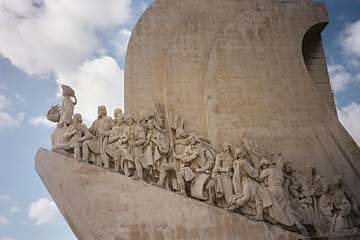
Photo of the Momument to the Discoveries in Belem, Portugal by Kelly Amabile, who took the photo in February 2006 during a four day stay in Lisbon that marked the beginning of my five month European backpacking adventure. “Visting the Momument to the Discoveries in Belem (a short bus or train ride from downtown Lisbon) as I began my own exploration seemed a perfect way to begin my travels,” she says. “It is one of my favorite shots.” Kelly writes for Written Road and at her own weblog, Lost in Place.
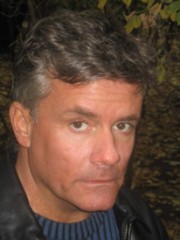
Photo of Jeffrey Tayler by Tatyana Shchukina
 Email to friend
 Twitter
 del.icio.us
 Digg
Digg Facebook
 Furl
Furl Ma.gnolia
 Mixx
Mixx Reddit
 StumbleUpon
 Yahoo! Buzz
Jeffrey Tayler is a contributing editor for The Atlantic and the author of six books, including River of No Reprieve: Descending Siberia's Waterway of Exile, Death, and Destiny. His latest is Murderers in Mausoleums. His second book "Facing the Congo"