
Travel Blog
Travels Through the Wreckage of Japan’s ‘Triple Disaster’
by Michael Yessis | 09.02.11 | 7:59 AM ET
World Hum contributor Daisann McLane’s Well-Traveled dispatches about her travels to Sendai, Fukushima and Tokyo four months after the 9.0 earthquake, tsunami and nuclear disaster struck Japan has concluded at Slate. It’s an amazing series, powerful and heartbreaking and beautifully written. From the first of three parts, Sendai Rising From the Wreckage:
Even after four months, it’s a mess of Augean proportion: uprooted pine trees, splintered wood beams, crumpled abandoned cars, wooden fishing boats tipped on their side, trying to sail away on a sea of mud. Your first reaction is to throw up your hands in desperation—how on earth do you begin cleaning this up? But the Japanese have passed that shock stage, and have whipped themselves into action: a squadron of earth movers is busy, steadily organizing the endless wreckage into tidy haystack-like hills. “This was the town of Natori.” Akawa-san points over to a spot on the eastern, coastal side of the highway. There’s nothing there but a solitary house without walls, its soggy furnishings and books spilling out the way junk tumbles from an overstuffed closet.
McLane, whose extraordinary writing career has ranged from contributing to Rolling Stone during its heyday to her current spot as the Real Travel columnist for National Geographic Traveler, explained how writing about the triple disaster affected her in an email to friends and colleagues:
The experience overcame me. Those of you who are writers, photographers and editors will understand: Sometimes you find yourself in the middle of an extraordinary story that makes you want to write your heart out. This was one of them.
 Email to friend
 del.icio.us
 Digg
Digg Facebook
 Furl
Furl Ma.gnolia
 Mixx
Mixx Reddit
 StumbleUpon
 Yahoo! Buzz
Alec Baldwin: ‘Save the Travel Book Shop!!!’
by Jim Benning | 08.31.11 | 4:32 PM ET
Actor Alec Baldwin is among those lending his support—or Tweets, at least—to a campaign to save the Travel Bookshop, the three-decades-old British bookstore made famous in the 1999 film “Notting Hill.”
The film starred Hugh Grant, who played the owner of the shop specializing in travel writing. Julia Roberts also starred, and Baldwin made an appearance.
The bookstore’s owner put the shop up for sale in May. Poet and journalist Olivia Cole launched a campaign last week to find a buyer, but some fear it’s too late. It could close in early September.
The news prompted Michael Jacobs to reflect on the state of travel writing in The Observer:
Some people might conclude that the Travel Bookshop is doomed because travel writing itself is doomed. Such pessimists tend to point to the internet as the final factor in the genre’s potential extinction. The internet has certainly made redundant a Victorian type of travel book bringing together a lot of factual and statistical information about a country. It is also likely to do away soon with the need for guide books and the travel pages of newspapers (at least in their present form).
But, despite the rise of the internet and all the recent negative attitudes towards travel writing, to predict the death of the genre seems to me as nearsighted as believing that this country’s pioneering travel bookshop has come to the end of its useful life.
Video: ‘The Sinner’s Grand Tour’
by Jim Benning | 08.31.11 | 3:39 PM ET
Traveler and historian Tony Perrottet discusses his latest book, The Sinner’s Grand Tour, and one of his most exciting discoveries:
David Brooks on Travel and the Haimish Line
by Jim Benning | 08.30.11 | 4:32 PM ET
The New York Times columnist recently took his family on safari to Kenya and Tanzania. They stayed in simple camps where they got to know people and more luxurious camps where they did not.
The more elegant camps felt colder. At one, each family had its own dinner table, so we didn’t get to know the other guests. The tents were spread farther apart. We also didn’t get to know the staff, who served us mostly as waiters, the way they would at a nice hotel.
I know only one word to describe what the simpler camps had and the more luxurious camps lacked: haimish. It’s a Yiddish word that suggests warmth, domesticity and unpretentious conviviality.
It occurred to me that when we moved from a simple camp to a more luxurious camp, we crossed an invisible Haimish Line. The simpler camps had it, the more comfortable ones did not.
Brooks goes on to extrapolate larger lessons about how we live. It’s a well-worn theme in travel—see Rick Steves and a thousand other sources. But the message never gets old, undoubtedly because most advertising continues to insist we’ll be happier if we just spend more money.
Ai Weiwei’s Beijing
by Michael Yessis | 08.30.11 | 12:37 PM ET
The Chinese artist has broken his post-detention silence in a piece for Newsweek. He writes of Beijing:
I feel sorry to say I have no favorite place in Beijing. I have no intention of going anywhere in the city. The places are so simple. You don’t want to look at a person walking past because you know exactly what’s on his mind. No curiosity. And no one will even argue with you.
None of my art represents Beijing. The Bird’s Nest—I never think about it. After the Olympics, the common folks don’t talk about it because the Olympics did not bring joy to the people.
There are positives to Beijing. People still give birth to babies. There are a few nice parks. Last week I walked in one, and a few people came up to me and gave me a thumbs up or patted me on the shoulder. Why do they have to do that in such a secretive way? No one is willing to speak out. What are they waiting for? They always tell me, “Weiwei, leave the nation, please.” Or “Live longer and watch them die.” Either leave, or be patient and watch how they die. I really don’t know what I’m going to do.
National Parks, as Seen from Space
by Michael Yessis | 08.25.11 | 11:14 AM ET
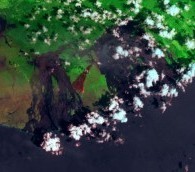
That’s Hawai’i Volcanoes National Park on the Big Island. Over at Wired, Betsy Mason pulled stunning images of 20 more parks.
Elisabeth Eaves Talks Wanderlust on ‘Q’
by Jim Benning | 08.23.11 | 7:36 PM ET
Nice interview with World Hum contributor Elisabeth Eaves on Canada’s public radio interview program, “Q.” She discusses her new book, Wanderlust, and reflects on the women travel writers of yore.
I’ve been listening to podcasts of “Q” pretty regularly since I downloaded the CBC’s iPhone app. It’s a great show. In my book, it rivals NPR’s “Fresh Air.”
R.I.P. Chelsea Hotel
by Eva Holland | 08.22.11 | 11:02 AM ET
The Daily Mail reports that the iconic New York City hotel is no longer accepting new guests, and that its remaining long-term residents are “resigned to being bought out to make way for a run-of-the-mill boutique hotel” now that a new developer has taken control of the site. It’s a sad end for a notorious building. Tom Leonard looks back on the Chelsea’s more than 100 years:
Surely no other single building can lay claim to so much creativity, destruction and sheer scandal as the Chelsea Hotel in New York. For decades it was a byword for Bohemian eccentricity and hellraising excess, an imposing but squalid sanctuary for writers and artists too penniless or troublesome to live anywhere else.
Jack Kerouac wrote his Beat Generation bible On The Road there, in one drug-fuelled, three-week marathon. Arthur C. Clarke wrote 2001: A Space Odyssey there, too, training his telescope not into space but at the apartment windows opposite… From writers such as Mark Twain, Tennessee Williams and Eugene O’Neill, through the hippies and on to the nihilist punks of the 1970s and beyond, ‘the Chelsea’ has more than lived up to its understated description of itself as a ‘rest stop for rare individuals’.
(Via Sophia Dembling)
Travel Movie Watch: ‘The Loneliest Planet’
by Eva Holland | 08.17.11 | 7:01 AM ET
The Loneliest Planet premiered at the Locarno Film Festival last week. It’s an adaptation of a travel-themed short story, “Expensive Trips Nowhere,” by World Hum contributor Tom Bissell, and it stars Gael Garcia Bernal of “The Motorcycle Diaries” fame. The story follows a pair of young backpackers on a guided hiking expedition in the Caucasus Mountains, and judging from this Variety review, it’s a must-see:
Much of the pic’s first hour unspools through continuous handheld shots of the threesome trudging along with backpacks, telling stories when they’re not silently concentrating on navigating treacherous terrain. At regular interludes, long-distance shots observe them dwarfed by the landscape as Richard Skelton’s haunting, rhythmic, ethnically inflected score intones in the background.
An encounter on the trail turns into a near-life-threatening test of manhood that Alex [Bernal] arguably fails. Thereafter, none of the characters discuss what happened, but it casts a profound pall over the adventure, shifting allegiances and sympathies among the threesome. ...[V]iewers may recognize a core emotional truth about how deeply travel tests relationships, how a single instinctive action can shift the ground irrevocably between people, and how no words can make things right.
The Unknown World vs. GPS
by Michael Yessis | 08.15.11 | 2:24 PM ET
Ari N. Schulman asks what “the greatest revolution in navigation since the map and compass” means for how we move through the world.
When driving down the highway, you can now expect to see, in a sizable portion of the cars around you, GPS screens glowing on dashboards and windshields. What these devices promise, like the opening of the Western frontier, and like the automobile and the open road, is a greater freedom—although the freedom promised by GPS is of a very strange new sort.
Toward the end of the piece, Schulman tackles the Kerouac question: “How, then, would the new technology of location affect an ‘On the Road’ today?”
Can we imagine its characters, and by extension ourselves, escaping into the Western night, navigating by GPS and choosing where to go with Yelp, supplied with surrounding-relevant multimedia by GeoTour, encountering city streets with their iPhones held up and overlaying the view, and still having the same adventure? Something about this image is absurd. To better appreciate what and why that might be, it is helpful to step back and consider On The Road‘s forerunner in American wayfaring legend, the classic Adventures of Huckleberry Finn.
(Via Andrew Sullivan)
An Argument Against the Summer Vacation
by Eva Holland | 08.15.11 | 8:55 AM ET
At Front Porch Republic, Jason Peters goes there:
There’s no paucity of smiling children, or of aching muscles after you’ve rough-housed the kids and cousins in the lake or pool, but then you can almost see the seeds of greater expectations germinating in the soils of their little brains. The danger is that they’ll grow up to live for their two weeks’ worth of vacation each year and hate the other fifty. And that is no way to live a life.
In fine, there is the sense that you have fully arrived: at long last you are all consumer, endlessly provided for and endlessly entertained. But if, deep down, you have reconciled yourself to your condition, which is not to play but to work, you know that without work you cannot fully inhabit your humanity. Or: all play and no work makes daddy a dull boy.
(Via Andrew Sullivan)
What Does it Mean to be a Nomad?
by Michael Yessis | 08.12.11 | 11:26 AM ET
Venkatesh Rao calls herself an “illegible person.” She explains:
My temporary nomadic state is just one aspect of a broader fog of illegibility that is starting to descend on my social identity. And I am not alone. I seem to run into more illegible people every year. And we are not just illegible to the IRS and to regular people whose social identities can be accurately summarized on business cards. We are also illegible to each other. Unlike nomads from previous ages, who wandered in groups within which individuals at least enjoyed mutual legibility, we seem to wander through life as largely solitary creatures. Our scripts and situations are mostly incomprehensible to others.
“Wanderlust” author Elisabeth Eaves calls Rao’s essay the “best thing I’ve read on nomadism since Bruce Chatwin.”
Rao means something else too: As nomads, we become illegible to a system that can’t pin us down by income, residence, or occupation. Governments and corporations begin to see us as either irrelevant or suspicious. I like to think I’ve contributed a little to this subject in “Wanderlust,” when I talk about stationary peoples’ mistrust of the nomad. The great work on this theme is Chatwin’s “The Songlines.”
(Via @ElisabethEaves)
Endless Travel Writing Ethics Debate Gets Kindle Singled
by Michael Yessis | 08.09.11 | 12:41 PM ET
Mike Albo, the freelancer who mused about feeling like a “guppy who is being eaten by his mother” after being outed as a taker of press trips, has fictionalized his experience and put it up for sale as a Kindle Single.
“I was perilously close to exposing a secret underground economy of promotion: favors and junkets and banquets and gifts that keeps the city in motion, and keeps underpaid writers at work,” Albo writes. “Basically, I became the Silkwood of Swag.”
Does Travel Change Us? The Debate Goes On.
by Eva Holland | 08.09.11 | 8:21 AM ET
A few months back, we blogged about a provocative essay by Caitlin Rolls that argued against travel as a life-changing force. Now The Smart Set’s Jessa Crispin has weighed in too, touching on everything from Rolls’ essay to Tony Hiss’ concept of “deep travel” to Crispin’s own early travels.
Videos You Must See: Move, Learn, Eat
by Eva Holland | 08.06.11 | 9:56 AM ET
Edith Zimmerman from The Hairpin summarizes these three gorgeous travel shorts thusly: “Three beautiful, infuriating young men had enough time and money to go everywhere, eat everything, and turn it into three little movies. Go to hell, beautiful young men!”
“Move” is my favorite. “Learn” and “Eat” are below the jump.
MOVE from Rick Mereki on Vimeo.
