
Travel Blog
New Travel Book: ‘The Turk Who Loved Apples’
by Eva Holland | 05.08.13 | 8:30 AM ET

Veteran travel writer Matt Gross has just released his first book: The Turk Who Loved Apples, a collection of never-before-published stories about his life as a traveler. Gross is a former Frugal Traveler columnist for the New York Times—he’s also an occasional contributor to World Hum. The Portland Book Review calls his book “part memoir, part travel odyssey and part growing-up story,” and National Geographic’s Intelligent Travel blog has named it one of the best travel books to land in stores this spring.
You can read an excerpt over at the New York Times.
 Email to friend
 del.icio.us
 Digg
Digg Facebook
 Furl
Furl Ma.gnolia
 Mixx
Mixx Reddit
 StumbleUpon
 Yahoo! Buzz
Chaos in Airworld? The 1981 PATCO Strike
by Eva Holland | 05.07.13 | 8:00 AM ET
In the wake of last week’s sequester-driven air travel delays, Jalopnik looks back at a short-lived 1981 strike by the Professional Air Traffic Controllers Organization, better known as PATCO. It’s a fascinating case study. Here’s writer Michael Ballaban:
As soon as the strike began, airlines reported losing $30 million a day. PATCO predicted insanity, with planes crashing into each other, hundreds, perhaps thousands (millions? billions?) of flights cancelled, and women and children crying and men gnashing their teeth.
The FAA began immediately to implement its contingency plan, which included asking airlines to voluntarily delay or cancel some flights, asking pilots to be a bit more vigilant, and calling in perhaps the best air traffic controllers in the world, the United States Air Force.
And after all that… nothing. Planes kept flying. Nobody crashed. Nobody died. Everybody still got to where they needed to go.
It spelled the end for PATCO.
AFAR Goes to Coffeeland
by Eva Holland | 04.25.13 | 8:58 AM ET
In the latest AFAR, longtime World Hum contributor David Farley goes to the world’s caffeine heartland: Ethiopia. Here’s Farley:
Coffee is to Ethiopia what hops are to Bohemia or grapes to Bordeaux. That is, coffee is almost everything, from the cornerstone of the community’s economic fortunes to the lifeblood of its social relations. Java drinking is so deeply rooted here that Azeb was dumbstruck that I could have lived 40 years on the planet never having seen what coffee looks like before it’s plucked, peeled, dried, roasted, and ground.
Which is exactly why I was in Ethiopia. I wanted to travel around this East African country’s primary coffee-growing regions and immerse myself in its coffee culture. I can sit around at coffeehouses in New York and San Francisco drinking all the Ethiopian coffee my brain can take before spinning out of control. But I was curious about the time and toil it takes to produce these beans, everything that goes into slaking the States’ obsessive thirst for small-batch artisan roasts.
Headed to Coffeeland yourself? Check out our primer on how to take part in an Ethiopian coffee ceremony.
Consider the Hotel Breakfast Waffle
by Eva Holland | 04.24.13 | 6:23 AM ET
In the Washington Post, veteran travel writer Tom Haines ponders the rise of the free hotel breakfast—specifically, the dominance of the DIY waffle maker—and what it means for travelers. “This is comfort without community,” he writes, “as the mood in these hotel breakfast rooms feels neither home nor away. There’s an isolation-among-the-crowd sense in the breakfast area that resembles that of an airline terminal: Everyone alone together while waiting to move on.” He goes on:
It is worth considering the costs of this world of waffles all cooked from the same mold. If the lure is to sleep, eat and move on, we Americans taste less and less of the diverse character of the country we call home. And as individuals, we miss the discovery that can come with the unexpected.
(Via @myessis)
Rocketing Through the Grand Canyon
by Eva Holland | 04.23.13 | 7:58 AM ET
The May issue of Outside includes a gripping story, Rocketing Into the Great Unknown, about a 1983 speed run through the Grand Canyon. The river was in full flood—there was so much water, the Glen Canyon dam was at risk—when three experienced river guides decided to attempt the run in a wooden dory. The resulting story, an excerpt from Kevin Fedarko’s forthcoming book “The Emerald Mile,” is a page turner. Here’s a taste:
And now he waited for it. At the top of every rapid, a moment comes when the topography of the whitewater reveals itself. This happens in an instant; there is no preamble. One second you’re approaching a flat horizon line, the next, what lies beyond is visible in all its fury. That final flash comes like a slap in the face, the sting amplified by the knowledge that the choices you’ve made—your angle, your timing, your speed—are now irrevocably set.
As Grua approached this point of no return, he processed a few last-second details. A slice of calmer water was sluicing past the right-hand shoreline—he could see that now. But that water was too shallow for a wooden boat, studded with half-submerged boulders and laced with broken tree limbs that stuck out like punji sticks.
“Do you think I should cut right?” Grua shouted over his shoulder, looking for confirmation from Petschek.
“You don’t have a chance of doing it,” Petschek called back. “Keep her straight!”
The men braced as the current seized the hull and slung them toward the biggest mess of whitewater that any Grand Canyon boatman had ever seen.
The issue is packed with adventure narratives. Aside from Fedarko’s Grand Canyon story, there are also dispatches from South Sudan and a long-distance Mongolian horse race, and a look back at the first American ascent of Everest. It’s worth checking out. Meanwhile, we published a story about a mellower journey through the Grand Canyon, Michael Shapiro’s River a Mile Deep, last year.
Drawing Every Building in New York City
by Eva Holland | 04.17.13 | 7:50 AM ET
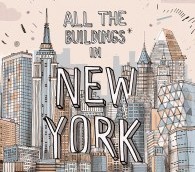
Yep. All 900,000 of them. That’s what artist James Gulliver Hancock is trying to do, and a book containing 500 of his completed drawings has just been released, All the Buildings in New York: That I’ve Drawn So Far.
The Atlantic Cities interviewed Hancock about the project. Here he is on his artistic style:
I’ve always drawn with this mix of technicality and whimsy. I think it is a great extension of my personality; a little bit of technical obsession, combined with a little bit of artistic messiness. It’s a push and pull which I think you can see in my drawings and is somehow relevant to New York, which is after all a crazy organic mess organized on a grid.
36 Hours in Taipei: Realist’s Edition
by Eva Holland | 04.16.13 | 11:57 AM ET
Vanity Fair’s Juli Weiner has a bone to pick with the NYT’s latest “36 Hours in…” travel feature. “We are very aware of the fact that The New York Times is an internationally read newspaper,” she writes, “and that many subscribers probably do live a short drive from Taipei, but does The New York Times recognize that ... many subscribers would have to travel for 36 hours just to reach Taipei?”
Weiner offers up a revised version of the itinerary. It’s funny and, at times, too familiar:
Friday
Five a.m.After a total of eight hours of flight delays, arrive at Taiwan Taoyuan International Airport and ask your significant other whether he remembered to exchange currency before you left. He did not. As it is five a.m., there are no banks open. There is a currency converter at the airport. Wait 25 minutes behind a very large family who seem to be exchanging their country’s entire G.D.P.
Six a.m.
After collecting your luggage, argue bitterly with your significant other about whether to “just take a cab to the hotel” or “get acclimated with the mass-transit system.” Roll your eyes and snap that you will “have lots of time to wander aimlessly around the subway but after sitting on a plane for 20 f*cking hours is not the time to start, O.K.?” Your significant other will stomp off and get a cab. The ride will be circuitous, bumpy, and extremely expensive and you will feel miserable and responsible for everyone’s unhappiness.
(Via @skiftnews)
R.I.P. Roger Ebert
by Eva Holland | 04.12.13 | 8:24 AM ET
The film critic with the famous thumbs died last week at age 70. He was a TV host, author, and—later in his life—a prolific blogger and Twitter user. He was also, as Meg Nesterov points out over at Gadling, an occasional travel writer. Here’s her roundup of his best travel-focused work.
Esquire has made its 2010 profile of Roger Ebert freely available online. It’s worth your time.
R.I.P. Chinua Achebe
by Jim Benning | 03.22.13 | 10:49 AM ET
The celebrated Nigerian writer has died at the age of 82.
He was best known for his novel “Things Fall Apart,” which is about the clash of traditional Nigerian culture with the arrival of bibles and British colonial rule. When the novel turned 50 in 2008, Frank Bures reflected on its impact and the world Achebe evoked.
The publication of “Things Fall Apart” is often cited as the birth of modern African literature, and since its publication the book has sold some 11 million copies in 50 countries.The Chronicle of Higher Education wrote that for Americans, is it “the quintessential novel about Africa.” In fact, it is the foundation of tens of thousands of college students’ introduction to the continent, and forms many of our ideas of the place even today.
That’s fine, and I realize that “Things Fall Apart” is required reading. But as important as it is, “Things Fall Apart” is a novel of the past. Since then Africa has changed so much and so fast that the amalgam of the world Achebe wrote about and the one we see today can be hard to recognize. These days, there are so many other great novels coming out that reflect the Africa of today: “Graceland,” “Waiting for an Angel,” “Purple Hibiscus,” and on and on.
GQ Goes ‘Place Hacking’
by Eva Holland | 03.14.13 | 8:01 AM ET
In GQ, Matthew Power goes on an epic, multi-day, two-nation ride-along with a band of London-based “urban explorers”—a thriving subculture of folks who illicitly climb public buildings, plumb the depths of city sewer systems, and otherwise challenge our notions of public space. The unlikely leader of Power’s crew is Dr. Brad Garrett, who’s completed a PhD on the phenomenon:
His dissertation in human geography, which he had defended the previous year, was entitled “Place Hacking.” The title came from his argument that physical space is coded just like the operating system of a computer network, and it could be hacked—explored, infiltrated, re-coded—in precisely the same ways. He conducted a deep ethnographic study of a small crew of self-described “urban explorers” who over several years had infiltrated an astonishing array of off-limits sites above and below London and across Europe: abandoned Tube stations, uncompleted skyscrapers, World War II bomb shelters, derelict submarines, and half-built Olympic stadiums. They had commandeered (and accidentally derailed) an underground train of the now defunct Mail Rail, which once delivered the Royal Mail along a 23-mile circuit beneath London. They had pried open the blast doors of the Burlington bunker, a disused 35-acre subterranean Cold War-era complex that was to house the British government in the event of nuclear Armageddon. The London crew’s objective, as much as any of them could agree on one, was to rediscover, reappropriate, and reimagine the urban landscape in what is perhaps the most highly surveilled and tightly controlled city on earth.
The catch-all term for these space-invading activities is “Urbex,” and in recent years it has grown as a global movement, from Melbourne to Minneapolis to Minsk. The Urbex ethos was, in theory, low-impact: no vandalism, no theft, take only photographs; as one practitioner put it, “a victimless crime.”
Read the whole thing. And don’t miss the slideshow that shares the unusual views urban explorers are privy to.
Armchair Traveling at Tax Time
by Eva Holland | 03.13.13 | 7:39 AM ET
It’s tax time again. For me, as a freelance writer, that means hours spent wading through all the work-related receipts I’ve collected in the past year. The process is a pain, but it comes with a silver lining: I get to revisit 12 months’ worth of travel.
A handful of restaurant receipts takes me back to my unofficial Halibut Taco Tour of Southeast Alaska last winter; a stack of gas station slips sends me retracing my summer road-trip routes. Every year I promise myself that I’ll start sorting and filing my receipts as I go, instead of filling a shoebox with them and leaving it until tax time. But even if I managed to up my organizational game, I’d still be tempted to delay and do it all in one shot anyhow—the trip down the memory-lane paper trail is just about worth it.
Anyone else do this sort of armchair traveling come tax time?
47 Hours on the Sunset Limited
by Eva Holland | 03.05.13 | 7:25 AM ET
For its Voyages issue, the New York Times Magazine includes a long, lingering story about a long-haul Amtrak ride. Writer Nathaniel Rich rode the Sunset Limited from New Orleans to L.A., and he captured the spirit of long-distance train travel along the way:
Traveling coach on Amtrak is not exactly luxurious, but amenities are superior to business class on many American airlines. A person seated in coach on a Superliner—the double-decker train used on the Sunset Limited route—has access to a dining room with white tablecloths and waiter service and to seats with 15 inches or so more legroom than those in some first-class airplane cabins, as well as access to electrical outlets. But playing video games or watching movies on a phone or computer tends only to distract for several hours, and there is no Wi-Fi, so most passengers turn to a more traditional form of entertainment: conversation.
The cliché, familiar to air travel, of the nosy passenger who makes pestering conversation with his seat partners does not exist on the long-distance train. On the Sunset Limited, everybody is nosy, and no one seems to mind.
Elsewhere, Slate’s Matt Yglesias notes that routes like the Sunset Limited are not exactly moneymakers. I think Rich’s story can be taken as an argument for why they matter nonetheless.
R.I.P. The International Herald Tribune
by Jim Benning | 02.26.13 | 11:56 AM ET
The venerable newspaper isn’t going away, but it will be getting a name change. The New York Times Company, which owns it, announced Monday that it will change the name of the publication this fall to The International New York Times.
From the New York Times’ story, which quotes IHT publisher Stephen Dunbar-Johnson:
The renamed paper will remain based in Paris, where it was founded 125 years ago as the European edition of The New York Herald, Mr. Dunbar-Johnson said. It will also keep its sizable office in Hong Kong where the Asian edition is edited. Mr. Dunbar-Johnson said there also would be investments in other locations. Until the fall it will continue to be published as The International Herald Tribune.
Some of my best travel memories—especially pre-internet—involve sitting down at a cafe with the International Herald Tribune, catching up on the news and watching the world go by. So the coming name change feels a bit like the end of an era.
Though of course that era—when papers like the IHT were the only source of news from home—came to an end with the rise of smart phone and digital media.
A Call to End Reclining Seats on Planes
by Eva Holland | 02.20.13 | 1:30 PM ET
Like many of us, Slate’s Dan Kois hates it when the person in front of him on a plane reclines their seat all the way—making it nearly impossible for him to watch his seatback TV, use his tray table, or even get in and out of his chair very easily. But instead of calling for passengers to use some restraint and common sense (I’m a never-recline-more-than-halfway gal, myself), he goes further: He demands an end to reclining seats entirely. Here’s Kois:
The problem isn’t with passengers, though the evidence demonstrates that many passengers are little better than sociopaths acting only for their own good. The problem is with the plane. In a closed system in which just one recliner out of 200 passengers can ruin it for dozens of people, it is too much to expect that everyone will act in the interest of the common good. People recline their seats because their seats recline. But why on earth do seats recline? Wouldn’t it be better for everyone if seats simply didn’t?
I’m convinced. What do you think? (Via @legalnomads)
R.I.P. Peter Root and Mary Thompson, RTW Bloggers
by Eva Holland | 02.18.13 | 4:07 PM ET
Very sad news from Thailand, where round-the-world cycle-tourists and bloggers Peter Root and Mary Thompson, of Two on Four Wheels, have been killed in a road accident. The couple, both 34, had been cycling since mid-2011, and had successfully crossed Europe, the Middle East, Central Asia and China before arriving in Southeast Asia. They were hit by a pickup truck east of Bangkok last Wednesday.
“What helps me is to think of how happy they were with each other,” Root’s father, Jerry, told the AP. “They were leading the life they wanted to. It was the happiest, the most fruitful of lives.”
