
Travel Blog: News and Briefs
R.I.P. Liberace Museum
by Eva Holland | 09.14.10 | 3:57 PM ET
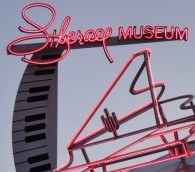
The Vegas classic is closing its doors after more than 30 years—apparently, due to shrinking revenue, from both the museum itself and the Liberace music royalties that help support it. Over at Flyover America, Sophia Dembling laments:
What is the world coming to?
I’ve been to the Liberace Museum more times than I should probably admit. Three? Four? I’m not sure, but I’ve been dazzled every time. What’s more, even though I lived through the Liberace era, I didn’t know until I visited the museum how really huge Liberace was—he sold out the Hollywood Bowl, for Pete’s sake! (Or George’s sake. And if you don’t know what I mean, then you don’t know Liberace.)
The Liberace Foundation is hoping to reopen the museum someday. In the meantime, some traveling exhibits are in the works.
 Email to friend
 del.icio.us
 Digg
Digg Facebook
 Furl
Furl Ma.gnolia
 Mixx
Mixx Reddit
 StumbleUpon
 Yahoo! Buzz
New Travel Book: ‘Under the Sun: The Letters of Bruce Chatwin’
by Eva Holland | 09.13.10 | 5:11 PM ET
A collection of the author’s letters is due out in February. Many were sent to family and friends—including fellow travel writers Patrick Leigh Fermor and Paul Theroux—during his travels around the world. Nowness.com has a few brief excerpts; here’s a tantalizing favorite:
To Francis Wyndham, Lima, Peru, 1974
I have done what I threatened. I suddenly got fed up with N.Y. and ran away to South America… I intend to spend Christmas in the middle of Patagonia… I’m working on something that could be marvelous, but I’ll have to do it in my own way.
Chatwin’s “In Patagonia” and “The Songlines” both made our list of the 100 most celebrated travel books of all time.
Meet the SkyRider, the Tiniest Airplane Seat Yet
by Eva Holland | 09.13.10 | 3:32 PM ET
Wired has the scoop on the SkyRider, a new “saddle-style” design that debuts next week at an aircraft interiors conference. This latest innovation shaves up to ten inches off each row. Blogger Charlie Sorrel asks: “Is it one step closer to just drugging us and piling us onto shelves like suitcases, or a legitimate next-step for cheap air-travel?”
Stranded: Ash Cloud Magazine On Sale Now
by Eva Holland | 09.13.10 | 2:19 PM ET
A few months back we noted that a group of travelers stranded by the volcanic ash cloud were putting a magazine together—and sure enough, the aptly-named Stranded has arrived. Its 88 ad-free pages are heavy on the graphics and photos; there’s a preview available online. All proceeds from sales go to the International Rescue Committee, “to help people stranded in a more permanent way.” (Via Kottke)
What We Loved This Week: Rock Creek Park, Rainy Day Camping and ‘Sweetness and Blood’
by World Hum | 09.10.10 | 5:36 PM ET
Eva Holland
I spent a rainy Labor Day weekend camping in Haines, Alaska, and the weather didn’t detract at all. The beautiful thing about camping in town? We were never more than a few minutes’ walk from a warm, dry bar and the local brew on tap.
Michael Yessis
Rock Creek Park. The too-hot summer in Washington D.C. seems to be over, and I spent some of the long holiday weekend walking through the park’s shady paths, basking in the glorious weather.
Jim Benning
I’ve really been enjoying Sweetness and Blood, which is both a travel narrative and a look at surfing and globalization. Great stuff.
Travel Movie Watch: ‘Gulliver’s Travels’
by Eva Holland | 09.09.10 | 3:13 PM ET
We blogged about the adaptation when it was first announced a couple years back, and now the release date is in sight—“Gulliver’s Travels” is due out December 22nd. Here’s the trailer:
(Via Gawker)
Airline-Fee Angst
by Jim Benning | 09.09.10 | 2:48 PM ET
MSNBC covers the latest in travelers’ frustrations over baggage fees and other supplemental charges, and it notes a new website for venting, aptly named MadAsHellAboutHiddenFees.com.
David Byrne’s ‘Bicycle Diaries’ Audio Book to Feature Music, Sounds
by Jim Benning | 09.09.10 | 1:34 PM ET
The “Bicycle Diaries” audio book comes out Sept. 28. I’m intrigued. From DavidByrne.com:
The audiobook version of Bicycle Diaries is available as individual chapters in a podcast-style download exclusively via this site. In addition to music and narration by DB, it also features location sounds, creating an atmosphere more akin to a radio show than a simple reading of the book.
We published Cycle Killer, an excerpt from the book, last year.
Slate Takes a Nudist Vacation
by Eva Holland | 09.08.10 | 2:50 PM ET
“Human Guinea Pig” columnist Emily Yoffe bared all for journalism. Here’s the introduction to her resulting, funny dispatch:
The most disconcerting part of my visit to a nudist camp I’ll call “Hidden Bush” occurred when I got in a discussion about the benefits of nudity with a longtime member I’ll call “Dick.” Nudists, nudists will tell you, are very friendly, and Dick had spotted me as a newcomer as I stood naked and adrift by the pool. He came over to welcome me and proselytize for the benefits of nudism. He told me about the cruise he had taken to Alaska with 2,000 other naked people, and as I tried to envision all of this sagging flesh chugging toward unsuspecting caribou, I was distracted by a more immediate, awful sight. I could see myself reflected in Dick’s sunglasses. All of me. It was impossible to follow our chitchat as I watched my pale flesh quiver every time I made a gesture.
A Conversation With Fidel Castro
by Eva Holland | 09.08.10 | 1:35 PM ET
Atlantic writer Jeffrey Goldberg recently got a personal invitation to visit Cuba—from Fidel Castro. His first dispatch from the trip is live, and it’s a fascinating mixture of traveler’s observations and quotations from the rarely-seen Cuban leader. Here’s a taste:
The morning after our arrival in Havana, Julia and I were driven to a nearby convention center, and escorted upstairs, to a large and spare office. A frail and aged Fidel stood to greet us. He was wearing a red shirt, sweatpants, and black New Balance sneakers. The room was crowded with officials and family: His wife, Dalia, and son Antonio, as well as an Interior Ministry general, a translator, a doctor and several bodyguards, all of whom appeared to have been recruited from the Cuban national wrestling team. Two of these bodyguards held Castro at the elbow.
...Fidel lowered himself gently into his seat, and we began a conversation that would continue, in fits and starts, for three days. His body may be frail, but his mind is acute, his energy level is high, and not only that: the late-stage Fidel Castro turns out to possess something of a self-deprecating sense of humor. When I asked him, over lunch, to answer what I’ve come to think of as the Christopher Hitchens question—has your illness caused you to change your mind about the existence of God?—he answered, “Sorry, I’m still a dialectical materialist.”
In the next installment, Goldberg tells the story of “one of the stranger days I have experienced, a day which began with a simple question from Fidel: ‘Would you like to go to the aquarium with me to see the dolphin show?’”
Europe: East vs. West, or North vs. South?
by Eva Holland | 09.07.10 | 4:21 PM ET
Anne Applebaum thinks the continent’s axis is changing, from the East-West divide of the Cold War era to a new, and more fluid, North-South split. She writes in Slate:
North and South: Not everybody is going to like that concept, especially not the new South, some of whose members are not necessarily in the southern half of the continent. For these are not geographical designations, but political terms of art. The South contains all those countries whose political classes have not been able to balance their national budgets, whose bureaucrats have not been able to reduce their numbers, whose voters have not learned to approve of austerity: Greece, Spain, Portugal, Italy, Hungary, Bulgaria, and—at the moment—Ireland.
The North contains the budget hawks: Germany, Poland, Estonia, Scandinavia, the Czechs, and the Slovaks. Britain’s new government, with its austerity budget, aims to return to the North, following its recent experience of life in the South. France floats somewhere in between. Wealth, as such, isn’t northern: Much of the South is very rich. But in the North, private wealth has grown more or less in tandem with the public sector. Private wealth and public squalor are more typical of the South.
Meet the Traveler Who Saved Graham Greene’s Life
by Eva Holland | 09.07.10 | 2:17 PM ET
In the Telegraph, Tim Butcher tells the little-known story of Barbara Greene, a cousin of the well-traveled author—and, apparently, his savior on a 1935 trip through Sierra Leone and Liberia. Here’s Butcher:
At the off, the adventure was the property of Graham Greene. He made all the arrangements and took all the decisions, hiring a team of 24 bearers, three servants and a cook. A child of the late Edwardian era, Barbara Greene was happy to go along with this.
But after crossing into Liberia and beginning the trek, a reversal took place. Graham fell ill, dangerously ill, while Barbara got stronger and stronger. They had various adventures and almost lost each other in the thick forest, but the key moment came about three weeks into the walk when his illness worsened dramatically and he lost consciousness.
“Graham would die,’’ she later wrote. “I never doubted it for a minute. He looked like a dead man already ... I was incapable of feeling anything. I worked out quietly how I would have my cousin buried, how I would go down to the coast, to whom I would send telegrams.’‘
Calmly Barbara Greene took over responsibility for the trip, settling on the route, arranging food and motivating the bearers. Having completed the same trek last year for my book, staying in the same villages and enduring the same climate, I am in awe of her achievement. And I am in no doubt that she saved her cousin’s life.
(Via The Book Bench)
Literature’s Best Train Trips
by Michael Yessis | 09.07.10 | 12:54 PM ET
The Guardian lists 10 of them, including ones in JK Rowling’s “Harry Potter and the Philosopher’s Stone,” Graham Greene’s “Stamboul Train” and Thomas Hardy’s “Midnight on the Great Western.” Of the latter, John Mullan writes:
Hardy’s poem is a vignette of Victorian public transport, preserved forever. By “the roof-lamp’s oily flame” a boy is seen half asleep in his third-class seat, his ticket stuck in his hat band, “Bewrapt past knowing to what he was going, / Or whence he came”.
(Via @nicholebernier)
What We Loved This Week: Rachid Taha, Fall Colors at Alaska’s Denali Park and More
by World Hum | 09.03.10 | 3:49 PM ET
Jim Benning
Algerian musician Rachid Taha. I discovered him recently on a flight—he was a featured artist on Delta’s in-flight audio entertainment system. He has covered the Clash’s “Rock the Casbah.” Here’s a taste of something perhaps slightly less familiar:
Political Pundits Tackle American Vacation Time
by Eva Holland | 09.03.10 | 10:28 AM ET
‘Tis the season for lots of vacation talk, and so the Capitol Hill crowd turned its attention to shrinking vacation syndrome this week: First, a British columnist speculated that Americans “find it hard to relax” because of their Puritan heritage. Washington Post columnist Ezra Klein responded:
I’d say it’s more closely related to the fact that it’s hard to pass social welfare legislation in the American political system, and thus America is the only industrialized country that doesn’t guarantee its workers some amount of paid-vacation leave.
NRO’s Reihan Salam followed up with a mild defense of the American system. (Via The Daily Dish)
