
Bhutan: How Will the World’s Last Independent Himalayan Buddhist Kingdom Survive?
Travel Blog • Michael Yessis • 03.20.08 | 12:30 PM ET
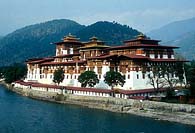 The once-isolated country has welcomed tourists, satellite television and Matt Lauer in its efforts to engage the world. Now, as Arthur Lubow writes in the latest Smithsonian, the country has begun efforts to preserve its culture by displaying it outside its borders. Two major exhibitions are set for the United States this spring and summer, displays of Buddhist art in New York and San Francisco, and “demonstrations of traditional Bhutanese dancing, weaving, metalworking, woodcarving and herbal medicine” at the Smithsonian Folklife Festival in Washington D.C. Lubow traveled to Bhutan to see how these efforts, as well as larger issues of globalization, are changing the country.
One person Lubow spoke to, Dasho Penden Wangchuk, Bhutan’s Secretary of Home and Cultural Affairs, put it this way: “We feel ourselves a drop in the ocean. And what do we need to survive? Our culture. You want to preserve a plant or the black-necked crane because they are endangered. But [people] are the highest form of living being. The world goes gaga over a particular variety of orchid, but here is a nation. Would you like to see Bhutan disappear?”
Bhutan faces another transformative, first-time event Monday: elections. The country’s citizens will go to the polls to elect a parliamentary government to replace the existing monarchy. Clashes have already been reported in advance of the election. To police the situation, some of Bhutan’s borders will be closed leading up to the vote.
Related on World Hum:
* Bhutan Opens Up to Tourists, Globalization and Matt Lauer
* Eric Weiner: On Following Your Bliss
Photo by babasteve, via Flickr (Creative Commons).
 Email to friend
 Twitter
 del.icio.us
 Digg
Digg Facebook
 Furl
Furl Ma.gnolia
 Mixx
Mixx Reddit
 StumbleUpon
 Yahoo! Buzz
Michael Yessis is the cofounder and coeditor-in-chief of World Hum.

David DeFranza 03.20.08 | 4:31 PM ET
When Dasho Penden Wangchuk said “[people] are the highest form of living being. The world goes gaga over a particular variety of orchid, but here is a nation. Would you like to see Bhutan disappear?” I wounder if he was thinking at all about more than 100,000 refugees that have fled Bhutan’s repressive and discriminatory “cultural preservation” policies since the 1980s.
If you are interested in Bhutan’s misguided struggle to preserve its culture I recommend the excellent “Unbecoming Citizens: Culture, Nationhood, and the Flight of Refugees from Bhutan” by Michael Hutt.
N Tshering 03.20.08 | 9:19 PM ET
Mr. Michael, without knowing well the real rationale on refugee issue, people like you will be definitely mis-leaded. If I may touch the history of arrival of Nepali ethenicty in Bhutan, it was in early 1960s that countable few of them arrived in Bhutan as labourers. Those few people were given in later years a Bhutanese citizen. By then lots many of them migrated to Bhutan illegally. Bhutan Government realized only in mid 1980s. Illegals immigrants were then flushed out as done still now by any nation - should I use word deported.
What has Bhutan’s ancient well-preserved and endured culture and survival in this modern world has to do with the flushing of the illegal immigrants? Why such issue you raised has to come un-deservingly and unwantingly be here.
Infact, which country allows illegal immigration? US, Australia, Europe?
I think world should know that real bare truth than listen to few disgruntled disguised people.
Bhutan is small least developed yet peaceful country sandwiched between two giants. World should therefore, feel sympathy and support its survival as peace-loving green-committed nation rather than creating such instability inside like our neighbour Nepal.
Thank you.
Tim Patterson 03.21.08 | 3:16 AM ET
I’m torn on this one. David and Tshering, I respect both of your opinions. I have nothing but love and respect for the land and people of Bhutan. I believe the Bhutanese government was within its rights to expel ethnically Nepali migrants who came to Bhutan to work and never left.
But the process of deportation was just plain ugly, and I fear that many people born and raised in Bhutan were forced out on the basis of their ethnicity.
A broader discussion of this over-looked refugee crisis is important and should be welcomed by all parties involved.
David and Tshering and others - I’ll look forward to continuing this conversation.
M. Norbu 03.21.08 | 4:49 AM ET
Isnt it just plain ignorance how people judge such serious allegations while reading just one book. My thinking was that the biggest bifference between humans and animals were that human beings had the capacity and the resource to gather information and then rationalize on the information. However, I am sorry to say I cannot say the same to David. He seems to just have a one sided view and definately a biased one. For your kind information, if Bhutan really did such a thing woudl the international community forgiven Bhutan? Bhutan has been put on the hotspot time and again by western countires as well as by groups on several occassions but all allegations were unfounded and thus could not do anything. FYI, Bhutan today has almost 23% of its population as from the ethnic Nepalese population who are genuine and true citizens of Bhutan and we do not have problem with them. In fact they are present in all walks of life from being high ranking civil sevants, armed forces, business.
However, David, it is indeed sd that you read just one book and come to conculsion on such serious allegations. Mr. Hutt’s book if I may comment is just a sadist point of view. I guess he just wanted to prove that he in another controversial writer and could garner name and fame. I am sorry it does not however contain any scholarly work (all fictions). BTW, the Govts of Bhutan and Nepal has undertaken a joint verifying exercise in one of the camps and have found that only 3-4% of those residents were actually Bhutanese citizens. Further, you may wish to seek UNHCR’s cencus results. It may shed more light as to th true identity of those people and the accuracy of Michael Hutt’s book.
student 03.21.08 | 7:35 AM ET
But the process of deportation was just plain ugly, and I fear that many people born and raised in Bhutan were forced out on the basis of their ethnicity.
Time,
The above stated points is not true to my knowledge. They were forced to leave the country by their ethnic group who tried to revolt aganist the government by not willing to accept the laws of the country. Nepali ethnic group tried thier best to bring nepali culture by not wearing our dress. IF they are Bhutanese, they should be able to speak national language and wear our dress and follow the laws of the country..let the culprit suffer.
Tim Patterson 03.21.08 | 7:26 PM ET
Dear Student -
I have never been to the refugee camps on the Nepal / Bhutanese border and none of my knowledge is first-hand, but I think the balance of evidence shows that in many instances the deportation process was violent, and clearly predicated on ethnicity, skin color and cultural habits.
An ethnic minority was forcibly removed from the territory of a sovereign nation by that nation’s military in order to maintain national and cultural unity.
I appreciate Bhutan’s efforts to preserve their wonderful culture and beautiful environment, but to callously say “let the culprit suffer” for not following a national dress codes is uncalled for - indeed, it smells strongly of fascism.
If your voice represents the majority opinion of the Bhutanese people, I would be leery to visit the Kingdom again - and I imagine many tourists would feel the same.
It would be unfortunate to engender bad press at this sensitive time in Bhutan’s political development. I would urge the Bhutanese government to act more like the Dalai Lama, and less like Beijing.
With respect,
Tim
N Tshering 03.22.08 | 6:05 AM ET
Mr. Tim,
I deeply respect for your views commented here from the information and knowledge you have gathered so far. I would not say you are wrong but I would rather say as you said, you might like to visit Bhutan once and feel the reality.
About the refugee problem, I have given only the historic issues in very brief and simplistic way in my earlier comment to make message clear across to readers on other side of river. In another short sentence, this time, I would be glad to put this way, “how can a man who has never been behind ploughing oxes would know how it is tough to plough?”
I understand that expulsion of some of the present refugees by means of military action would not be called as deportation, as you questioned. In 1990, those people made uprising with violence, therefore needs to be retaliated in military way as any country do. Country like Bhutan having just 0.6 million population sandwiched between two world giants which even the world-power US is afraid of,will have instability if we do not act as per the needs. Bhutan’s stability is like being right on the tip of needle - any small jerk could topple, if not careful. Therefore, we should act in a best way to stabilize. And to create coercion among ourselves to have one strong nation through its cultural unity and identity rather than through economy, development or military or nuclear - you name all.
But most importantly I would like to BROADCAST here that many of the people that being claimed as refugees are not real refugees of Bhutan, but they are people from Nepal and India (nepali ethenic). Only less than 10,000 out of 1 million people would be our real refugees. Those people also went on their own either accompanying their ex-puled non-Bhutanese relatives due to sentiments or warned and tortured by those refugee militant who keep attacking them across the border at home.
Before 1990, the Bhutan’s immigration system and check, has been very crude and almost impossible to detect well and early those illegal immigrants, owing to landlocked and mountainous terrain without any roads and vehicles within the country requiring almost week to travel from one town to another (distance of 200km) on foot over several high mountains and deep unfriendly gorges (and rivers). Those times were than taken for granted by those people to migrate into Bhutan in the southern border which has few kilometers of plains near India, for the free education system and health that Bhutan was receiving then. Frankly, it took almost a decade to realize the Bhutan government to smell the huge influx of immigration. Even the simple hand made citizenship ID of Bhutan was easily forged by them across the border in India and claimed themselves as Bhutanese.
By the time Bhutan Government announced for official authentication of citizenship through their records, those guilty made uprising with violence which I said has to be controlled by military action and flush out the non- Bhutanese militants (in fact calling refugees will be inappropriate term to them).
Perhaps, I can go on writing or talking but is not appropriate here. Please visit Bhutan one day soon to have right opinion of the situation and feelings there. We never liked China and so our way will definitely not be that of Beijeng. that is for sure Mr. Tim.
Democracy has knocked in the country and truth will not be far to be injected into people like you who has been misinformed. And remember, King has granted the democracy, and that alone has becomes exemplary things in this world ever, with focus on gross national happiness. And this too will not be definitely like those claimed by China and the communist.
all the best to visit to Bhutan.
N Tshering 03.22.08 | 7:13 AM ET
Mr. Tim,
Forgot to answer your one question. Bhutan government was sincere in determining to bring back those few genuine refugees till 2004 if it was not due to that gross incident happened in the refugees camp. The high-level Bhutanese officials were near to their death bed from the violent mass attack of refugees. It was final round to categorize and bring back the genuine refugees and was announcing the strategy.
Because of this unfortunate pre-mediated incident occurred, Bhutanese high-level officials nearly lost their lives. And for the time being the issue has been deferred until appropriate time. Before that I feel Nepal has to have sincere and good-willing government - to facilitate well this process.
So Mr. Tim, tell Nepal government to be sincere for humanitarian sake and blame them while our country cannot do anything without their great assistance.
Mr. Tim, visit Bhutan, don’t read such non-sense news from unethical and unauthenticated internet sources.
David DeFranza 03.22.08 | 2:51 PM ET
N. Tshering commented that, fearing its neighbors, Bhutan has sought stability “And to create coercion among ourselves to have one strong nation through its cultural unity and identity.” While I understand this was likely a typographic error, I think the statement accurately summarizes what has happened in Bhutan. The only way to illustrate what I mean is to outline the events:
According, not to Mr. Hutt’s book which I maintain is a fair and academic assessment of the situation, but to a report from the UNHCR, the King of Bhutan, His Majesty Druk Gyalpo, granted citizenship to a group of Nepali settlers living in southern Bhutan in 1958. These settlers began migrating to Bhutan as early as the late-nineteenth century (Human Rights Watch, 2007). These settlers were, in fact, invited into the country to develop an agriculture industry in the southern region (UNHCR, 1995). By the mid 1950s, many ethnic Nepali Bhutanese had attained positions in the police and even central government. In light of this, the 1958 Citizenship act was a reasonable step towards acknowledging Bhutan’s demographic realities (Human Rights Watch, 2007).
However, the requirements for citizenship outlined in this 1958 act were revised to become more stringent in 1977. This new act required knowledge of written and spoken Dzongkha, the language of rule in Bhutan (UNHCR, 1995). Citizenship, under this new law, could also be revoked for political dissent or association with those expressing dissent (Human Rights Watch, 2007).
Another citizenship act in 1985 changed the language requirement from “some knowledge of Dzongkha” to “proficiency in Dzongkha.” More significantly, the 1985 Citizenship Act defined 1958 as the cut off for establishing citizenship. Those who could not prove their citizenship was established before December 31, 1958 lost their status in Bhutan, despite their compliance with previous regulations (UNHCR, 1995).
This new legislation was followed by a national census in 1988. The new census project was administered only in southern Bhutan and rejected ethnic Nepalis as naturalized citizens. Instead, the census required proof of residency in 1958 (Human Rights Watch, 2007). Evidence showing residency prior to 1957 was rejected, as was evidence showing residency in 1957 and 1959. Those who could not provide this evidence were labeled either “returned migrants” or “illegal immigrants” (Human Rights Watch, 2007).
Shortly after the results of this “census” became available, a new series of “Bhutanization” policies were introduced. These policies sought to foster the government’s new vision of “One Nation, One People.” The policies forced Bhutan’s population to conform to the ruling Drukpa people’s tradition of dress, etiquette, language, and values (UNHCR, 1995). Failure to comply with the new dress code resulted in one week imprisonment or immediate payment of a fine, of which arresting officers were allowed to keep 50% (UNHCR, 1995). In fairness to Bhutan’s government, they quickly realized an over enforcement issue had developed and have taken measures to make it more relaxed (UNHCR 1995). Still, the incident, along with the changing citizenship legislation, and the arbitrary census, are important for establishing the chain of events that led to the Nepali’s sense of insecurity in Bhutan.
These feelings led Bhutan’s ethnic Nepalis to draft a petition, airing their grievances with the legislation, census, and “Bhutanization” policies. This petition was submitted to the King in 1988 by two members of the Royal Advisory Council. The petition was ruled seditious (UNHCR, 1995).
Conditions continued to worsen, with disenfranchised Nepalis in southern Bhutan becoming more anxious and politicized. In 1990, a demonstration against the government erupted across southern Bhutan. The demonstrations, involving thousands of Nepalis, were mostly peaceful, though there were incidents of violence and vandalism targeted at local officials, census offices and records (UNHCR, 1995). The demonstrators were immediately classified as “anti-nationals” and thousands were detained (Human Rights Watch, 2007). Reports of torture and deaths in detention, as well as rape involved with raids on Nepali homes after the demonstrations have emerged (Human Rights Watch, 2007).
(continued below)
David DeFranza 03.22.08 | 2:53 PM ET
(continued from above)
By the end of 1990, officials initiated a campaign against Nepalis in Bhutan that can, as N. Tshering stated, only be called coercion. It began when several Nepali demonstrators were released from prison on the condition that they leave the country. Other people, now classified as “anti-nationals,” were given the choice to leave Bhutan or face imprisonment (Human Rights Watch, 2007). As people began to disappear from their homes and police visits became common, the remaining Nepalis in the south were given one last option: sign a “voluntary migration form” and leave (Human Rights Watch, 2007). Under these circumstances, and the promise of a small amount of money, many people did this.
In drawing attention to this crisis, and it is just that, I do not want to point a finger of blame at Bhutan’s people. Horrible things happen around the world, precipitated by democracies, monarchies, and dictatorships alike. Often, there is little citizens can do by the time they realize what is happening. However, denial of the situation will not lead to solutions. Regardless of whether, as a citizen of Bhutan or any country, you view these ethnic Nepali refugees as illegal immigrants or not, you must accept that, in some capacity, Bhutan is responsible for what has happened to them. Now it is the responsibility of Bhutan and the world to find a solution.
Citations:
Human Rights Watch. “Last Hope: The Need for Durable Solutions for Bhutanese Refugees in Nepal and India.” May, 2007
UNHCR. “The Exodus of Ethnic Nepalis from Southern Bhutan.” April 1, 1995.
Note: I have many more resources related to this issue, if anyone is interested.
Mr. David 03.22.08 | 8:38 PM ET
Mr. David,
Whichever ways we approach I understand that ultimate target is one and the same. I understand you might have some figures and data with your references to UNHCR and other sources, as far as you are concerned. But I don’t want to deny that there are few thousand refugees (less than 10,000) that deserves to be returned home. That makes around 90% to 95% are pure bogus refugees. They were attracted just for UN free foods, money and other assistances. How does your references say on this figures?
And as I mentioned in my last comment, as equal as Bhutan is committed to bring back these few countable deserving refugees, Country like Nepal needs to be highly cooperative to deal the matter appropriately. And the world over?
While we can discuss this issue from many angles and go on, I insist you visit Bhutan if you have not, and also try to visit refugees place and other NEARBY areas rather than read only the perceptions of the international communities and views of few (10 or less) peoples.
As mentioned, we will not be far from the truth with the new democratic government to be installed anytime within these few months.
Mr. David, I respect your views (of single person) on the refugees, but all persons do not have same views on it (even the international people like you). Therefore, we should not be inclined but be judging correctly as neutral party.
Tim Patterson 03.23.08 | 4:07 AM ET
David, N. Tshering, others -
I’m grateful for this discussion and hope we can keep it up.
A quick clarification - when I said that my knowledge of the Bhutanese / Nepali refugee problem is not based on firsthand observation, I meant that I haven’t been to the refugee camps.
I have been to Bhutan, in October of 2006, and was overwhelmed by the good cheer of the people and the sheer, majestic beauty of the landscape, and, moreover, by how well the culture and land are integrated.
I wrote a guide for travelers to Bhutan, which you can read here:
http://www.talesofasia.com/bhutan.htm
Again, I haven’t been to the refugee camps, but here is a dispatch from Chris Ord, a colleague who lived there for a time and conducted extensive interviews.
http://www.thetravelrag.com/docs/10137.asp
Let’s keep the discussion flowing…
-Tim
N Tshering 03.23.08 | 6:35 AM ET
Tim,
It is great you have visited Bhutan and thank you for your article on guide-tour to Bhutan. I deeply appreciate it.
Well, Tim and David, coming back to our subject, I wanted to inform you that the Government of Bhutan has only recognized that few thousand people (less than 10,000 as far as I know) in the Nepali refugee camp are genuine Bhutanese, eligible for returning to Bhutan. That makes as far as I know 90% to 95% of the refugees are not Bhutanese refugees but came from elsewhere - which Bhutan Government will and should not be responsible. And therefore, Bhutan should not be blamed by the international communities on Bhutan’s failure to prove from where the balance refugee came in.
Bhutan should be responsible for that few thousand people; but without the needful cooperation of Nepalis Government, Bhutan cannot do anything on this matter.
We pray this matter be resolved in more responsible way soon.
Tim Patterson 03.24.08 | 1:06 AM ET
Dear N. Tshering -
Thanks for your kind words about my tourist guide to Bhutan!
I’m curious - what is your position in Bhutan? Are you a journalist, or a representative of the government, or an interested observer?
I am a 25 year old journalist from the States.
Thanks again for the discussion.
Best,
Tim
N Tshering 03.24.08 | 5:58 AM ET
Mr. Tim,
I am 33 year old man residing in Australia for more than a year.
Basically, you can term me as ‘interested observer’. I have nothing more of interest than to educated people about the real truth on Bhutan and its refugees problems, especially the ones who has been mis-leaded and misguided.
I just want to request people like you who are media professionals that you need to be just and fair without being inclined on either side.
Please study well in depth before you writeespecially on Bhutan without giving your personal views and conclusions - writing only facts you hear and see.
Thank you.