
The Critics: ‘Travels With Herodotus’
Travel Blog • Ben Keene • 07.03.07 | 4:13 PM ET
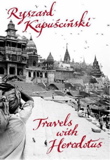 Many of us rely on guidebooks when we travel, whether for practical advice, personal insight or a bit of simple reassurance. Ryszard Kapuscinski, or “the legendary chronicler of anarchy” as he’s called in the July issue of Outside, apparently never made a trip without his copy of The Histories by the 5th century BC Greek polymath, Herodotus. Writing for the magazine, Patrick Symmes aptly describes the newish Travels With Herodotus—it was published in Polish in his native country in 2004—as a “final gift, a call to wander widely and see deeply” from the journalist. Since the appearance of an English edition on bookshelves earlier this month, lengthy reviews have peppered periodicals in Canada and England, as well as across the United States. World Hum’s review appears today. With one exception that I was able to find, all of them—perhaps knowing it was their last chance—nearly fall over themselves offering praise.
Ben Ehrenreich’s Los Angeles Times review suggests that Kapuscinski writes “as if Kafka and García Márquez had teamed up and pinched Isaac Babel’s press pass.”
Honing in on the writing itself, Tahir Shah contributes an admiring review to the Washington Post. He lauds Kapuscinski for his journalistic attributes, namely his skillful powers of observation and his willingness to try to understand the experience of his subjects on a very real—and as Shah sees it, rare—level. In his conclusion, Shah laments a lazier method of reporting today and positions the author of “Travels With Herodotus” as a foil of sorts: “For me, this is a travel book that all students of writing and of literature ought to read, not so much to learn what to put into their writing, as to glean what to leave out.”
Tom Bissell, a World Hum contributor, recommends the memoir in the New York Times Book Review. Giving some context to Kapuscinski’s noteworthy career and then gradually bending his tune from reluctant apologist to ardent defender of the foreign correspondent against recent critics who would fault him for allegedly deliberate misrepresentations, Bissell finds plenty to complement within the 275 pages of “Travels”:
A nameless energy gathers as one reads deeper into “Travels With Herodotus,” and one begins to realize that, in many ways, Kapuscinski’s previous books, however brilliant, were somewhat impersonal. Here, finally, we experience the early tremors Kapuscinski underwent for the privilege to write them. Not all of it is painful; much of it, in fact, is delightful—especially the revelation that Kapuscinski learned English from Hemingway. And one finally sees that in writing about Herodotus Kapuscinski is actually writing about himself. Herodotus tried to get the best information available, Kapuscinski notes, ‘and, given the epoch, this speaks to a tremendous expenditure of effort and to great personal determination. ... And if he knows something, how does he know it? Because he heard, he saw.’
Kapuscinski saw more, and more clearly, if not always perfectly, than nearly any writer one can think to name. Few have written more beautifully of unspeakable things. Few have had his courage, almost none his talent. His books changed the way many of us think about nonfiction and made many of us want to travel for ourselves and see for ourselves.
In her complimentary review for the Financial Times, Elizabeth Speller tries to “search for clues about the man behind the words,” just as Kapuscinski did with “The Histories,” and she finds an explorer who is at once amazed and alienated. In this pursuit she seems to be at least partially successful, learning on the one hand that his desire to see the world was total and unrelenting, while on the other, that his childhood in Communist Poland heavily influenced his writing, leaving him preoccupied with the universality of war and determined to peel back the contradictory layers of totalitarian governments.
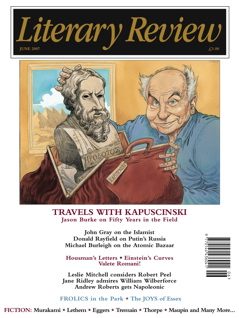 Besides dubbing it “classic Kapuscinski” and “a fitting testament” to his quest to discover the truth within his stories, the Literary Review picks up this same sense of alienation in its June issue, which also happens to feature a humorous illustration of the two globetrotting scribes on the cover (pictured). Commenting that “Travels” is “full of references to various languages, to identities based on languages, to differences based in language,” reviewer Jason Burke uncovers yet another revealing fascination held by the prolific Pole.
Margaret Atwood, who met Kapuscinski in Warsaw in 1984 and again in Toronto in 1986, provides a unique and rather personal review for the Guardian that reads more like a belated obituary. Praising him for his intellectual courage as well as his physical resilience, she comments on how surprised she was to discover the shy and nervous side of his personality he revealed in their two encounters. As she reflects in her thoughtful piece though, she finds these qualities to be indicative of strength, not frailty:
Surely no other writer has had greater grounds for pessimism, considering all he saw, but this is not an emotion Kapuscinski expresses often. More frequent is the note of wonder: wonder that such things—both splendid and squalid—can exist on earth. Near the end of Travels with Herodotus, there’s a single line. It describes merely a scene inside a Turkish museum, but it has the ring of an epitaph for this modest man who was a superlative witness to our times, and so I will place it as one: “We stand in darkness, surrounded by light.”
Perhaps basking in the glow of Kapuscinski’s implied optimism, the Atlanta Journal-Constitution delivered a one-word verdict for “Travels”: Exhilarating. Calling him a “magically lucid chronicler of lands in violent flux,” Peter Lewis argues that Kapuscinski relied on Herodotus for help so often because like the Greek, he was cheerful, kind, and relaxed, and “it is only to such people that strangers reveal their secrets.”
Finally, in the Village Voice, a lone voice of dissent. At first Giles Harvey seems to agree with the critics already mentioned, explaining that “Kapuscinski attempts to emulate the humility, curiosity, and intelligence that he sees as the chief virtues of his beloved historian.” But while he clearly admires the author, he’s not much of a fan of the book itself, finding “Travels” instead to be “effete,” “ponderous,” and “desultory,” ultimately concluding that the “stylistic slackening” he observes “is indicative of a broader intellectual senescence. Although Kapuscinski’s books have always closed in obliquely on their destinations, so that the reader is never quite sure where he is going, but feels himself to be in safe hands nevertheless, the maunder-ing twists and turns of Travels seem those of an author who has genuinely lost his way.”
Not exactly a rave, but then again, I think it’s rather early to predict the legacy of the last title Kapuscinski produced before his death. Evidence of its merits already seems to be mounting. Sales have begun to pick up appreciably. Time and history are on his side.
Related on World Hum:
* ‘Travels with Herodotus’: Kapuscinski and the Weight of History
* R.I.P. Ryszard Kapuściński
* World Hum’s Top 30 Travel Books
 Email to friend
 Twitter
 del.icio.us
 Digg
Digg Facebook
 Furl
Furl Ma.gnolia
 Mixx
Mixx Reddit
 StumbleUpon
 Yahoo! Buzz