
Weighing the Thrills and Ethics of ‘Shark Safaris’
Travel Blog • Terry Ward • 06.20.07 | 2:14 PM ET
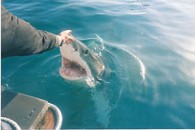 I’m not one to go bungee jumping in New Zealand or canyoning in Costa Rica, yet presenting myself as great white bait in an underwater cage in South Africa has always held a certain appeal. I’ll admit it—I’m obsessed with sharks. And the chance to see the greatest predator of them all in a purportedly safe environment appeals to me in a totally primal way. I have, however, pondered the ethical questions that go along with cage diving. So I was interested to read about Joshua Hammer’s experience in Kleinbaai (two hours from Cape Town) in a detailed piece in the New York Times.
Hammer’s February visit fell during the off season for shark viewing. And while he never actually saw a shark underwater—only from the boat—his trip managed to pack in some serious thrills. And at the end of his story, I was left thinking that just the pursuit of these nomadic creatures—one great white was recently tracked 12,000 miles during a return journey between South Africa and Western Australia—is adventure enough.
Of course, there’s another side to these dives, also known as “shark safaris.”
Critics maintain that luring sharks into human encounters by chumming the water (a common shark safari practice) conditions them to associate humans with food—the Pavlovian response at its most petrifying, if you ask me.
Oddly, Hammer didn’t address the issue in his story. But a Guardian piece from last October examined the ethics of cage dives, presenting views from both a celebrated marine biologist/shark tour operator and a local waterman wary of increasing attacks on humans in the area.
If you’re considering a shark safari yourself, it’s worth feeling out all angles before diving in.
Related on World Hum:
* Swimming Tourism: ‘Ferries Are For Whimps’
* The Rise of Luxe Surf Travel (at Least According to the NY Times)
* Yosemite Visitor’s Death Prompts Half Dome Safety Review
 Email to friend
 Twitter
 del.icio.us
 Digg
Digg Facebook
 Furl
Furl Ma.gnolia
 Mixx
Mixx Reddit
 StumbleUpon
 Yahoo! Buzz
Terry Ward is a Florida-based writer and a long-time contributor to World Hum.

Jupp Kerckerinck 06.21.07 | 4:43 AM ET
My first shark dive was in a cage near Isla Guadalupe in Mexico. We saw 9 Great Whites and helped a Mexican scientist to take DNA samples of 4 of them. It was a wonderful experience, which turned me into a shark enthusiast, who now is an avid shark protector. In the meantime I have done quite a few shark dives without a cage. I have been in the water with Tiger sharks, Bull sharks, Lemon sharks and all kinds of reef sharks. Cage diving has taught me about sharks, without it I would not do what I do now. (Take a look at my web-site) I do not believe that cage diving results in more shark attacks. My God, there are hardly any sharks left to attack anyone. They are being killed by the millions by greedy long-line fisheries, greedy companies like “Alibaba” and greedy countries. Cage diving is educational. Chumming is done with fish and not with human blood; we are not really on their menu. The few shark accidents that happen world-wide per year, are certainly not the result of cage diving. Most accidents are the result of negligent and inexperienced people, who situations to which the sharks react.
Cape Town Villas 10.12.07 | 1:41 PM ET
Yes it’s a tough dilemma! I don’t like sharks so much myself, so wouldn’t really have a problem winding the shark up. But discovering someone got eaten off one of Cape Town’s beaches the day after your dive wouldn’t be too amusing.
Cape Town Villas 10.12.07 | 1:42 PM ET
Yes it’s a tough dilemma! I don’t like sharks so much myself, so wouldn’t really have a problem winding the shark up. But discovering someone got eaten off one of Cape Town’s beaches the day after your dive wouldn’t be too amusing.
Jupp Kerckerinck 10.13.07 | 11:52 AM ET
People and, most of all the media, should stop all the nonsense about “sharks being killers and man eaters”, and respect sharks for what they are: The apex predators in the oceans and as such essential for maintaining the biological balance in that very complex ecosystem. “If the sharks die the oceans die” says Andy Cobb from South Africa, and when that happens, we humans have no chance of survival either. The oceans are our life support system and therefore we need to stop people like ALIBABA, who promote the killing of millions of sharks and make money doing so, and who are business partners with Yahoo.cm That’s where the problem lies, the greedy companies like AlIBABA and Yahoo. Those few people make a fortune on the expense of the world community. They are thieves in my opinion and the fact that a company like Yahoo is making money from such ruthless behavior, should give us all something to think about. If you are really concerned about the environment and the survival of mankind, then switch to another search engine.
search engine optimisation 10.20.08 | 3:50 PM ET
i have never personally been on a shark safari but considering the fact that m extremely….extremely scared of sharks…i dont see it happening anyways…