
What Does it Take to Understand a Culture’s Cuisine?
Travel Blog • Joanna Kakissis • 06.18.08 | 12:41 PM ET
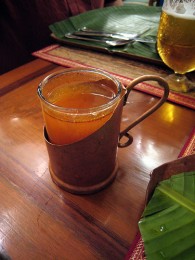 Gourmet contributor Shoba Narayan recently dined with her mother at Masala Klub, a new high-end eatery at the Taj West End hotel in Bangalore. The meal began well enough, with white wine and a good lemongrass rasam (“the holy grail of our community, the Tamil Brahmin people”). But the main course—a collection of too-chewy paneer, undercooked spiced haricots verts and other “forgettable” dishes—left the women underwhelmed. Why couldn’t the savvy chef at Masala Klub impress these compatriot foodies? Narayan says it’s because Indians are so famously possessive of their cuisine that even the most talented haute and fusion chefs rarely stand a chance in the kitchen.
The Narayan family knows the difference between a truly authentic dal makhni and the one I’ve eaten with ignorant satisfaction at a North Raleigh strip mall. Write them off as inflexible food snobs at your own risk. They know exactly what cultural detail each taste evokes, and for that alone, they should be heard.
You don’t have to be a local to understand a culture’s cuisine, though it’s easier if you’ve grown up connecting these foods to places, memories and people. Those who attach cuisine to identity have a hard time with traditional food that’s been modernized or globalized.
I see this in my own attachment to Greek food, which I grew up eating as a child of immigrants in the United States and, of course, eat all the time now that I live in Greece. I’m definitely no fan of fusion Greek: it confuses me, with its non-compatible tastes overwhelming each other, disconnecting me from one of the Mediterranean’s greatest food cultures. Haute Greek is usually too pretentious or Frenchified, though there are notable exceptions such as 48, a don’t-miss restaurant in Athens. The best Greek food is not haute but rustic: chickpeas stewed with eggplant, boiled wild greens dressed with olive oil and lemon, sea bass broiled on fennel fronds, thick yogurt sweetened by a dollop of quince preserves.
My family’s “holy grail” food is, of course, a traditional one. It’s called gamopilafo (wedding pilaf), and it’s made on my mother’s native island of Crete. The preparation sounds deceptively simple—rice cooked with the goat or lamb stock and a sheep’s milk roux called staka. I’ve eaten it at Cretan weddings and at restaurants in Crete and Athens. These attempts at gamopilafo are often tasty, but they have never wowed me. Only the version made by my mother’s brother, Stavros Birikakis, has that power. His gamopilafo is rich with flavor, powerful and lively—like Crete itself.
Woe to any non-Uncle Stavros chef who tries to make it.
Photo Charles Haynes by via Flickr (Creative Commons).
 Email to friend
 Twitter
 del.icio.us
 Digg
Digg Facebook
 Furl
Furl Ma.gnolia
 Mixx
Mixx Reddit
 StumbleUpon
 Yahoo! Buzz
Beth Preddy 06.18.08 | 7:28 PM ET
The question in the headline is interesting since I’ve just returned from Los Cabos and an unbelievable dining experience at Don Emiliano, where Chef Margarita Salinas served a flat out amazing meal that made us swoon and take a breather half way through. Black bean broth from Huichol indians ... roasted mangos with nuts. Ahh. Her point of view differs from yours; she insists that her recipes have come down through generations and while they are thoroughly updated and have a contemporary wow factor (small servings, bright and fresh flavors that collide wonderfully, precious presentations) she feels her deep “genetic” knowledge of the food is what makes the difference. Fact is, it’s the best Mexican food I’ve ever had, by far, and she does happen to be a local.
Ling 06.19.08 | 3:47 AM ET
The key issue, when it comes to appreciating foreign food, is to eat home-cooked food. Unless you’ve tasted teh stuff at home regularly (whether it be with friends or family), you can’t really tell whether the restaurant stuff is good or bad.
COL Jim 06.19.08 | 10:02 AM ET
In order to appreciate foreign food you have to EAT foreign food. I’ve been to 53 countries and eaten everything from durian fruit and jungle rat in Vietnam to Guinea Pig and llama in the Amazon, and I always find in extremely humourous whenever I encounter travelers ordering meals they cannot eat, dislike, criticize etc. Who cares if the Baklava isn’t like your Yaya’s, or what the impact on the schema of life is if the French Onion soup in Paris is too salty, the bratwurst in Munich not a Johnsonville, or the donuts in Prague filled with sweetened lard. The enjoyment is in the adventure!! How to understand a cultures cuisine? Rule Number One-It is THEIR cultures cuisine NOT yours, and if you eat something you don’t like,makes you upchuck, or gives you 4 days of Moctezuma’s revenge, just add it to your war stories and look forward to your next adventure.
Beth Preddy 06.19.08 | 11:31 AM ET
Two comments both on and off the subject: My mother’s family has lived in Southern California for close to a century, and every family gathering featured “enchiladas” as the main meal. A Mexican home cook or chef might be horrified, but that dish became a signature cuisine in its own right. Whether “real” or not.
And today’s Andrew Weill newsletter features a story headlined “Eat like a native.” It’s about health rather than flavor, but here’s the link: http://www.drweil.com/drw/u/WBL02093/Eight-Ways-to-Eat-Like-a-Native.html
Nyura 06.20.08 | 4:10 PM ET
And there’s also really <u>bad</u> authentic cooking. Just because somebody’s mom cooked it doesn’t mean it’s going to be representative of local cuisine at its best.
I agree, to understand a cuisine you have to have eaten a lot of it, and also understand the culture itself to some degree—why certain ingredients are used, how cooking methods developed, who are the people eating it. Understanding a cuisine doesn’t necessarily mean you have to like it.