
Destination: Afghanistan
Summer Travel Reading
by Michael Yessis | 06.07.04 | 9:45 PM ET
The New York Times Book Review’s annual summer reading issue takes a look at seven new travel titles, including Elinor Burkett’s “So Many Enemies, So Little Time” and Michael Gorra’s “The Bells in their Silence: Travels Through Germany.” Reviewer Brooke Allen likes the crop of tomes. “A handful of recent travel books, featuring subjects that range from the only slightly offbeat (revisionist looks at Germany and modern Greece) to the truly mind-stretching (Kyrgyzstan, the Gobi Desert, wartime Afghanistan, peacetime Iraq), have thoroughly trumped the standard travel literature this summer,” she writes.
 Email to friend
 del.icio.us
 Digg
Digg Facebook
 Furl
Furl Ma.gnolia
 Mixx
Mixx Reddit
 StumbleUpon
 Yahoo! Buzz
“I Am Not a Domestic Tyrant”
by Jim Benning | 10.06.03 | 9:18 PM ET
Depending on your perspective, the story is either every travel writer’s worst nightmare or the worst nightmare of anyone who has ever invited a writer into his home. Norwegian journalist Asne Seierstad was covering the war in Afghanistan when a curious Kabul bookseller invited her to stay with him, to see from the inside what life for locals was like. Seierstad accepted the invitation and wrote a non-fiction book about it, “The Bookseller of Kabul,” which is flying off bookshelves in Europe. Trouble is, the bookseller in question happened to read an English translation of the book, and he doesn’t agree with Seierstad’s conclusion that he is a tyrant, and that the women in his home live in slavery. He was so angered by her portrayal of him, in fact, that he has flown to Europe to speak out against the book, calling it “shameful,” and promising to sue the author. “There is more than a smattering of irony that a man who loves literature and has devoted himself to publishing now finds his life scarred by a book,” reporter William Wallace writes in a fascinating account of the conflict in the Los Angeles Times. “And it is equally troubling to see a man who risked his life to hide books from both Soviet and Islamic fundamentalist censors now demand that an offending book be banned, stripped from bookstore shelves and burned.” Free registration is required to access the article.
Rory Stewart Quit British Foreign Office, Walked Across Asia
by Michael Yessis | 03.25.03 | 9:09 PM ET
Rory Stewart quit a promising career in international relations to walk across central and southern Asia. “I think when I set off, my motivation really was to try to put myself in the background and get a feeling, almost an anthropological feeling, of how it is in villages in very remote places, how they see the world, how people see Islam, for example,” he told Guy Dixon, who recently profiled Stewart for Canada’s Globe and Mail newspaper. Stewart chronicled his journey through Pakistan, India and Afghanistan—he’s thought by some to be the first tourist there after the fall of the Taliban—in articles for the London Review of Books and other publications. The stories were so well received, Stewart landed a book deal. “The Places In Between,” which covers his two-year walk, will be released later this year.
‘I Would Get Stopped on the Road Because They Can Tell ... That You’re Not From Around Here’
by Michael Yessis | 02.14.03 | 4:12 PM ET
This week public radio’s nationally syndicated This American Life, one of the nation’s best radio shows, will air American teen-ager Hyder Akbar’s audio journal from his recent journey to Afghanistan. The show promises to be compelling. In many ways, Akbar is like any other suburban American teen-ager: U2 posters cover one of his bedroom walls. But he also has deep family ties to Afghanistan. After September 11, he wanted to see the country for the first time, so he skipped his high school graduation ceremony and went. “As a personal challenge, Akbar insisted on immersing himself totally in the experience,” today’s Los Angeles Times reports. “He refused to be vaccinated beforehand, and while there he suffered intense digestive problems because he drank the water and deliberately ate undercooked meat. It was his attempt to belong in a community that clearly didn’t see him as one of its own.”
War Zones for Idiots
by Tom Bissell | 10.21.02 | 10:54 PM ET
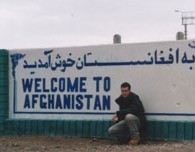 Photo courtesy Tom Bissell
 The "World Series of Journalism" had begun in Afghanistan, and Tom Bissell didn't have to qualify to play. He just had to show up.
What Awaits Visitors to Kabul?
by Jim Benning | 06.15.02 | 12:57 AM ET
After the Berlin Wall fell and Eastern Europe rolled out the welcome mat, Prague was the place to go, at least for a while. Then it was Vietnam. We’re guessing that once the situation stabilizes in Afghanistan, Kabul and its surroundings will get their share of curious backpackers. But what will they find when they arrive? There’ll be a lot to see, according to an Associated Press report on CNN. “There are the mighty snowcapped Hindu Kush mountains, the spectacular blue lakes of Band-e-Amir. And for war historians, the rusting hulks of hundreds of Soviet tanks, helicopters and fighter jets, left in fields where they were abandoned or blown apart.” In addition, according to the report, old postcards for sale on Chicken Street will show visitors how the city has changed as a result of war, and just how much has been lost.
The Critics: The Carpet Wars
by Jim Benning | 06.01.02 | 1:05 AM ET
In “The Carpet Wars,” Australian writer Christopher Kremmer travels a route through Afghanistan, Pakistan, Iraq, Iran, India and other countries to investigate the region’s carpet trade. Morag Fraser of The Age raves,”[It’s] a source of vivid, unexpected pleasure—sharp as the air in the Afghan mountains.” Washington Post reviewer Tracy Lee Simmons is a bit more subdued with her praise: “This book, in its sobriety, puts a human and—despite the random, ritualistic violence—oddly sympathetic face on a part of the world that history, ancient and modern, has brought home to all of us.” Simmons also reviews Tony Perrottet’s “Route 66 A.D.” She notes that it’s “a splendid trip with two gutsy companions, and, by the end, the reader needs a shower as much as they do.”
Travels With Daisy
by Jim Benning | 05.09.02 | 10:22 PM ET
After she was famously kidnapped and released by the Taliban last fall, journalist Yvonne Ridley was accused of being a “bad mother” to her nine-year-old daughter, Daisy. The experience rattled Ridley. She re-examined their relationship and realized she didn’t even know Daisy’s favorite color. So she decided to take Daisy traveling. “We basked on Bondi Beach, shivered in an air-conditioned Dubai taxi, got drenched in torrential rain in Afghanistan and sweated in the stifling heat of Lahore,” Ridley writes in the Observer. “We had an amazing time together but, more importantly, I have emerged from a wonderful bonding experience with a child I am very proud to call my daughter.”
Afghanistan’s Airline: One Place, 1,600 Employees
by Jim Benning | 04.30.02 | 7:08 PM ET
U.S. airlines complain about tough times, but they’ve got nothing on poor Ariana Afghan Airlines. Six of Ariana’s planes were destroyed during recent U.S. bombings. How many are left? “Don’t ask me that question,” the man charged with rebuilding the airline, Jahed Azimi, told CNN. “One aircraft and 1,600 employees. Can you believe it?” It’s hard to believe. But don’t write off Ariana yet. CNN reports that Afghanistan’s commercial airline is resilient: “After all, this is the airline that began domestic flights in December despite an unexploded bomb in the middle of the runway.”
Interview with Robert Young Pelton
by Michael Yessis | 03.05.02 | 2:29 PM ET
Kojo Nnamdi, host of the Public Radio program Public Interest, interviewed Robert Young Pelton last week. Pelton, the author of The World’s Most Dangerous Places, spoke about several of his adventures, including his recent experiences in Afghanistan where he famously interviewed American Taliban John Walker Lindh for CNN.
Flying Afghanistan’s Ariana Airlines
by Jim Benning | 02.27.02 | 11:44 PM ET
The Chicago Tribune’s E.A. Torriero, on assignment in Afghanistan, flew the local carrier recently and lived to tell the tale. As it turns out, Ariana isn’t doing so well these days. The company is down to just two planes. “Look, we used to have three Boeing 727s and five Russian Antonovs,” a ticket clerk explained. “But you [Americans] bombed us. One bomb fell on three planes at once. Now we have one 727 and one Antonov.”
“It Would Be a Pity to be Killed, Of Course”
by Jim Benning | 01.30.02 | 1:16 AM ET
Rory Stewart, a pale, wispy 29-year-old Scotsman, might very well be the first tourist to return to Afghanistan. On Sunday, the Oxford-educated traveler set out on a 600-mile walk through the country, tracing a path once taken by Alexander the Great, Genghis Khan and Tamerlane. The only food in is backpack is a yellow container of emergency rations dropped over Afghanistan by American planes last fall. “Oh dear—why, of course I’m worried,” Stewart’s mother, back in Scotland, said in today’s Los Angeles Times.
The Future of Foriegn News in America
by Jim Benning | 01.29.02 | 1:14 AM ET
Foreign news coverage has long been on the decline in the United States. Has the paucity of international reporting fed American isolationism? Have the September 11 attacks prompted improved international coverage on network TV and in newspapers? If so, will it last? Former Los Angeles Times Editor Michael Parks examines these issues in the latest edition of the Columbia Journalism Review. “American newspapers have carried more stories about Afghanistan on page one in the four months since the September 11 attacks than in the previous four decades,” he writes.
“Sales of Guidebooks to Afghanistan Have Not Been Strong”
by Jim Benning | 01.12.02 | 2:30 AM ET
The latest edition of the New York Review of Books features a story by Tim Judah about his recent travels in Afghanistan. “Sales of guidebooks to Afghanistan have not been strong during the last two decades, so the bookshop in Kabul’s Intercontinental Hotel (no running water on most floors, and bring your own sleeping bag) still has plenty of copies of Nancy Hatch Dupree’s 1977 Afghanistan left on its shelves,” he writes. “It is perhaps the most extraordinary guide I have ever read.” In the same issue, Ian Buruma, author of the analytical Asia travel narrative God’s Dust, among other books, offers a historical perspective on Occidentalism, September 11 and anti-modernization movements. “There is no clash of civilizations,” he writes. “Most religions, especially monotheistic ones, have the capacity to harbor the anti-Western position.”
Travels in Afghanistan
by Michael Yessis | 01.09.02 | 2:36 AM ET
A Los Angeles Times columnist recalls travel writing about Afghanistan, including Bruce Chatwin’s 1980 short essay, “A Lament for Afghanistan.”