
Destination: Antarctica
Where’s Andrew? At Home.
by Pam Mandel | 06.23.14 | 2:45 PM ET
I didn’t know Andrew Evans when he set out to take the bus to Antarctica. By the time he’d been there and back, we were friends, making plans to meet on stopovers and detours. Now, we trade travel stories and advice, send each other postcards and chat online. But before all that, he was a voice in 140 characters on Twitter under the name@Bus2Antarctica. He was on an adventure I wanted to be a part of. I remember when he posted a picture of himself at a city bus stop with his pack. He was serious; he really was taking the bus all the way from Washington DC to the tail end of the planet. I was hooked, as were thousands of others who tagged along for the ride.
Because his travel stories brought me such joy, my first reaction on learning yesterday that he was going on hiatus was this: Noooooooooo!
As he wrote:
It’s impossibly hard to step away from a dream job that I built from scratch, but after nearly five years on the road, I have decided to take a sabbatical from this blog and its accompanying lifestyle. Over the next year, I intend to write my next book and spend a lot more time with my dog.
Andrew’s Bus2Antarctica project wasn’t the first time someone had chronicled a travel experience on Twitter, but it may be the first instance of a major travel publisher—National Geographic—putting its eggs in a basket that carried a mere 140 characters. Andrew’s ability to both be present in his travels and to share them in little haiku-like snapshots enchanted his followers. We wanted desperately to know what was going to happen next. Twitter was still a mystery to many of us when Andrew starting using it to share his adventures. He showed us how we could use this medium for maximum impact.
I’m one of many who, after seeing his penguin photos, asked if he could please bring me a penguin chick. When we met for the first time—after a series of missed connections— he handed me two fluffy little penguin plush toys. “This one is named Frida,” he said, “and you’ll have to name the other one.” I’d been considering a trip to Antarctica but I was hesitant. I get terribly seasick. We’d been trading email about the trials of crossing the Drake, but Andrew wouldn’t hear of my staying home. “You’re going,” he said, “and you should take them with you. You need mascots.” I went, and in one of those funny travel coincidences, I crossed paths with Andrew in Santiago, Chile, where I’d stopped over on my way back from Antarctica. We went for ice cream at an upscale shopping mall. “You were right,” I said. He did not say, “I told you so.”
Heather on the path/ Where the mountains disappear/ Ever-changing clouds.—Isle of Sky, Scotland
Another soft yawn of the leopard’s jaws, though it looks like she’s laughing at the funniest joke in the world. —Londolozi Game Reserve, South Africa
Andrew took us all over the world—to the middle of the Atlantic and up Kilimanjaro and, most recently, to the heart of Nashville. When he wasn’t on Twitter, he wrote for his blog or for the magazine, National Geographic Traveler. But Twitter was where we could always find him. A guy with more than 30,000 followers and often in demand, he made time for fourth graders, grown-ups with a sense of adventure, and like-minded friends. We can still find him on Twitter, though we’re more likely now to see him posting photos of his dog’s quizzical face—or maybe we’ll hear about his progress on the book we all want him to write.
Andrew’s (hopefully temporary) goodbye to his readers was touching and personal.
A story isn’t a story until somebody listens, so thank you all so much for listening and following my travels. I believe strongly in Tim Cahill’s sentiment that, “A journey is best measured in friends, rather than miles.” Though I lost count after the first million miles, I remember all of my friends around the world, even those I knew briefly—sitting next to me on a train, behind the bar, or chatting around a campfire.
From the bottom of my dingy backpack, thank you. Thanks for reading, commenting and encouraging me in my work. I am lucky to have never been lonely on the road, because I’ve always had you with me.
No, Andrew. Thank you.
 Email to friend
 del.icio.us
 Digg
Digg Facebook
 Furl
Furl Ma.gnolia
 Mixx
Mixx Reddit
 StumbleUpon
 Yahoo! Buzz
A Visit With the Emperors
by Chris Epting | 07.12.11 | 10:05 AM ET
 Chris Epting
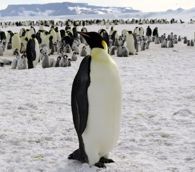
 Lured by the possibility of seeing penguins, Chris Epting ventured to Snow Hill Island in Antarctica
See the full audio slideshow: »
How Do You Maintain an ATM in Antarctica?
by Eva Holland | 07.21.10 | 11:56 AM ET
Inquiring minds at Needcoffee wondered. A Vice President at Wells Fargo, which operates the bank machine at McMurdo, offers a detailed and weirdly fascinating answer. (Via Kottke)
Shackleton’s Scotch: Coming to an Auction House Near You?
by Eva Holland | 11.03.09 | 2:43 PM ET
Two cases of the explorer’s drink of choice have been discovered under a hut at Cape Royds, apparently left behind after a failed 1909 polar expedition. The question now, of course: What will happen to the excavated bottles? If they do go to auction, maybe the lucky buyer will want to BYOB on Shackleton’s ship-turned-restaurant.
R.I.P. Dr. Jerri Nielsen FitzGerald, South Pole Physician
by Jim Benning | 06.24.09 | 3:16 PM ET
 REUTERS/Ho New
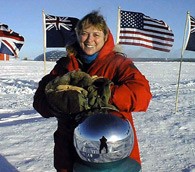
Dr. Jerry Nielsen FitzGerald captured the world’s attention in 1999.
She was at the National Science Foundation’s Amundsen-Scott South Pole Station when she discovered a lump in her breast. Isolated by bad weather, she followed instructions over the internet to perform a biopsy on herself and then began cancer treatment with drugs delivered in an air-drop. In so doing, she came to personify courage in the face of adversity.
Her sister-in-law told CNN: “She would want to be remembered for the adventure and, you know, living every day, and not just the sickness.”
Her cancer went into remission but reappeared in 2005, her husband told the Associated Press. She died at the age of 57.
R.I.P. Edith ‘Jackie’ Ronne: ‘First U.S. Woman on Antarctica’
by Michael Yessis | 06.18.09 | 10:48 AM ET
Edith “Jackie” Ronne was 28 years old when she set foot on Antarctica in 1947. It was a journey she never intended to take.
She was, according to the Washington Post, talked into joining the expedition by her explorer husband so she could, among other things, write stories about the expedition for the North American Newspaper Alliance and the New York Times. As part of the expedition team, she became the first U.S. women on Antarctica and, along with Canadian Jennie Darlington, the first woman to spend a winter on the continent. (The first woman on Antarctica: Norwegian Caroline Mikkelsen, in 1935.)
Ronne was 89.
Here’s the trailer for the documentary about the expedition she joined:
Eating Penguin with Ernest Shackleton in Scotland
by David Farley | 04.09.09 | 1:02 PM ET

In March 1901, the RRS Discovery set sail from Dundee, Scotland, its crew pointing it toward largely unexplored Antarctica. The ship was a wooden three-masted sailing vessel and, as it turned out, the last of its kind to be made in Britain.
But that’s not exactly what makes the RRS Discovery significant. Ten months later, the crew members definitively found what they were looking for. In fact, the ship was stuck, frozen in ice, leaving captains Ernest Shackleton and Robert Falcon Scott with no choice but to wait it out until the spring when the ice would thaw. The next few months were harrowing ones, the crew eventually having to munch on seal liver and roasted penguin (described as tasting like “leather steeped in turpentine”).
Obama Administration Wants Controls on Antarctic Tourism
by Joanna Kakissis | 04.07.09 | 2:30 PM ET
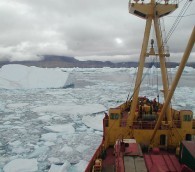
Secretary of State Hillary Clinton wants to limit landings in Antarctica from ships carrying a lot of tourists in an effort to save the continent from further environmental degradation, Reuters reports. Speaking to a joint session of the Antarctic Treaty Consultative Meeting and the Arctic Council, Clinton also said the U.S. is offering new rules for lifeboats, to better protect passengers in stranded or sinking cruise ships. One cruise ship was already stranded this past winter, while some 150 crew and passengers had to be rescued in late 2007 after their ship struck ice and sank.
Where are the Elegies to the World’s Troubled Landscapes?
by Joanna Kakissis | 03.04.09 | 4:02 PM ET

The Eagles were on to something in 1976, when they lamented the pillaging of the western American landscape in “The Last Resort.” As eco-awareness of global warming makes major headlines, and movie stars and scientists link hands to march against coal-fired power plants, I wonder: Where are the music videos? The equivalent of “We Are The World,” climate-change edition? Or at least a few elegies to the troubled landscapes of our world?
Then I came across “Uyan (Wake Up),” a song about the ravages of environmental irresponsibility released late last year by hunky Turkish pop star Tarkan and baglama viruoso Orhan Gencebay. It’s a fabulous tune, brimming with eastern Mediterranean soul and accompanied by a video (see below) featuring the sexier-than-thou Tarkan and the comfortably weathered Gencebay jamming in a cracked and desiccated land—likely a reference to the fact that great swathes of Turkey are in danger of desertification.
So, inspired by Tarkan and Orhan Gencebay, I compiled a short list of place-evoking environmental songs. I’d love to hear your picks—and if you think eco-songs can save fragile lands, or at least get people thinking that they should stop abusing them.
Morning Links: JetBlue Fare Refunds, America’s Emptiest Cities and More
by Michael Yessis | 02.18.09 | 8:31 AM ET
- It happened again: Another cruise ship ran aground in Antarctica.
- Las Vegas and Detroit finished 1-2 in a Forbes list of America’s emptiest cities.
- Inside the hardened, restless lives of business-travel nomads.
- Here’s a scathing takedown of the idea of Dubai. (via Kottke)
- Here’s another dancing guy. He doesn’t go around the world, though. Just to hallways and stairwells and such.
- Teresa Watanabe looks at African Americans who are being “called back to Africa by DNA.”
- JetBlue promises fare refunds if you lose your job—with some fine print.
- “Afghan Model” is coming to Emrooz TV.
- The Yankees are building a new vacation stadium in the Hamptons, complete with on-deck gazebos and yacht parking for the players. The Onion has exclusive video.
Got a suggestion? .(JavaScript must be enabled to view this email address) your link.
Recession Hits Antarctica (Is That Good or Bad?)
by Joanna Kakissis | 02.13.09 | 12:58 PM ET
Trips to the (melting) frozen continent can cost anywhere between $8,000 and $30,000, a prohibitive amount in today’s crisis economy of failed banks and indebted consumers. That may explain the projected 7,000-person drop in visitors between the 2007-08 season (which registered a record high of 46,000 people) and the current 2008-09 season, which the International Association of Antarctica Tour Operators (IAATO) predicts will bring in around 39,000 people.
Morning Links: Mexico City’s War on Gum, South Pole Trek and More
by Michael Yessis | 01.09.09 | 9:15 AM ET
- Deep-fried bacon and butter powered three Canadians in the fastest-ever trek to the South Pole.
- Mexico City has had it with all the gum.
- Another amusing story about how it is no longer 1967 in San Francisco’s Haight-Ashbury—except the parts of Haight-Ashbury that recall 1967.
- Interesting piece on 2008’s “cartography boom” and the way maps are changing the way we organize and look at the world.
- Can you get better travel deals by deleting your cookies? A case study.
- This Just In asks what the economic downturn means for coverage in high-end travel magazines.
- Travel book publishers are having problems in this financial climate, too. (Via Eoin Purcell)
- Fewer people live in Montpelier, Vermont (7,495) than any other U.S. capital, yet it supports four independent bookstores. Go Montpelier.
Got a suggestion? .(JavaScript must be enabled to view this email address) your link.
Morning Links: Robots Around the World, ‘Pizza Huh’ and More
by Michael Yessis | 01.07.09 | 9:34 AM ET
 Design by Open.
 - ReadyMade asked artists to “reimagine” Depression Era WPA posters. Open created a great one (pictured).
- McDnoald’s. Bucksstar Coffee. Pizza Huh. Is someone in China building a shopping mall filled with fake brands, or is it all just fake?
- Barack Obama: Restaurant critic. He loves his peach cobbler at Dixie Kitchen in Chicago.
- World Hum contributor David Farley talked travel with Arthur and Pauline Frommer.
- Voting begins on the New 7 Wonders of Nature. There are 261 nominees.
- An American tourist was stabbed outside a bar in Rome.
- Happy 50th birthday, Alaska.
- Farewell to the SS Catalina.
- Another farewell to the San Francisco Chronicle’s John Flinn.
- Jon Bowermaster started a two-month residency at Gadling, writing from Antarctica. He calls the continent “the beating heart of Planet Earth.”
- Why not measure the world’s countries by robot density? Here are the top 10. (Via Passport)
- This may be the least scenic hot tub in the world. I prefer this view.
Got a suggestion? .(JavaScript must be enabled to view this email address) your link.
Cruise Ship Runs Aground in Antarctica
by Eva Holland | 12.04.08 | 5:45 PM ET
The 122-passenger ship is reported to be taking on “minimal” water and leaking fuel after running aground on the Antarctic Peninsula. No one is injured and help is on the way, but the incident is sure to bring back memories of last year’s cruise ship sinking and renew concerns about tourism in Antarctica.
South Pole Area Threatened by Antarctica Tourism?
by Michael Yessis | 09.30.08 | 12:01 PM ET
Science Daily looks at the issue, and points to a possible solution: “Market the visitor rights to the highest bidder.”
- « Prev Page
- Next Page »