
Destination: Asia
War Zones for Idiots
by Tom Bissell | 10.21.02 | 10:54 PM ET
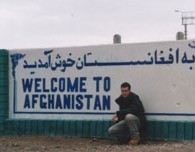 Photo courtesy Tom Bissell
 The "World Series of Journalism" had begun in Afghanistan, and Tom Bissell didn't have to qualify to play. He just had to show up.
 Email to friend
 del.icio.us
 Digg
Digg Facebook
 Furl
Furl Ma.gnolia
 Mixx
Mixx Reddit
 StumbleUpon
 Yahoo! Buzz
On Bali, Fear and Imagination
by Jim Benning | 10.18.02 | 7:44 PM ET
The terrorists who killed backpackers and others in Bali see tourists as symbols of materialist culture. With their murderous act, they want to reverse the trend of globalization, but Andrew Lam hopes they don’t succeed.
“While I mourn the deaths of those killed in Bali, I remain optimistic that human movement will continue,” he http://www.alternet.org/story.html?StoryID=14309” target=“_blank”>writes in Pacific News Service via Alternet. “The world is too interconnected, too integrated, after all, for that trend to be reversed by fear.”
Lam sees travel as a radical act that challenges orthodoxy, and he won’t be deterred from traveling. “The idea of a static world immobilized by fear is one where the imagination dies,” he writes. “That is far more terrifying to me than any terrorist bomb.”
We couldn’t agree more.
R.I.P. Bali Bomb Victims, Bali Tourism
by Jim Benning | 10.17.02 | 7:48 PM ET
The terrorist bomb that killed hundreds in Bali has touched travelers the world over. Jason Gaspero, for one, knew he’d never be the same when he heard about
the explosion from his home in Hawaii. Gaspero spent years teaching English in Bali, and he was a regular at the Sari Club, the site of the explosion.
“The Sari Club was, in my opinion the finest international vortex of hedonism and decadence in the whole wide world, and I say that after much consideration,” he writes on Lonely Planet Online. “I mean, you could find people from everywhere in this place: Australia; Canada; Sweden; New Zealand; South Africa; Denmark; Norway; England; Argentina; South Korea; France; Germany and dozens and dozens of other countries. It was the United Nations of drunken, sweaty, sex-crazed glory, and it was all in fantastic fun.” Gaspero insists that his will to travel will not be diminished.
Meanwhile, shaken British tourists are returning home. Australians are trying to make sense of the devastation in their backyard. And Southern California surfers, at least a few of them, say they won’t be deterred from visiting Bali, where great waves promise to be less crowded than ever.
Power Trip
by Emily Maloney | 09.03.02 | 10:58 PM ET
 Art by Emily Maloney.
 Grab your 3-D glasses! Pin that name tag to your jacket! Now get on the bus with American art student Emily Maloney for a class excursion to a Japanese nuclear plant.
Innocence Abroad
by Drew Forsyth | 07.13.02 | 11:00 PM ET
When the Taiwanese police hauled him in, Drew Forsyth experienced one of a traveler's worst nightmares: He went to jail for a crime he didn't commit.
‘My Parents Didn’t Know How To Behave at Some of the Grandest Sights in China’
by Jim Benning | 06.26.02 | 11:49 PM ET
When Rolf Potts headed out with his parents onto the vast expanse of the Mongolian steppe, he worried about them. First, they seemed to lollygag on the hike. Then they became obsessed with finding botanical specimens and what looked to be garbage. Rolf was sure their parent-child relationship had suddenly reversed. Before he could scold his mom and dad, however, he came to a realization: Travel hadn’t turned his parents into children.
Seattle Times Debuts Weekly Travel Essay
by Michael Yessis | 06.25.02 | 11:52 PM ET
Each Sunday the Times will feature a 700-word essay, written by readers, focusing on “a travel perception or adventure.” If Hubert Smith’s first
installment is any indication of what’s to come, the column should be a weekly stop. Smith tells of three months he spent in Korea. His hosts were wonderfully generous and helpful, but they interfered with his every attempt to preserve private time and private space.
World Cup: “Travel Through Sport”
by Michael Yessis | 06.18.02 | 12:46 AM ET
If it’s Monday, it must be time for another batch of World Cup-themed stories. South Florida Sun-Sentinel travel editor Thomas Swick leads off with a sweet, short essay on the event’s ability to bring people together, despite national grudges and bad haircuts. “When else can you see Americans (some of us, anyway) taking an interest in Turkey and Costa Rica?” he writes. “At what other time do you find Norwegians cheering on Senegalese; Chileans admiring, reluctantly, the artistry of Argentinians?” On ESPN.com, Englishman Michael Davies has been keeping a daily diary of his travels through Japan and Korea while covering the games—and, sometimes, Japan’s ubiquitous vending machines. “Do you like vending machines? I love them,” he writes. “Everything tastes better out of a vending machine. The whole transaction is just so damn enjoyable, like winning something at the fair.”
It’s Called Shangri-La, But it Won’t Be Paradise for Long
by Jim Benning | 06.18.02 | 12:43 AM ET
What’s in a name? Gobs of tourists, it turns out. To lure travelers with disposable income, authorities in a Chinese town on the Tibetan plateau recently renamed the place Shangri-La. They’re arguing that the town was the basis for the Shangri-La described in James Hilton’s classic novel Lost Horizon. Evidence is sketchy, but no matter. According to the Los Angeles Times’ Henry Chu, who has been filing some great stories from China recently, the tourists are rolling in. In the novel, Hilton wrote that Shangri-La was a place “touched with the mystery that lies at the core of all loveliness.” Writes Chu, “Amid the current fanfare, and the proliferation of hotels and kitsch-filled souvenir shops trading on the Shangri-La name, little of that mystery appears to be left.”
The Old Woman Under the Tree
by Maria Möller | 06.18.02 | 12:38 AM ET
 Photo by Maria Möller.
 What Awaits Visitors to Kabul?
by Jim Benning | 06.15.02 | 12:57 AM ET
After the Berlin Wall fell and Eastern Europe rolled out the welcome mat, Prague was the place to go, at least for a while. Then it was Vietnam. We’re guessing that once the situation stabilizes in Afghanistan, Kabul and its surroundings will get their share of curious backpackers. But what will they find when they arrive? There’ll be a lot to see, according to an Associated Press report on CNN. “There are the mighty snowcapped Hindu Kush mountains, the spectacular blue lakes of Band-e-Amir. And for war historians, the rusting hulks of hundreds of Soviet tanks, helicopters and fighter jets, left in fields where they were abandoned or blown apart.” In addition, according to the report, old postcards for sale on Chicken Street will show visitors how the city has changed as a result of war, and just how much has been lost.
The Only Time Most of Us Will Notice the Moon is When We are Standing Shin-Deep and Urinating
by Jim Benning | 06.14.02 | 12:54 AM ET
As a group, backpackers are generally considered globally conscious, well-meaning citizens. Melbourne native Campbell Smith thought so, too. Then he visited Ko Pha-Ngan for the Full Moon Party of Hat Rin Nok, the renowned festival that draws thousands of backpackers and world-famous DJs to white sand beaches along the Gulf of Thailand. “Twenty years ago, before the full moon parties, Hat Rin Nok was a tiny fishing village unchanged in millennia. A generation later—our generation—and the streets are paved with Internet cafes and the fishing boats conduct all-you-can-smoke ganja cruises,” he writes in the Sydney Morning Herald. “Backpackers Inc. has become a franchise, too, a prefabricated worldwide formula that is constructed wherever two or more Germans are gathered. It exploits the disparity in Third World wages just as surely as does Nike.”
The Critics: The Carpet Wars
by Jim Benning | 06.01.02 | 1:05 AM ET
In “The Carpet Wars,” Australian writer Christopher Kremmer travels a route through Afghanistan, Pakistan, Iraq, Iran, India and other countries to investigate the region’s carpet trade. Morag Fraser of The Age raves,”[It’s] a source of vivid, unexpected pleasure—sharp as the air in the Afghan mountains.” Washington Post reviewer Tracy Lee Simmons is a bit more subdued with her praise: “This book, in its sobriety, puts a human and—despite the random, ritualistic violence—oddly sympathetic face on a part of the world that history, ancient and modern, has brought home to all of us.” Simmons also reviews Tony Perrottet’s “Route 66 A.D.” She notes that it’s “a splendid trip with two gutsy companions, and, by the end, the reader needs a shower as much as they do.”
Sleeping in Airports
by Michael Yessis | 05.24.02 | 7:32 PM ET
The best airport for sleeping? Singapore’s Changi. The worst? Port Moresby in Papua New Guinea. Says who? Donna McSherry and the readers of her Web site, The Budget Travellers Guide to Sleeping in Airports, who are all very passionate about sleeping in airports. “Sleeping in airports is an adventure,” McSherry writes. “Enjoy it! Have fun. From someone who does do it, let me tell you that it is fun and it adds an extra element of strangeness to your trip.” It’s true. I once slept on a baggage carousel in Kansas City, Missouri. It was great until someone turned the thing on.
Malaysia vs. the Bikini
by Jim Benning | 05.23.02 | 7:34 PM ET
Backpackers flock to the Perhentian Islands in Malaysia for cheap fun in the sun. But some Muslims in the conservative northern state of Terengganu aren’t happy that so many women travelers want to strip down to bikinis on the beach. In fact, state tourism officials are thinking about banning the skimpy swimwear. That doesn’t sit right with tourism officials farther south in Kuala Lumpur, who view the northern state’s thinking as a threat to Malaysia’s tourism business. CNN.com offers a full report.